
Open work permit Canada eligibility is one of the most important questions for foreign nationals planning to work in Canada. An open work permit allows eligible individuals to work for most Canadian employers without being restricted to a single employer.
However, an open work permit is not available to everyone. You must qualify under a specific immigration program or policy administered by Immigration, Refugees and Citizenship Canada (IRCC).
Whether you are an international graduate, the spouse of a foreign worker, the spouse of an international student or an applicant pursuing Canadian permanent residence, understanding the correct work permit category can help you avoid unnecessary refusals.
This guide explains open work permit eligibility, application procedures, required documents, spousal rules, government fees, extensions and common mistakes.
What Is an Open Work Permit in Canada?
An open work permit in Canada is a temporary work authorization that generally allows its holder to work for most eligible employers across Canada.
Unlike an employer-specific work permit, an open work permit is not normally tied to one employer, specific job title or employment contract.
An open work permit holder usually does not require:
- A Labour Market Impact Assessment (LMIA).
- An employer-specific job offer for the open permit itself.
- Authorization from IRCC every time they change eligible employers, provided all permit conditions are respected.
However, open work permits can contain restrictions regarding occupation, medical requirements or geographical location.
Applicants must also meet the requirements of a specific eligible program.
Official source:
IRCC – Open Work Permits.
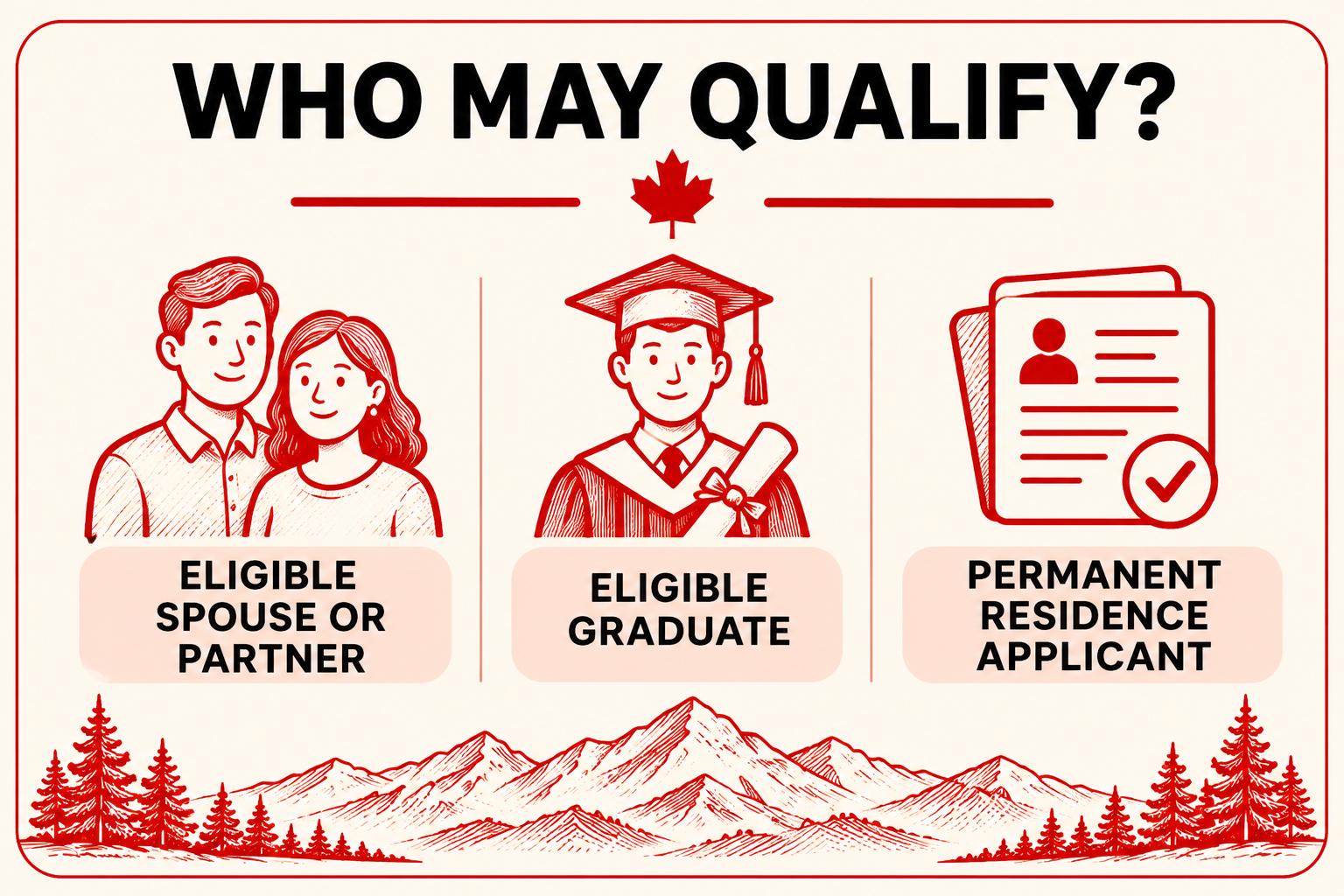
Who Can Apply for an Open Work Permit in Canada?
Not everyone can apply for an open work permit. IRCC provides specific categories in which eligible foreign nationals may receive open work authorization.
1. Eligible International Graduates
International students who complete an eligible program at a designated learning institution may qualify for a Post-Graduation Work Permit (PGWP).
Depending on the applicant’s situation, eligibility may involve:
- Graduation from a PGWP-eligible institution and program.
- Meeting applicable language requirements.
- Meeting field-of-study requirements where applicable.
- Maintaining the required study status.
- Applying within the applicable deadline.
Not all institutions or programs qualify for the PGWP.
Check official PGWP eligibility requirements.
2. Eligible Spouses and Common-Law Partners
Certain spouses or common-law partners of international students and foreign workers may qualify for an open work permit.
Eligibility depends on the principal applicant’s immigration status, study program, work authorization, occupation and other program-specific requirements.
3. Bridging Open Work Permit Applicants
Certain permanent residence applicants may qualify for a Bridging Open Work Permit (BOWP) while waiting for a decision on their qualifying PR application.
Creating an Express Entry profile or receiving an invitation to apply does not, by itself, establish bridging work permit eligibility.
4. Sponsored Spouses in Canada
Certain spouses or common-law partners being sponsored for Canadian permanent residence may qualify for an open work permit under the applicable sponsorship policy.
5. Other Eligible Categories
Additional categories may include:
- International Experience Canada Working Holiday participants.
- Eligible vulnerable workers facing abuse or risk of abuse.
- Certain refugee claimants or protected persons.
- Applicants covered by specific temporary public policies.
- Certain permanent residence applicants and family members.
Spousal Open Work Permit Canada: Current Eligibility Rules
Canada introduced restrictions on family open work permits effective January 21, 2025. These restrictions continue to affect many spouses and common-law partners.
Spouses of International Students
Under the general rules, a spouse or common-law partner may qualify when the international student holds a valid study permit and is enrolled in:
- A master’s degree program lasting at least 16 months.
- A doctoral degree program.
- Certain eligible professional degree programs.
- Other specifically eligible programs recognized by IRCC.
A typical college diploma or bachelor’s degree does not automatically make a spouse eligible.
IRCC – Spouses of International Students.
Spouses of Foreign Workers
Under the general measure for high-skilled foreign workers who are not on an eligible permanent residence pathway, spouses may qualify when the principal worker:
- Works or will work in a TEER 0 or TEER 1 occupation.
- Works or will work in a selected eligible TEER 2 or TEER 3 occupation.
- Has at least 16 months of eligible work authorization remaining when IRCC receives the spouse’s application.
- Meets the remaining program requirements.
Separate rules can apply to certain permanent residence pathways, free trade agreements and special measures, including specific Quebec measures.
Read:
Official IRCC foreign worker family eligibility rules.
You can also review Eiffel Immigration’s
Spousal Open Work Permit Guide.
How to Apply for an Open Work Permit in Canada
Most open work permit applications are submitted online through the appropriate IRCC application process.
The exact process depends on whether the applicant is applying from inside Canada, outside Canada or under a program with special instructions.
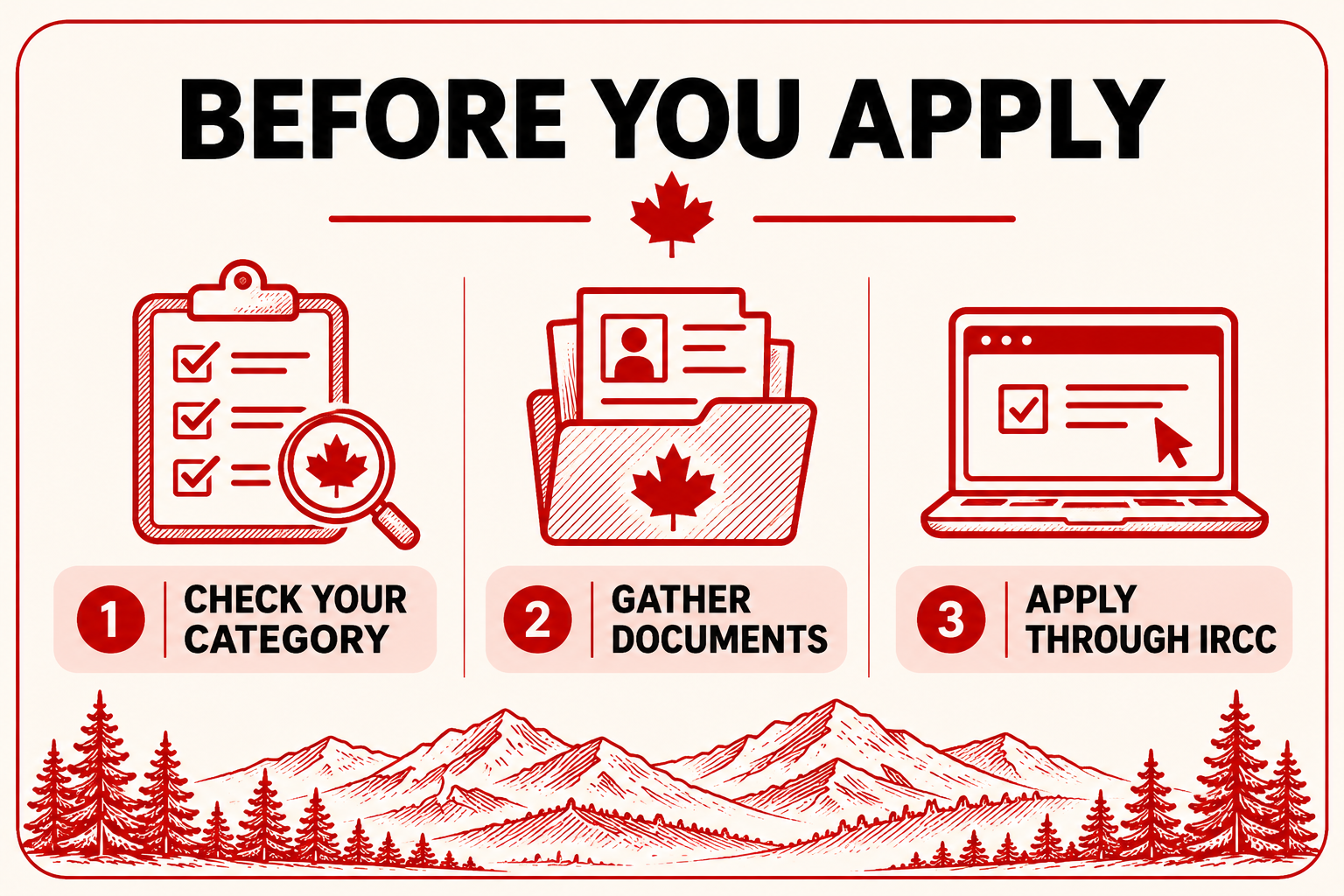
Step 1: Confirm Your Eligibility
Identify the open work permit category that applies to your circumstances. Review its eligibility criteria before beginning an application.
Step 2: Gather Required Documents
Prepare the documents necessary to establish your immigration status and eligibility.
Depending on your category, IRCC may request:
- Valid passport or travel document.
- Current Canadian immigration documents.
- Digital photograph.
- Marriage certificate or common-law relationship evidence.
- Principal applicant’s work or study permit.
- Employment confirmation and occupation details.
- Graduation documents and transcripts.
- Permanent residence acknowledgement of receipt.
- Other supporting evidence required for the category.
Step 3: Create or Access Your IRCC Account
Sign in using the appropriate IRCC application process and complete the eligibility questions accurately.
Step 4: Complete the Application
Provide the requested personal, immigration and employment information. Review all entries for accuracy before submitting.
Step 5: Upload Supporting Documents
Upload clear, legible copies of the documents requested in your personalized checklist.
Step 6: Pay Fees and Submit
Pay the applicable government fees and submit the completed application.
If required, complete biometrics or medical examinations and respond to further IRCC requests.
Open Work Permit Canada Fees
For a standard open work permit application, the government fees generally include the following:
| Government Fee | Amount (CAD) |
|---|---|
| Work permit processing fee | $155 |
| Open work permit holder fee | $100 |
| Biometrics (individual, if required) | $85 |
| Typical total without biometrics | $255 |
| Typical total with individual biometrics | $340 |
Some applicants qualify for fee exemptions. Other charges, such as medical examinations, document translations or professional fees, may apply.
Always verify current fees using the
official IRCC fee schedule.
Can You Extend an Open Work Permit in Canada?
Open work permits are not automatically renewable. You need to continue qualifying for the relevant program or establish eligibility for another work permit category.
In many circumstances, submitting an eligible application to extend or change a work permit before your existing authorization expires can provide maintained status.
Under maintained status, eligible workers may be permitted to continue working under the conditions of their previous authorization while remaining in Canada and awaiting a decision.
Applicants whose permits have already expired may need to consider restoration of status, where eligible.
IRCC – Work Permit Expiry and Maintained Status.
Open Work Permit vs. Employer-Specific Work Permit
An open work permit and an employer-specific work permit serve different immigration purposes.
| Feature | Open Work Permit | Employer-Specific Permit |
|---|---|---|
| Employer | Most eligible employers, subject to permit conditions | Employer named on permit |
| Job offer | Usually not required for the permit itself | Usually required |
| LMIA | Generally not required | May be required depending on exemption |
| Changing jobs | Generally flexible within permit conditions | Usually requires new authorization |
| Eligibility | Specific eligible open permit categories | Relevant employer-specific program requirements |
Open Work Permit Canada Processing Times
There is no universal processing time for all open work permit applications.
Processing times vary according to:
- The specific work permit category.
- The country or location of application.
- Application completeness.
- Biometrics requirements.
- Medical examination requirements.
- Additional IRCC verifications.
Applicants should consult the
IRCC Processing Times Tool
for current estimates.
Processing-time estimates are not guaranteed approval deadlines.
Common Open Work Permit Application Mistakes
1. Applying Without an Eligible Category
Wanting to work in Canada is not sufficient to qualify for an open work permit. Applicants must establish eligibility under an applicable category.
2. Assuming Every Spouse Qualifies
Spousal work permit eligibility depends on detailed requirements involving the principal applicant’s studies, occupation, status or permanent residence pathway.
3. Submitting Incomplete Documents
Failure to include necessary employment evidence, education records or relationship documents can negatively affect the application.
4. Confusing Express Entry With BOWP Eligibility
Being in the Express Entry pool does not automatically qualify a person for a Bridging Open Work Permit.
5. Misunderstanding Maintained Status
Applicants should not assume that submitting any new work permit application automatically gives them permission to begin working or change employment conditions.
6. Ignoring Permit Restrictions
Even an open work permit may contain occupation, medical or geographical restrictions that must be respected.
What Happens After Open Work Permit Approval?
Once your open work permit is approved and issued, review the document carefully.
Verify:
- Your name and identifying details.
- Work permit start and expiry dates.
- Any occupational restrictions.
- Any geographical limitations.
- Medical-related work conditions.
If you plan to work in Canada, ensure that you meet the applicable Social Insurance Number and employment requirements.
Can an Open Work Permit Help You Get Permanent Residence?
An open work permit does not provide permanent residence by itself.
However, eligible Canadian work experience gained while authorized to work may contribute toward certain permanent residence pathways, including programs under Express Entry or provincial nomination.
Each immigration pathway has separate requirements relating to employment, language proficiency, education and other factors.
Frequently Asked Questions About Open Work Permit Canada
Can I get an open work permit without a job offer?
Yes, an open work permit generally does not require a job offer for the permit itself. However, you must qualify under a specific eligible category.
Can I work for any employer in Canada?
You can generally work for most eligible employers, subject to the conditions and restrictions printed on your permit.
Can visitors apply for an open work permit?
Visitor status alone does not provide open work permit eligibility. Applicants must qualify under a specific program and meet the applicable rules for submitting an application.
How much does an open work permit cost?
The standard processing fee is $155, plus a $100 open work permit holder fee, totaling $255. Biometrics fees may apply, and exemptions exist for certain categories.
Can I apply for an open work permit after creating an Express Entry profile?
An Express Entry profile alone does not establish eligibility for a Bridging Open Work Permit. Additional permanent residence application requirements must be met.
Can I extend my post-graduation work permit?
A PGWP is generally a one-time permit. Limited extensions may be available when the original permit was shortened because of passport validity.
Can my spouse work in Canada?
Some spouses qualify for an open work permit depending on the principal applicant’s study program, employment, immigration status or eligible PR pathway.
How long does an open work permit application take?
Timelines depend on the particular immigration category and application location. Check IRCC’s official processing-time tool.
Can I change employers on an open work permit?
Generally, yes. You must comply with any restrictions listed on your work permit and work only for eligible employers.
Does an open work permit guarantee permanent residence?
No. Permanent residence requires separate eligibility and an approved application under an applicable immigration pathway.
Not Sure If You Qualify for an Open Work Permit?
Every immigration situation is different. Eiffel Immigration can help you review your circumstances, understand eligible work permit categories and prepare your application documentation.
Applying on your own? Explore our
Self-Immigration Toolkit
for useful official immigration resources and portals.
Official Open Work Permit Canada References
The following Government of Canada and IRCC resources provide additional guidance on work permits, eligibility, applications, family members, extensions, fees and processing procedures. Some cover special categories or related programs rather than eligibility for all applicants.
1. General Work Permit Rules
- Open work permits: eligibility and restrictions
- Find out if you need a work permit
- Work permit programs and special instructions
- Employer-specific work permits
- IRCC Help Centre: who can apply for an open permit?
2. Post-Graduation Work Permits
- Post-graduation work permit program
- PGWP overview and validity
- PGWP eligibility criteria
- PGWP required documents
- How to apply for PGWP
- After submitting a PGWP application
- PGWP eligible fields of study
- Designated learning institutions list
3. International Experience Canada
4. Spousal and Family Open Work Permits
- Open work permits for spouses of students
- Work permits for family members of workers
- Family member eligibility and TEER requirements
- When family members can apply
- How family members apply
- Open work permit for sponsored spouses
5. Permanent Residence and Special Work Permits
- Bridging open work permits
- Work permits for permanent residence applicants
- Open permits for vulnerable workers
- Refugee protection in Canada
- IRCC special measures
6. Work Permit Applications
- Apply for a work permit from inside Canada
- Eligibility to apply inside Canada
- Required work permit documents
- Inside Canada application instructions
- Waiting for an application decision
- What happens after approval
- Applying from outside Canada
7. Extensions and Maintained Status
- Extend or change a work permit
- Work permit extension eligibility
- Apply to extend a work permit
- Expired permits and maintained status
- After applying for an extension
8. Fees, Biometrics and Processing
- IRCC government fees
- Biometrics eligibility and requirements
- Immigration medical examination requirements
- Current IRCC processing times
- IRCC work permit extension application guide
Information reviewed November 18, 2026. Immigration policies, eligibility requirements and application fees may change. Always consult official government instructions before submitting an application.
This article is general information, not legal advice. Confirm details with IRCC or a regulated consultant before you act.