
Canada’s Labour Market Impact Assessment (LMIA) rules continue to change in 2026. If you are a Canadian employer planning to hire a temporary foreign worker—or a foreign worker waiting for an LMIA-supported work permit—these changes can directly affect your application.
The Government of Canada has introduced stricter requirements to make sure Canadian workers are considered first and that employers genuinely need foreign workers.
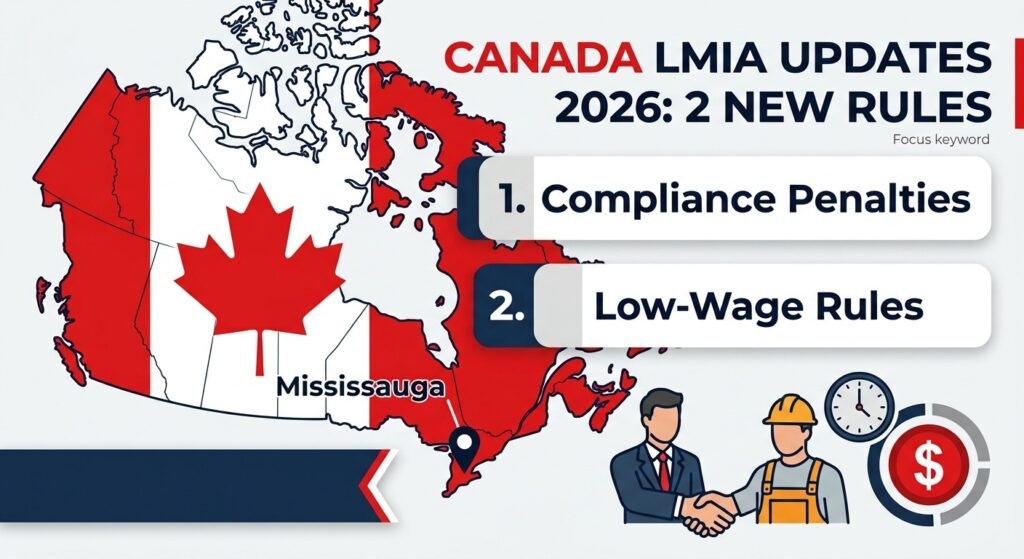
Here are 2 important LMIA updates in 2026 that employers and foreign workers should know.
1. LMIA Compliance Penalties Have Become Much More Serious
The Canadian government is taking employer compliance more seriously than ever.
In July 2026, the Government of Canada reported that monetary penalties under the Temporary Foreign Worker Program had increased significantly. Between April 2025 and March 2026, 1,488 compliance inspections were completed. Around 12% of inspected employers were found to be non-compliant, resulting in more than $10.2 million in monetary penalties and 30 employers being banned from the program.
This means an employer cannot simply obtain an LMIA and then treat the requirements as optional.
Employers must:
- Pay the foreign worker the wages stated in the LMIA and employment agreement.
- Provide the promised working conditions.
- Follow federal and provincial employment laws.
- Keep proper records.
- Provide the worker with a safe and abuse-free workplace.
- Follow the terms and conditions of the approved LMIA.
The government has also strengthened its review of higher-risk industries, including food services, accommodation, retail and trucking.
What does this mean for employers?
An LMIA application should be prepared carefully from the beginning. Employers should make sure that their business is genuine, the position is genuine and the recruitment process can be properly supported with documents.
A mistake in the application or failure to follow the approved terms can create serious problems later.
What does this mean for foreign workers?
Foreign workers should also understand their rights.
If your employer is not paying the promised wage, forcing you to work in conditions different from your employment agreement, or otherwise violating program requirements, you may have options to seek help.
An LMIA is not a licence for an employer to exploit a foreign worker.
2. Low-Wage LMIA Rules Are Becoming More Important in 2026
Low-wage LMIA applications face some of the strongest restrictions.
In many cases, applications for low-wage positions in a census metropolitan area (CMA) with an unemployment rate of 6% or higher will not be processed. There are specific exemptions for certain sectors and occupations, so employers must check the rules that apply to their particular position and location.
There is also a limit on the number of low-wage temporary foreign workers an employer can have at a particular work location. Generally, the cap is 10%, although certain sectors have different rules and some positions may qualify for exemptions.
A new opportunity for some rural employers
There is also some positive news.
From April 1, 2026, to March 31, 2027, eligible employers in rural areas of participating provinces and territories may benefit from temporary measures for certain low-wage positions.
For eligible employers, the low-wage TFW proportion may be increased to 15% instead of the usual 10% cap, or an employer may be able to retain its existing proportion if it is already above the cap.
However, these measures do not automatically apply everywhere. The employer must be located in an eligible rural area and satisfy the applicable requirements.
This is particularly important for businesses outside major Canadian cities that are struggling to find workers locally.
Another Important 2026 Change: LMIA Validity Is Now Shorter
Employers and foreign workers should also be aware that an approved LMIA generally has a maximum validity period of 6 months, rather than the previous 12-month period.
The foreign worker must submit their work permit application before the LMIA expires. This applies across TFWP streams, with the Seasonal Agricultural Worker Program being an exception.
Why is this important?
Imagine an employer receives an LMIA but the foreign worker waits too long before applying for the work permit.
If the LMIA expires before the work permit application is submitted, the situation can become much more complicated.
Timing matters.
Employers and workers should therefore coordinate the LMIA and work permit process carefully.
What Employers Should Do in 2026
If you are an employer considering an LMIA, do not treat the process as simply “advertise a job and submit an application.”
You should first check:
- Whether the position qualifies for an LMIA.
- Whether it falls under the high-wage or low-wage stream.
- The applicable wage threshold.
- Whether the work location is affected by the 6% unemployment restriction.
- Whether the employer’s low-wage worker cap creates an issue.
- Whether additional recruitment requirements apply.
- Whether the business can demonstrate genuine recruitment efforts.
- Whether all supporting business and payroll documents are available.
- Whether the employer can comply with the conditions after approval.
The Government of Canada also updated the hourly wage thresholds effective July 17, 2026, so employers should use the current wage information rather than relying on an old LMIA application or previous wage calculation.
What Foreign Workers Should Know
For foreign workers, an LMIA-supported job can still be an important pathway to a Canadian work permit and, in some situations, future permanent residence.
But an LMIA does not automatically guarantee a work permit or permanent residence.
The worker must still meet the applicable IRCC requirements, and the work permit application must be submitted correctly and within the required timeframe.
If you are currently working in Canada and your employer wants to extend your employment, you should also check whether a new LMIA is required before extending your work permit.
Final Thoughts: LMIA Rules Are Getting Stricter
The biggest message from the LMIA updates in 2026 is simple: employers need to be prepared, and foreign workers need to understand the process.
Canada is focusing on reducing misuse of the Temporary Foreign Worker Program while ensuring that employers with genuine labour shortages can still access foreign talent.
For employers, this means stronger recruitment, better documentation and strict compliance.
For foreign workers, it means checking that the job offer, employer and work permit process are legitimate before making major decisions about working in Canada.
If you are considering an LMIA in 2026, getting professional advice before submitting the application can help you understand the current rules and avoid preventable mistakes.
Eiffel Immigration Solutions can help employers and foreign workers understand their options and prepare for the changing Canadian immigration landscape.
This article is for general information only and does not constitute legal or immigration advice. LMIA requirements can vary depending on the occupation, wage, location and employer circumstances. Always check the latest government requirements before applying.