
Express Entry 2027 could bring another important shift in how Canada selects economic immigrants. Immigration, Refugees and Citizenship Canada (IRCC) is currently consulting on the economic priorities that could shape Express Entry 2027 categories.
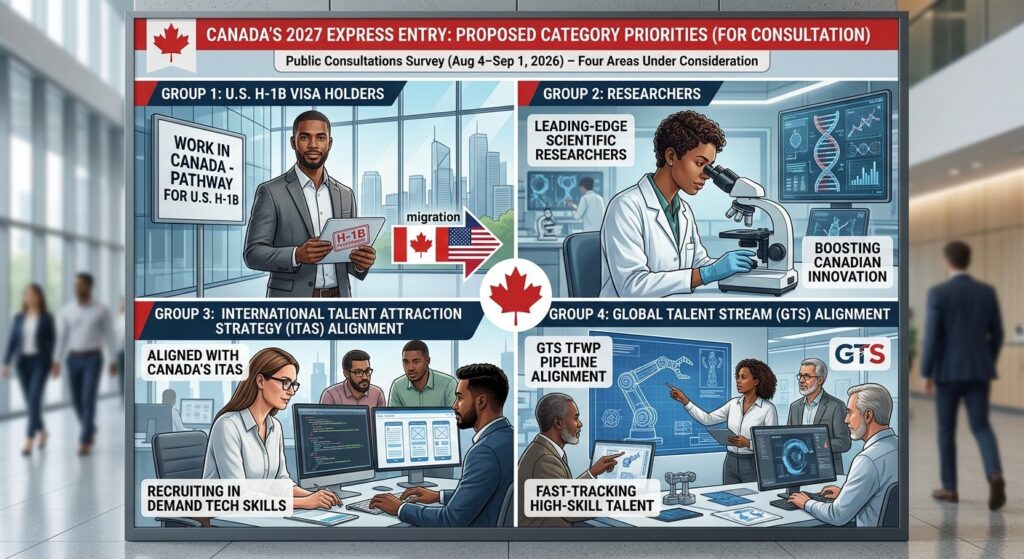
The public consultation opened on August 4, 2026, and is scheduled to run until September 1, 2026. While the final Express Entry 2027 categories have not yet been announced, IRCC has provided a clear indication of the types of talent it is considering for future category-based selection.
Among the most notable groups under consideration are:
- U.S.-based H-1B visa holders
- Researchers
- Highly skilled workers aligned with Canada’s International Talent Attraction Strategy
- Foreign nationals connected to the Global Talent Stream
For anyone planning Canada PR through Express Entry 2027, these potential priorities are worth watching closely.
Important: These are areas currently being considered by IRCC. They are not confirmed Express Entry 2027 categories. The final categories will depend on government decisions following consultations and analysis.
What Is Express Entry 2027?
Express Entry 2027 refers to the future selection priorities and invitation rounds that IRCC may establish for the Express Entry system in 2027.
Express Entry manages applications for three federal economic immigration programs:
- Canadian Experience Class (CEC)
- Federal Skilled Worker Program (FSWP)
- Federal Skilled Trades Program (FSTP)
In addition to program-specific and general invitation rounds, IRCC can conduct category-based selection to invite candidates who have skills, work experience or language abilities that support specific economic priorities.
Candidates must first qualify for Express Entry. Being eligible for a category does not automatically guarantee an Invitation to Apply (ITA). IRCC ranks eligible candidates and invites the highest-ranking candidates in a particular round.
Why Express Entry 2027 Could Be Different
Canada has increasingly used Express Entry as a tool to respond to labour-market needs and attract talent that can contribute to economic growth.
In 2026, IRCC introduced new categories for:
- Physicians with Canadian work experience
- Researchers with Canadian work experience
- Senior managers with Canadian work experience
- Transport occupations
- Skilled military recruits
At the same time, Canada continued categories for French-language proficiency, healthcare and social services, education, STEM and trades.
The consultation for Express Entry 2027 suggests that IRCC may take this strategy even further by putting greater emphasis on highly skilled international talent and Canada’s long-term economic competitiveness.
IRCC is also considering whether some labour-shortage categories should be narrowed because the number of available permanent resident spaces is limited.
The 4 Groups IRCC May Prioritize in Express Entry 2027
1. U.S. H-1B Visa Holders
One of the most closely watched possibilities for Express Entry 2027 is a potential focus on H-1B visa holders working in the United States.
Canada’s 2025 federal budget included a commitment to launch an accelerated pathway for H-1B visa holders. IRCC says this initiative is intended to strengthen Canada’s innovation ecosystem, address labour shortages and attract highly skilled talent in areas such as:
- STEM
- Healthcare
- Research
- Advanced industries
- Other key sectors
This is particularly significant because H-1B workers are often already employed in specialized occupations and have experience in highly competitive sectors.
Who could benefit?
Potentially, professionals working in the United States who have:
- H-1B status
- Specialized professional experience
- Strong educational credentials
- Experience in technology or other priority sectors
- Strong English or French language skills
- A profile that meets the requirements of an eventual Canadian pathway
However, holding an H-1B visa alone would not automatically mean eligibility for an Express Entry 2027 category.
The exact requirements would need to be announced by IRCC.
2. Researchers and Global Research Talent
Researchers are another major group to watch under Express Entry 2027.
Canada has already introduced a Researchers with Canadian work experience category for 2026. The government is now considering how its broader talent-attraction initiatives could influence Express Entry selection in 2027.
IRCC specifically refers to the Canada Global Impact+ Research Talent Initiative, which is designed to attract leading international researchers in critical fields and strengthen Canada’s position in scientific innovation.
This reflects a broader immigration strategy.
Canada wants to attract people who can contribute not only through employment, but also through:
- Research
- Innovation
- Scientific development
- New technologies
- Economic growth
- Health and social development
Could researchers receive special treatment in 2027?
It is possible, but applicants should be careful about assuming that the 2026 category will simply continue unchanged.
The 2027 consultation is about determining future priorities, and the final eligibility requirements could be different.
For researchers currently working in Canada, maintaining eligible Canadian work experience could become strategically important if a similar category is established for 2027.
3. Workers Aligned With Canada’s International Talent Attraction Strategy
Another important area for Express Entry 2027 is Canada’s International Talent Attraction Strategy (ITAS).
This strategy is designed to help Canada attract and retain highly skilled international talent in sectors that are important to the country’s economic future.
IRCC identifies areas such as:
- Emerging technologies
- Healthcare
- Skilled trades
- Artificial intelligence
- Other priority sectors
The strategy also aims to create clearer pathways to permanent residence for the international talent Canada wants to retain.
Why is this important?
This could represent a broader change in how Canada thinks about Express Entry.
Instead of focusing exclusively on occupations experiencing immediate shortages, Canada may increasingly look at which workers can contribute to future economic growth.
That could benefit candidates with specialized skills, advanced education and experience in strategic industries.
For applicants considering Express Entry 2027, this means that simply asking, “Is my occupation in demand?” may no longer be enough.
Candidates may also need to consider:
Does my education, occupation and experience align with Canada’s future economic priorities?
4. Global Talent Stream Workers
The fourth group to watch is foreign nationals connected to Canada’s Global Talent Stream (GTS).
The Global Talent Stream is designed to help Canadian employers access highly skilled international workers.
IRCC’s consultation specifically identifies the Global Talent Stream as one of the government initiatives that could inform Express Entry 2027 category-based selection.
Canada’s National Artificial Intelligence Strategy, for example, recognizes AI talent as an important strategic asset and uses the Global Talent Stream to facilitate the entry of highly skilled AI professionals.
This creates an interesting potential immigration pathway:
Global talent → Canadian employment → Canadian experience → potential permanent residence.
The government has already indicated that attracting highly skilled workers is not simply about bringing people to Canada temporarily. It is also about retaining the talent Canada needs for long-term economic growth.
What About the Existing Express Entry Categories?
One of the biggest questions surrounding Express Entry 2027 is whether the current categories will continue.
As of 2026, IRCC lists categories including:
- French-language proficiency
- Healthcare and social services
- STEM
- Trades
- Education
- Transport
- Physicians with Canadian work experience
- Senior managers with Canadian work experience
- Researchers with Canadian work experience
- Skilled military recruits
However, IRCC has indicated that it is considering narrowing the number or eligibility of categories designed to address labour shortages.
This does not mean that these categories will disappear in 2027.
It means applicants should avoid assuming that a category available in 2026 will automatically remain unchanged.
French-Language Proficiency Could Remain Important
Although the four talent groups above are receiving significant attention, French-language proficiency remains an important part of Canada’s Express Entry strategy.
IRCC says it is considering maintaining its focus on Francophone immigration outside Quebec for 2027.
The 2026–2028 Immigration Levels Plan sets targets for French-speaking permanent residents outside Quebec at:
- 9% in 2026
- 9.5% in 2027
- 10.5% in 2028
IRCC is also working toward a target of 12% French-speaking permanent resident admissions outside Quebec by 2029.
Therefore, candidates with strong French-language abilities should continue to watch Express Entry 2027 closely.
Will CRS Score Still Matter in Express Entry 2027?
Yes, CRS is expected to remain an important part of Express Entry selection.
Category-based selection does not eliminate the Comprehensive Ranking System.
Generally, candidates must:
- Qualify for an Express Entry program.
- Enter the Express Entry pool.
- Meet the requirements of the relevant category.
- Be ranked against other eligible candidates.
- Receive an ITA if they rank high enough in that particular invitation round.
Therefore, even if a candidate qualifies for a future Express Entry 2027 category, a strong CRS profile can still be extremely valuable.
Express Entry 2027: What Should Applicants Do Now?
If you are planning to apply for Canadian permanent residence in 2027, waiting for the final categories may not be the best strategy.
1. Check your Express Entry eligibility
Determine whether you qualify under CEC, FSWP or FSTP.
2. Calculate your CRS score
Understand where your profile currently stands and identify areas where your score could improve.
3. Review your occupation
Check your NOC and determine whether your work experience could align with current or potential future categories.
4. Improve your language scores
Higher English or French results can significantly strengthen an Express Entry profile.
5. Consider French
French-language proficiency is likely to remain an important part of Canada’s immigration strategy.
6. Look at Canadian experience
For candidates already working in Canada, gaining eligible skilled Canadian work experience could be particularly valuable.
7. Explore Provincial Nominee Programs
Express Entry should not be viewed in isolation. A provincial nomination can provide another route toward permanent residence and can be particularly valuable for candidates whose CRS score is not competitive in federal draws.
What We Know—and What We Don’t Know About Express Entry 2027
It is important to separate confirmed information from speculation.
What we know:
- IRCC is consulting on economic priorities for 2027.
- The consultation opened August 4, 2026.
- The consultation is scheduled to close September 1, 2026.
- IRCC is considering ways to attract and retain highly skilled international workers.
- H-1B holders, researchers, ITAS-aligned talent and GTS-related talent are specifically identified as areas that could inform 2027 selection.
- IRCC is also considering continued labour-shortage and Francophone priorities.
What we don’t know yet:
- The final Express Entry 2027 categories
- The exact occupations that may qualify
- The number of ITAs for each category
- The CRS cut-offs
- Whether current categories will be renewed, modified or removed
- The exact eligibility requirements for any new talent-focused category
Therefore, applicants should not make immigration decisions based solely on a proposed category.
What Express Entry 2027 Could Mean for Future Immigrants
The direction of Canada’s immigration policy is becoming increasingly clear.
Canada wants immigration to respond to both current labour shortages and future economic needs.
The potential focus on H-1B holders, researchers, international talent, AI and Global Talent Stream workers suggests that Canada’s Express Entry system may increasingly be used to compete for highly skilled workers globally.
At the same time, Canada continues to face labour shortages in healthcare, education, trades, transport and other sectors.
This means Express Entry 2027 could become a system where economic relevance matters even more.
For applicants, the key question may no longer be simply:
“What is my CRS score?”
Instead, it could increasingly become:
“How does my profile fit Canada’s economic priorities?”
Final Thoughts: Is Express Entry 2027 Worth Preparing For Now?
Absolutely.
Although Express Entry 2027 categories have not been finalized, the current IRCC consultation provides valuable insight into the government’s direction.
The four groups attracting particular attention are:
🇺🇸 U.S. H-1B visa holders
🔬 Researchers
🌎 International talent aligned with ITAS
💻 Highly skilled workers connected to the Global Talent Stream
But these should be viewed as potential priorities—not guaranteed immigration categories.
For people planning Canada PR in 2027, now is a good time to review your Express Entry eligibility, CRS score, language results, work experience, NOC and potential category options.
At Eiffel Immigration Solutions, we help applicants assess their immigration profiles and develop a strategy based on their individual circumstances and Canada’s evolving immigration programs.
Disclaimer: This article is for general information purposes only and does not constitute legal or immigration advice. Express Entry 2027 categories and eligibility requirements are subject to change. Applicants should rely on official IRCC announcements for final program requirements.