
Canada’s Express Entry invitations 2026 have already reached a remarkable level — and the year is not over yet.
As of September 16, 2026, Immigration, Refugees and Citizenship Canada (IRCC) had issued approximately 131,022 Invitations to Apply (ITAs) through Express Entry invitations 2026.
That is significant because there are still more than three months remaining in the year.
So, what does this mean for candidates still sitting in the Express Entry pool? Could Canada issue more invitations before December 31?
The short answer is that more draws are possible, but candidates should be careful about trying to predict exactly how many invitations will be issued or which category will be selected next.
Let’s understand what the 2026 numbers are telling us.
Express Entry Invitations 2026 Has Already Been an Extremely Active Year
Canada started 2026 with some very large Express Entry draws.
For example, the year began with a Canadian Experience Class (CEC) draw on January 7 that invited 8,000 candidates with a minimum CRS score of 511.
That was followed by several large rounds targeting CEC candidates, French-language candidates and specific occupations.
By September 16, Canada had conducted 56 Express Entry rounds and issued approximately 131,022 ITAs.
What makes the number even more interesting is that invitations have not been concentrated in just one type of draw.
Canada has been using multiple pathways to select candidates.
Which Candidates Has Canada Been Inviting?
The Express Entry invitations 2026 show that IRCC is no longer simply focusing on one large pool of candidates.
Instead, different groups have been targeted throughout the year.
1. Canadian Experience Class
CEC has been one of the biggest parts of Express Entry invitations 2026.
Some notable CEC rounds included:
- January 7: 8,000 ITAs — CRS 511
- January 21: 6,000 ITAs — CRS 509
- February 17: 6,000 ITAs — CRS 508
- March 3: 6,000 ITAs — CRS 508
- March 17: 4,000 ITAs — CRS 507
- June 23: 4,000 ITAs — CRS 516
- August 5: 3,000 ITAs — CRS 516
- September 1: 2,000 ITAs — CRS 521
- September 15: 2,000 ITAs — CRS 519
This shows that candidates with Canadian skilled work experience continue to be an important part of Express Entry.
However, there is also something candidates should notice.
While CEC draws have continued, the size of recent draws has generally been smaller than some of the large rounds seen at the beginning of the year.
That can put upward pressure on CRS cut-offs when there are many high-scoring candidates in the pool.
2. French Continues to Play a Major Role
French-language proficiency has been another major source of invitations in 2026.
IRCC has conducted several large French-language rounds under Express Entry Invitations 2026, including:
- February 6: 8,500 ITAs
- March 4: 5,500 ITAs
- March 18: 4,000 ITAs
- April 15: 4,000 ITAs
- April 29: 4,000 ITAs
- May 28: 4,500 ITAs
- July 9: 5,000 ITAs
- July 22: 5,000 ITAs
- August 6: 5,000 ITAs
- August 19: 5,000 ITAs
This makes French one of the clearest trends in Express Entry in 2026.
For candidates who are struggling with a CRS score that may not be competitive in CEC rounds, French could therefore be worth considering — provided they can realistically achieve the required language level.
But candidates should remember that learning French is not a quick immigration shortcut. Reaching the required level takes time and serious preparation.
3. Healthcare and Social Services Have Also Received Thousands of Invitations
Healthcare and social services occupations have continued to receive attention.
For example, IRCC issued Express Entry Invitations 2026 under Health category:
4,000 ITAs on February 20 with a CRS cut-off of 467.
Another 4,000 ITAs were issued on June 25 with a CRS cut-off of 475.
Then on September 4, 2026, IRCC invited another 3,500 healthcare and social services candidates with a minimum CRS score of 475.
This means thousands of candidates have already received invitations through healthcare and social services draws in 2026.
For eligible candidates, category-based selection can therefore make a major difference.
4. Trades and Transport Have Also Seen Draws
Trades candidates received a significant round earlier this year.
On April 2, 2026, IRCC invited 3,000 candidates in trade occupations in Express Entry Invitations 2026 with a CRS cut-off of 477.
Transport also returned to category-based selection in 2026.
On August 7, IRCC issued 300 invitations to transport occupation candidates, with a CRS cut-off of 470.
This is another reminder that candidates should not look only at CEC draws when trying to understand their Express Entry opportunities.
Your occupation could be just as important as your overall CRS score if you qualify for a category selected by IRCC.
5. Canada Is Also Testing More Targeted Categories
One of the most interesting developments in Express Entry Invitations 2026 has been the use of highly specific categories.
Canada has held rounds for:
Physicians with Canadian work experience
Senior managers with Canadian work experience
Skilled military recruits
These draws may be much smaller than the large CEC or French rounds, but they tell us something important about the direction of Express Entry.
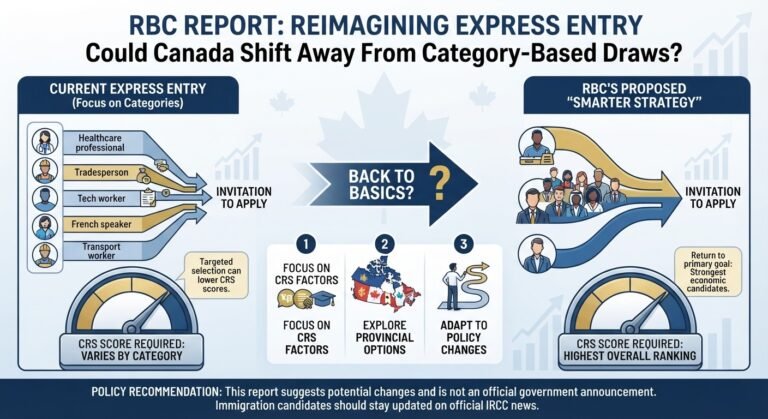
Canada is increasingly using the system to target specific economic and labour-market priorities rather than relying only on broad CRS-based selection.
Why Are CRS Scores Still High Despite So Many Express Entry Invitations 2026 ?
This is probably one of the biggest questions candidates have.
If Canada has already issued more than 131,000 Express Entry invitations 2026, why are CEC scores still above 500?
Because the number of invitations is only one part of the equation.
New candidates continuously enter the Express Entry pool.
Some candidates improve their language scores.
Others gain additional Canadian work experience.
Some complete another year of foreign work experience.
Others receive provincial nominations.
As a result, the Express Entry pool is constantly changing.
Also, category-based draws remove candidates from particular groups. A large French-language or healthcare draw does not necessarily remove thousands of candidates who would otherwise have been competing at the same CRS level in a CEC-specific round.
That is why a record number of total ITAs does not automatically mean that CEC CRS scores must fall dramatically.
Could Canada Issue More Express Entry Invitations in 2026?
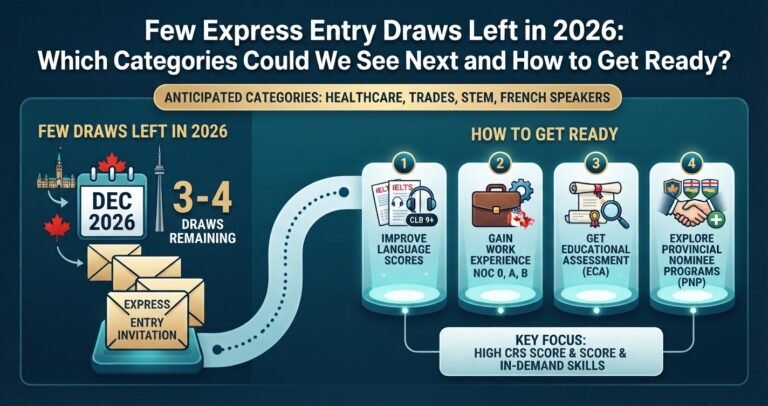
Yes, additional Express Entry rounds can still take place before the end of 2026.
IRCC states that candidates are invited from the Express Entry pool through rounds held throughout the year.
However, there is no fixed public schedule guaranteeing exactly how many draws will take place between now and December 31.
IRCC determines the type of round and the number of candidates to invite.
That means candidates should be cautious about claims such as:
“The next draw will definitely be CEC.”
“CRS will definitely drop below 500.”
“Canada must issue another 20,000 invitations.”
Unless IRCC announces something officially, these remain predictions rather than confirmed facts.
What Could the Remaining 2026 Draws Look Like?
Recent draw patterns give candidates some areas to monitor, but they do not guarantee future draws.
CEC continues to receive invitations.
French-language proficiency continues to be an important category.
PNP rounds have been held regularly throughout the year.
Healthcare and social services have received multiple rounds.
IRCC has also used targeted categories such as physicians, senior managers, trades and transport.
Therefore, candidates should prepare for a system where different profiles can receive invitations at very different CRS scores.
A CEC candidate may need a score above 500, while a candidate qualifying under a particular category may receive an invitation at a substantially lower CRS score.
Don’t Wait for the CRS Score to Drop
One of the biggest mistakes an Express Entry candidate can make is simply waiting and hoping that the CRS cut-off will eventually reach their score.
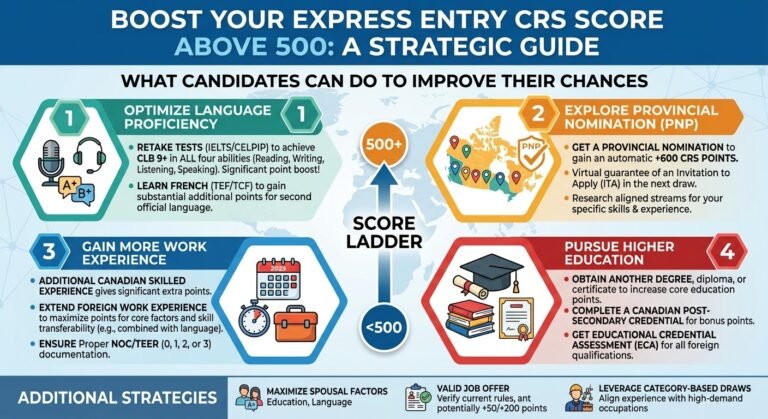
Instead, look at the parts of your profile that you can improve.
Can you increase your IELTS, CELPIP or PTE Core score?
Can your spouse improve their language results?
Can you realistically learn French?
Will you complete another year of qualifying work experience soon?
Are you eligible for any Provincial Nominee Program?
Does your work experience fall under one of the current category-based selections?
Is your NOC code correct based on the work you actually perform?
These questions may be more useful than trying to predict the exact CRS score of the next draw.
What Does This Mean for Express Entry Candidates?
The biggest takeaway from Express Entry invitations 2026 is that Canada is still using Express Entry extensively — but it is becoming increasingly targeted.
More than 131,000 invitations had already been issued by mid-September, but those invitations were spread across CEC, French-language proficiency, PNP and several occupation-based or Canadian-experience categories.
For candidates still waiting in the pool, the year is not necessarily finished.
More invitations could still be issued before the end of 2026, but the number, timing, category and CRS requirements of future rounds cannot be guaranteed.
The better strategy is to keep your Express Entry profile accurate and active while looking for realistic ways to improve your CRS score or become eligible for a category-based or provincial pathway.
With Express Entry changing quickly, 2026 has shown that having a CRS score is only one part of the PR strategy — understanding where your profile fits within Canada’s immigration priorities has become equally important.
Eiffel Immigration Solutions continues to monitor Express Entry draws and IRCC policy changes as Canada moves toward the final months of 2026.