


International Experience Canada (IEC) lets young people from partner countries live and work in Canada for up to two years on a work permit. You can’t apply directly. You first enter a pool, wait for an invitation to apply (ITA), then submit your permit application. For most people the programme is a time-limited chance to gain Canadian work experience, so it works best when you also plan what comes next, such as permanent residence through Express Entry or a provincial program. If you want a personal view of that next step, our team offers a free consultation and a full profile review.
Key Takeaways
- IEC gives youth from partner countries a work permit of up to two years. Most applicants must be 18 to 35 years old, and in some countries 18 to 30.
- There are three categories: Working Holiday, Young Professionals and International Co-op (Internship). Only Working Holiday gives an open work permit without a job offer.
- You enter a pool, and invitations are issued in rounds. After an ITA you have 10 days to accept and 20 days to apply.
- The 2026 IEC season is closed. Profiles that did not get an ITA are removed, and you create a new one when pools reopen for the next season.
- IEC experience can support a later PR application, so plan the pathway before your permit ends.
Table of Contents
- What International Experience Canada is
- Who can apply
- The three IEC categories
- Pools, rounds and invitations
- Applying after you receive an invitation
- What an IEC work permit costs
- Recognized organizations and representatives
- Does IEC lead to permanent residence?
- Our perspective
- Plan your next step with a licensed consultant
- FAQ
- Sources
What International Experience Canada is
IEC is the Government of Canada’s youth mobility programme. It gives international youth the chance to travel and work in Canada for up to two years, and Canadians aged 18 to 35 can also use it to go abroad. This article covers the side that matters to people coming to Canada.
IEC is based on youth mobility agreements between Canada and other countries or territories. Your citizenship decides whether you can take part, and it also decides how many times. Some countries allow only one participation, while others allow two in different categories. A participation counts only if you arrive in Canada and receive your work permit. An ITA you never use does not count.
Who can apply
To take part, you must be a citizen of a partner country or territory, hold a valid passport, be in the allowed age range, carry valid health insurance for your whole stay and have enough money for your initial living costs. The age range depends on your country’s agreement.
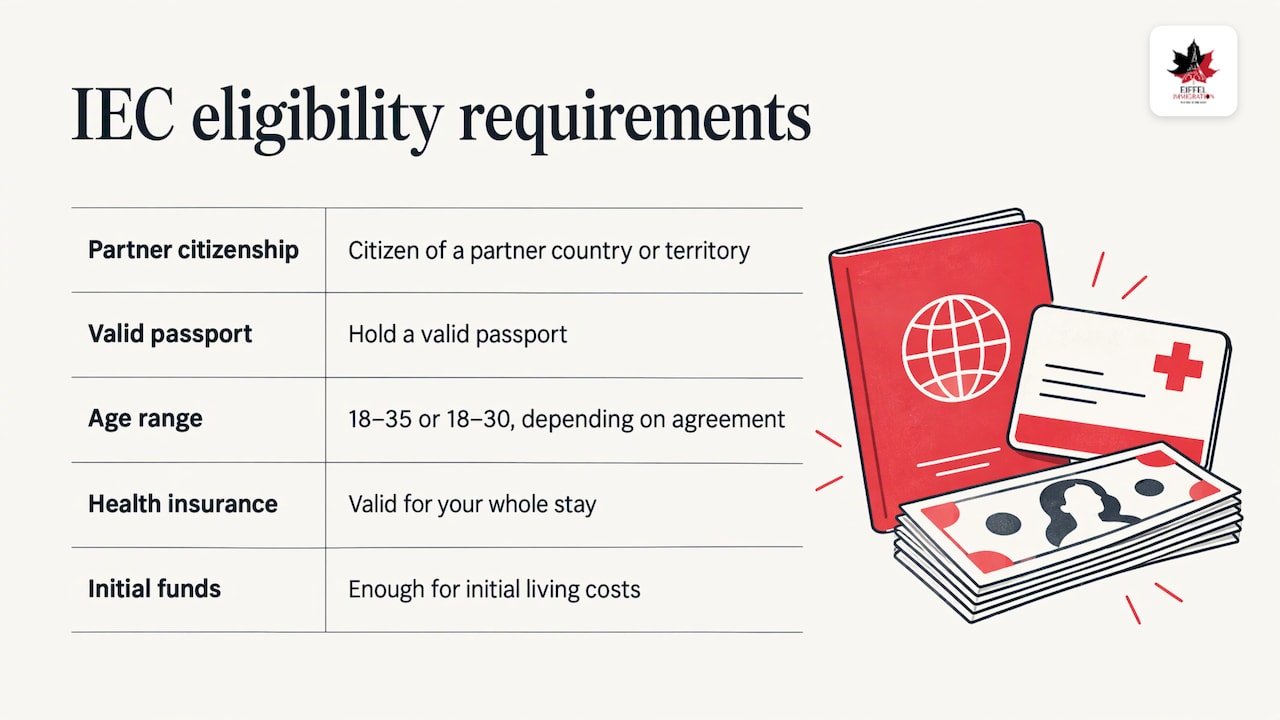
The official list of participating countries and territories runs from Andorra to the United Kingdom. It states that applicants must be 18 to 35, or 18 to 30 in some countries. Check your own country’s row on that page before you do anything else. Holders of a refugee travel document from any country are not eligible.
Eligibility at a glance
| Requirement | What it means in practice |
|---|---|
| Citizenship | Your country must have a youth mobility agreement with Canada |
| Age | 18 to 35, or 18 to 30 depending on the country |
| Passport | Valid for the period required by your permit |
| Health insurance | Valid for the entire length of your stay |
| Funds | Enough to cover your initial living expenses |
| Prior participation | Limited to once or twice, depending on your country |
The three IEC categories
Choosing the right category is the most important decision, because it sets your permit type. The three categories are:
- Working Holiday: an open work permit. No job offer is needed, and you can work for multiple employers anywhere in Canada.
- Young Professionals: an employer-specific permit. You need a paid job offer that counts toward your professional development.
- International Co-op (Internship): an employer-specific permit for students registered at a post-secondary institution outside Canada. The placement must be required to complete your studies and directly linked to your field.
For Young Professionals, the job must be classified under NOC TEER category 0, 1, 2 or 3. A TEER 4 job may qualify if it is in your field of study and you submit your post-secondary diploma, certificate or degree. NOC is Canada’s National Occupational Classification, and TEER is its training, education, experience and responsibilities rating, from 0 (most senior) to 5.
If your goal is to build a career in Canada, a Young Professionals job tied to your field can bring skilled experience that Working Holiday work may not. Working Holiday suits you if you want flexibility to move between jobs and provinces.
Pools, rounds and invitations
IEC is not first come, first served. The steps are:
- Create a profile. You can have only one IEC profile at a time. You submit it to one or more pools, and there is one pool per country and per category.
- Wait for a round. IRCC (Immigration, Refugees and Citizenship Canada) holds rounds of invitations. Rounds continue until spots run out or the season closes. IRCC gives at least five days’ notice before the final round, and it may issue a very small number of ITAs afterwards if many candidates decline, let invitations expire or have applications refused.
- Accept the ITA. You have 10 days to accept and then 20 days to submit your work permit application.
Invitations follow a set order: International Co-op, then Young Professionals, then Working Holiday. If you are in both a co-op pool and a Working Holiday pool, the co-op ITA comes first.
The 2026 season and the next one
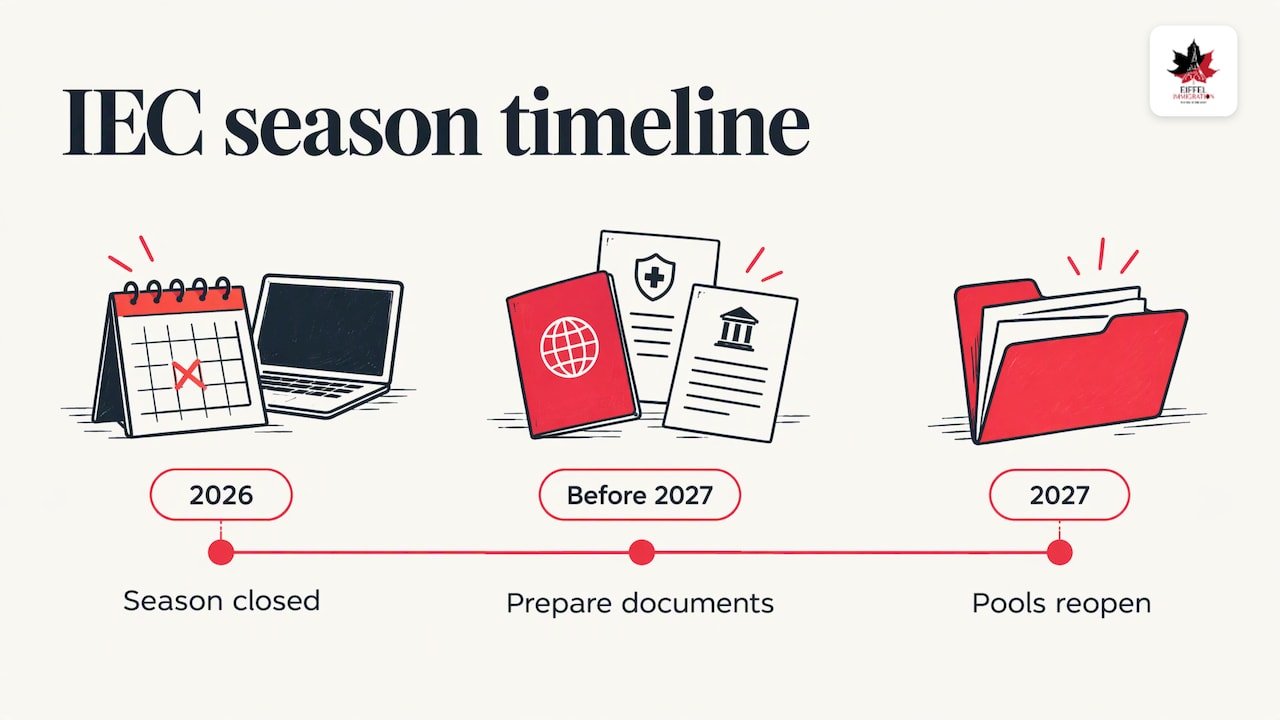
IRCC’s rounds page says the 2026 IEC season is closed. If you received an ITA, you can still complete and submit your work permit application. If you did not, your profile is removed, and you can create a new one when pools reopen for the 2027 season. Your existing account and GCKey (the login for your IRCC account) stay valid.
Pools have opened late in the year in the past, but IRCC announces the actual date. Check the official rounds of invitations page for the current status rather than relying on a date you read elsewhere. Before pools open, you can get your documents ready: passport, insurance quote, proof of funds, and for Young Professionals or Co-op, your job or placement offer.
Applying after you receive an invitation
The application page states you can’t apply without an ITA. After you accept, you have exactly 20 days, with the deadline shown in UTC (Coordinated Universal Time), to:
- complete the online form, filling every mandatory field;
- upload readable colour scans of all supporting documents;
- pay your fees.
If you can’t get a police certificate or medical exam before the deadline, you can submit proof that you requested the certificate or booked the exam appointment. Do this early, because certificates from some countries take weeks.
For Young Professionals and International Co-op, your employer must pay the compliance fee and submit the offer of employment before you submit your application. Confirm with the employer on day one of your 20 days, not on day 18.
Once approved, you receive a port of entry letter of introduction. If you don’t meet certain entry requirements, you must leave Canada after you get the letter and re-enter from a country other than the US or Saint-Pierre-et-Miquelon to activate your permit.
What an IEC work permit costs
For the 2026 season, the IEC fee is CAN$184.75, paid online by credit card through your IRCC account. Other fees may include CAN$85 for biometrics and a CAN$100 open work permit holder fee for Working Holiday.
| Category | What you pay | What the employer pays |
|---|---|---|
| Working Holiday | CAN$184.75 IEC fee plus CAN$100 open work permit holder fee | Nothing |
| Young Professionals | CAN$184.75 IEC fee | CAN$230 employer compliance fee |
| International Co-op | CAN$184.75 IEC fee | CAN$230 employer compliance fee |
The CAN$85 biometrics fee applies where biometrics are required. Fees are set by IRCC and can change from one season to the next, so confirm the amounts on the official page before you pay. Submitting a profile to a pool carries no fee; fees start at the work permit stage.
Recognized organizations and representatives
Some people meet the term “recognized organization” while researching. Recognized organizations are Canadian-based groups that help foreign nationals and Canadian youth work and travel internationally through IEC. They are not employers, though they can help you find work. They are also different from representatives who can help with immigration or citizenship applications. If you need advice on your immigration options, your eligibility or the risks of an application, that comes from a licensed representative.
Does IEC lead to permanent residence?
IEC itself is a temporary permit. It does not give you PR, and it does not extend beyond the period of your permit. What it can give you is Canadian work experience and time in the country to prepare a PR application. Which route fits depends on your age, language results, education and the kind of work you did.
- Express Entry: skilled Canadian work experience can matter for programs such as the Canadian Experience Class. See our guide to the Canadian Experience Class, and our overview of how Express Entry draws are changing in 2026.
- Provincial nominee programs: some provinces select people already working in their labour market. Our PNP draws page tracks recent invitations.
- A longer work permit: if your employer wants to keep you, an LMIA or LMIA-exempt work permit may be the bridge once your IEC permit ends.
The type of job matters here. A Working Holiday job in a TEER 4 or 5 occupation may not help a later PR claim the way a skilled job does. Choosing your category and employer with that in mind is a decision to make before you accept an ITA.
Our perspective
Most people who write to us about IEC treat it as the finish line: get the invitation, get the permit, go. We see it differently. The permit is a start, and the quality of what you do in those two years decides what you can do afterwards.
Our approach is to look at the whole path. Before you choose a category, we look at your age, language ability, education and work history, and we explain eligibility and risks clearly from the first contact. Every file is handled by a licensed and accredited consultant, and we give you a written fee agreement before you pay anything.
Our work covers the routes that usually follow an IEC permit: Express Entry, the Canadian Experience Class, provincial nominee programs, LMIA and LMIA-exempt work permits, and, for people who stay, citizenship. We also track CRS scores and provincial draws, so you can see where a profile stands against recent rounds. We support clients in multiple languages, because a plan only works if you understand every step of it.
LB
Plan your next step with a licensed consultant
If you are thinking beyond an IEC permit, or you are a student, skilled worker or family member weighing other routes to Canada, we can assess your case. Initial consultations are free. You can book a free profile review or browse the full list of services, including study permits, Post-Graduation Work Permits, spousal sponsorship and citizenship.
FAQ
Can I apply for an IEC work permit without an invitation?
No. You can’t apply without an ITA. You must first submit a profile to a pool and be selected in a round of invitations.
How long do I have to respond to an invitation?
You have 10 days to accept an ITA, and then 20 days to submit the work permit application with documents and fees. The 20-day deadline is shown in UTC, so check your account for the exact time.
Can I join IEC more than once?
It depends on your country. Some countries allow participation only once, others twice in different categories. A participation counts only if you arrive in Canada and get your work permit.
Is IEC the same as a study permit or PR?
No. IEC is a temporary work permit for youth from partner countries. A study permit is for studying at a designated learning institution, and permanent residence is a separate application, such as through Express Entry. IEC experience may support a later PR application, depending on the job.
Sources
- International Experience Canada: About the program (Canada.ca)
- International Experience Canada: Who can apply (Canada.ca)
- International Experience Canada: Create your IEC profile (Canada.ca)
- International Experience Canada: Submit your work permit application (Canada.ca)
- Work and Travel in Canada with International Experience Canada (Canada.ca)
- International Experience Canada: Rounds of invitations (IRCC)
- Rounds of invitations, Young Professionals pool page (IRCC)
- Visit Canada.ca/iec (IRCC publication, 2025)
Recommended
Talk it through with an Eiffel case worker
Eiffel Immigration has helped families come to Canada since 2019. Book a free 15-minute call and a case worker will explain what this change means for you. For a full profile review, ask about our $170 flat-rate consultation.
This article is general information, not legal advice. Confirm details with IRCC or a regulated consultant before you act.