


The announcement is particularly relevant for temporary foreign workers, Provincial Nominee Program candidates and selected permanent residence applicants already living in Canada.
Combined with Canada’s earlier Express Entry talent priorities, the announcement signals a continued focus on retaining skilled workers who support the country’s economy.
But does this mean Canada is offering permanent residence to every worker? Who could benefit, and is a new application required?
Here is what the government has confirmed.
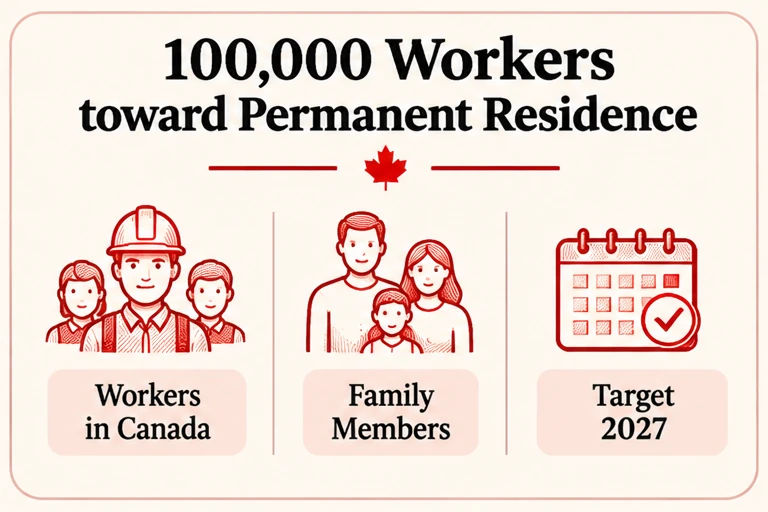
Canada is offering additional immigration spaces to provinces and territories to support the transition of up to 100,000 workers and family members to permanent residence in 2027. The measure is time-limited and does not create a new immigration program.
Canada PR for Workers 2027: What Has IRCC Announced?
On November 12, 2026, Minister Lena Metlege Diab provided further details about Canada’s worker-retention initiative, first outlined in Budget 2026.
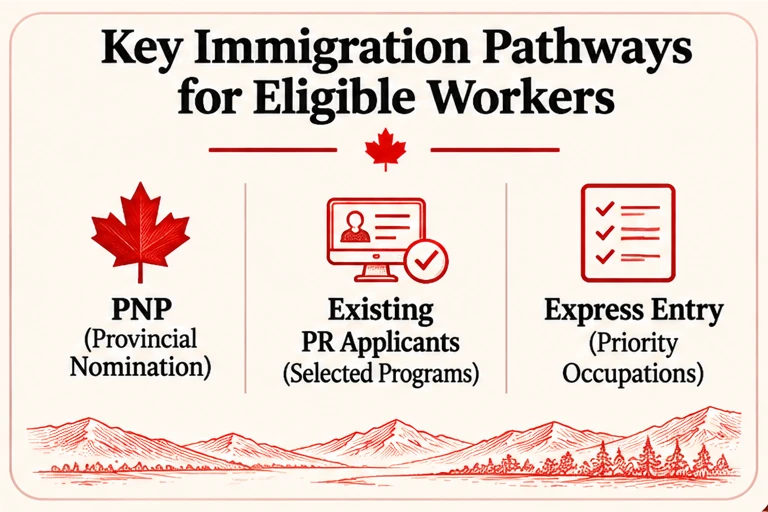
Under this measure, provinces and territories will be offered additional spaces through the Provincial Nominee Program (PNP).
Provincial and territorial governments can choose how much of this additional capacity to use for eligible workers already established in their communities.
These workers may already be filling important roles in industries facing labour shortages.
IRCC stated that the additional provincial allocations are intended to be used by March 31, 2027, to support permanent residence transitions during 2027.
Three Key Details About the Announcement
| Key measure | What it means |
|---|---|
| Up to 100,000 people | Workers already living in Canada and their family members may transition to PR. |
| Additional PNP spaces | Provinces and territories can nominate eligible workers according to regional needs. |
| March 31, 2027 | Target date for using the additional provincial allocations. |
These spaces do not automatically guarantee permanent residence. Applicants must meet the requirements applicable to their immigration program.
Who Could Benefit From Canada’s 100,000-Worker PR Measure?
The new measure focuses on workers already established in Canadian communities, particularly those whose skills and experience match provincial labour market needs.
1. Workers Eligible for Provincial Nomination
Provinces and territories will have additional opportunities to nominate eligible workers under their Provincial Nominee Programs.
For example, a worker in an occupation identified as important to a province’s economy may be able to explore an applicable PNP stream.
However, provincial nomination is not automatic. Applicants must meet specific stream requirements.
2. Selected Workers Already Waiting for PR Decisions
Provincial and territorial governments may also identify eligible workers who have already submitted permanent residence applications through selected federal immigration programs.
These include applicants under:
- Atlantic Immigration Program
- Start-up Visa Program
- Self-Employed Persons Program
- Agri-Food Pilot
- Home care worker programs
Some of these programs are closed to new applications. The additional processing measure does not reopen them.
IRCC has confirmed that existing applicants do not need to contact the department or submit another application solely to be considered under the additional spaces.
How Is This Connected to Express Entry Priorities?
The worker-retention announcement builds on Canada’s broader immigration strategy, including priorities outlined by Minister Metlege Diab on February 18, 2026.
During that speech, the minister described Express Entry as an important tool for selecting skilled workers who can contribute to economic growth and help address labour shortages.
The government’s approach includes continued category-based selection for occupations and skills identified as important to Canada’s economic priorities.
Although the 2027 worker measure and Express Entry are different mechanisms, both reflect Canada’s increased focus on labour market needs.
Express Entry Priority Categories for Skilled Workers
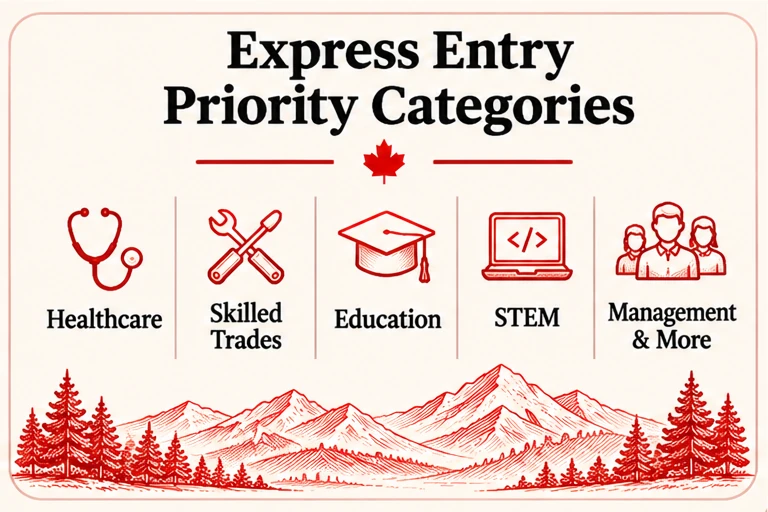
Canada’s Express Entry selection priorities continue to include targeted occupations and skills.
Continuing Express Entry Priorities
IRCC’s February announcement confirmed continued attention to several established areas.
- French-language proficiency: Candidates who meet the requirements of the French-language category.
- Healthcare and social services: Selected healthcare and related professionals.
- Skilled trades: Eligible workers in construction and other designated trades.
- Education: Candidates with qualifying education-related work experience.
- STEM: Selected science, technology, engineering and mathematics occupations.
Additional Express Entry Categories Announced in 2026
The federal government also announced categories targeting:
- Researchers with qualifying Canadian work experience
- Senior managers with qualifying Canadian work experience
- Selected transport occupations, including pilots and aircraft-related professionals
- Eligible foreign medical doctors with Canadian work experience
- Selected skilled military recruits
These categories have specific eligibility criteria. Simply working in a priority field does not guarantee an Invitation to Apply.
PNP vs. Express Entry: What’s the Difference?
Understanding the difference between the Provincial Nominee Program and Express Entry is important for workers planning their permanent residence strategy.
| Feature | Express Entry | 2027 worker measure |
|---|---|---|
| Main purpose | Select eligible skilled immigrants for permanent residence. | Support selected workers already established in Canada. |
| Selection | Program eligibility, CRS ranking and invitations. | Additional provincial nomination and selected application-processing capacity. |
| Eligible applicants | Candidates in Canada or abroad who meet program requirements. | Selected workers already in Canada and eligible family members. |
| New standalone pathway | Express Entry is an existing application management system. | No new standalone application program. |
| Timeline | Ongoing. | Additional capacity targeted for 2027. |
What About the Additional 100,000 Humanitarian Spaces?
The worker-retention measure is one part of a broader temporary initiative intended to support up to 200,000 people already in Canada.
Alongside the workers cohort, the federal government has identified additional permanent residence processing capacity for selected humanitarian and family-related applicants.
These include:
- Up to 32,000 applicants under Hong Kong permanent residence pathways.
- Up to 18,800 applicants under the Ukraine Family Reunification Pathway.
- Up to 12,600 applicants already found eligible on humanitarian and compassionate grounds.
- Up to 45,000 spouses, partners and dependent children of Canadian citizens or permanent residents living in Canada.
These figures describe the government’s additional processing objectives. They are not new open application programs or guaranteed approvals.
What Does Canada PR for Workers 2027 Mean for Temporary Foreign Workers?
For temporary foreign workers already living in Canada, the announcement may create additional opportunities where provincial nomination requirements or existing application criteria are satisfied.
However, having a valid work permit does not automatically make someone eligible for permanent residence.
For Workers With Canadian Experience
Review whether your occupation, experience and employment situation meet the requirements of a Provincial Nominee Program or an existing federal immigration pathway.
For Express Entry Candidates
Continue checking your eligibility, CRS score and applicable category-based selection requirements.
The 100,000-worker measure should not be confused with an automatic increase in Express Entry points.
For Applicants Waiting for Permanent Residence
If you have an application under one of the programs identified by IRCC, continue following official instructions and responding to requests for documents.
Do not submit unnecessary duplicate applications simply because additional processing capacity has been announced.
Will Canada’s New Measure Make PR Easier?
The announcement could improve opportunities for selected workers and applicants, but it does not mean that permanent residence will become easier for everyone.
Canada’s immigration system continues to balance economic priorities with immigration levels, housing availability and infrastructure capacity.
The 2027–2029 Immigration Levels Plan sets a target of 380,000 permanent resident admissions annually, with economic immigration representing more than 64% of planned admissions.
The temporary worker-retention measure provides separate additional capacity for selected people already living in Canada.
This represents a more targeted immigration approach, rather than an unrestricted expansion of permanent residence opportunities.
What Should Workers in Canada Do Next?
- Confirm your current immigration status. Make sure you understand your permit validity and any applicable extension requirements.
- Review your NOC code. Confirm your occupation accurately reflects your employment duties.
- Explore provincial nomination options. Check the current streams and eligibility requirements in your province.
- Review Express Entry eligibility. Understand whether you meet the requirements for an existing Express Entry program or category.
- Check existing PR applications. If you have already applied, follow official IRCC updates and requests.
- Prepare supporting records. Keep employment letters, work history and relevant immigration documents organized.
For useful government immigration links and self-service tools, explore Eiffel Immigration’s
Self-Immigration Toolkit.
How Eiffel Immigration Can Help
Canada’s latest immigration announcements highlight the importance of understanding which permanent residence pathways are genuinely available to individual applicants.
Eiffel Immigration Solutions can help review your circumstances and assess potential immigration options based on your occupation, Canadian work experience, province and current immigration status.
Already Working in Canada and Planning for PR?
Find out which Express Entry or provincial immigration options may be available based on your circumstances.
Frequently Asked Questions About Canada PR for Workers 2027
Is Canada giving permanent residence to 100,000 workers in 2027?
Canada has announced additional capacity to support the transition of up to 100,000 workers and their family members to permanent residence in 2027. Eligibility and applicable application requirements still apply.
Who can qualify for Canada’s 100,000-worker measure?
The measure targets eligible workers already living in Canada, including candidates who may qualify for provincial nomination and selected workers with existing permanent residence applications.
Can I apply directly for the new worker-retention measure?
No separate open application pathway has been announced. The measure provides additional immigration capacity through provincial and territorial nominations and selected existing applications.
Does the measure reopen closed immigration programs?
No. IRCC has confirmed that the temporary measure does not reopen closed programs such as the Agri-Food Pilot or Start-up Visa Program.
Is the 100,000-worker measure part of Express Entry?
It is a separate time-limited measure involving provincial nominations and selected applications. Express Entry continues to operate under its own eligibility and selection rules.
Which Express Entry occupations are being prioritized?
IRCC’s announced priorities include selected healthcare, skilled trades, education, STEM, research, transport and management occupations, along with French-language proficiency and other targeted categories.
Does having a Canadian work permit guarantee permanent residence?
No. A work permit does not guarantee provincial nomination, Express Entry selection or permanent residence approval.
Do existing PR applicants need to contact IRCC about the new spaces?
IRCC states that applicants do not need to submit a new application or contact the department solely to be considered under the additional processing capacity.
Official IRCC Sources
IRCC — November 12, 2026 Worker Retention Announcement
IRCC — February 18, 2026 Express Entry Talent Priorities
IRCC — Time-Limited Immigration Measures
Last updated: November 12, 2026.
This article is for general information and does not replace individualized immigration advice. Immigration policies and eligibility criteria may change.
This article is general information, not legal advice. Confirm details with IRCC or a regulated consultant before you act.