

The Canadian citizenship application has six stages: confirm you are eligible, calculate your physical presence, gather documents, submit the application and fee, attend the test and interview, then take the oath. Most mistakes happen in the first three, before IRCC (Immigration, Refugees and Citizenship Canada) has even opened your file. A licensed consultant who checks your days, tax filings and identity documents first can keep a simple error from sending your application back. We offer a free consultation for that review.
Key Takeaways
- You need 1,095 days in Canada in the five years before you apply, and the Citizenship Act also requires tax filings for three of those years if the law required you to file.
- Adults aged 18 to 54 must prove English or French at CLB 4 and pass the citizenship test.
- The adult fee is $630, and IRCC recommends applying online unless you fall into one of the paper-only situations.
- An incomplete application is returned and the processing clock restarts when you resubmit.
- Stay available in Canada: the test, interview and oath are all held in person.
Table of Contents
- Step 1: Check that you are eligible
- Step 2: Calculate your physical presence
- Step 3: Gather your documents
- Step 4: Apply and pay the fee
- Step 5: What happens after you submit
- Can you travel while you wait?
- How long does it take?
- What is changing
- Where applications go wrong
- Our perspective
- Get a review before you apply
- FAQ
- Sources
Step 1: Check that you are eligible
IRCC’s eligibility rules say you must:
- be a permanent resident with no unfulfilled PR conditions and no removal order;
- have been physically in Canada for at least 1,095 days in the five years before you apply, including at least 730 days as a permanent resident;
- have filed income taxes for three of those five years, if you were required to;
- prove English or French at Canadian Language Benchmark (CLB) level 4 if you are 18 to 54;
- pass the citizenship test if you are 18 to 54;
- take the oath if you are 18 or older, and not be under a citizenship prohibition (for example, certain criminal matters).
The same page has a short question tool that gives a first indication of whether you qualify. For the exact wording of the law, see section 5 of the Citizenship Act. Our own overview of the 1,095-day rule, the test and fees covers the same ground in more depth.
Step 2: Calculate your physical presence
This is the step where most applicants go wrong, so do it carefully.
Under the Citizenship Act, days spent in Canada before you became a permanent resident, as a temporary resident or protected person, count as half a day each, up to a maximum of 365 credited days. Days after you became a permanent resident count in full. A student who spent three years on a study permit and a work permit before PR can therefore bring in at most 365 credited days from that time.
Worked example. Suppose you became a permanent resident 20 months ago and spent 800 days in Canada on temporary status before that. Those 800 days are worth 400 days, but the cap limits them to 365. Your PR time adds roughly 600 days. The total is about 965, which is under 1,095. You would wait until the total, with the cap applied, reaches 1,095 and at least 730 days are as a PR.

IRCC provides a physical presence calculator. Online applicants use the one in their online account. Paper applicants can print the online result or complete form CIT 0407.
Build the count from passport stamps, travel records and entry and exit dates. A gap between your calculation and IRCC’s records can lead to extra questions later. Time spent in prison, on parole or on probation does not count.
Step 3: Gather your documents
IRCC’s documents page lists what an adult application package needs:
- The completed document checklist (CIT 0007).
- The adult application form (CIT 0002).
- Colour copies of the identity pages of every passport and travel document you held during the five-year period.
- Your physical presence calculation.
- Language proof, if you are 18 to 54: education documents in English or French, or a third-party test result.
- Copies of two pieces of personal ID, each showing your name, photo and date of birth.
- Two identical citizenship photos, your fee receipt and police certificates where they apply, as the CIT 0002 guide describes.
The CIT 0007 checklist tells paper applicants to tick each item and place documents in the listed order, with the checklist on top. IRCC also publishes separate application packages for minors, Canadian Armed Forces members, adoptions and stateless persons born to a Canadian parent. Choose the one that matches your situation.
For language proof, a language test result is the most direct route. School or university documents can work if the education was in English or French.
Step 4: Apply and pay the fee
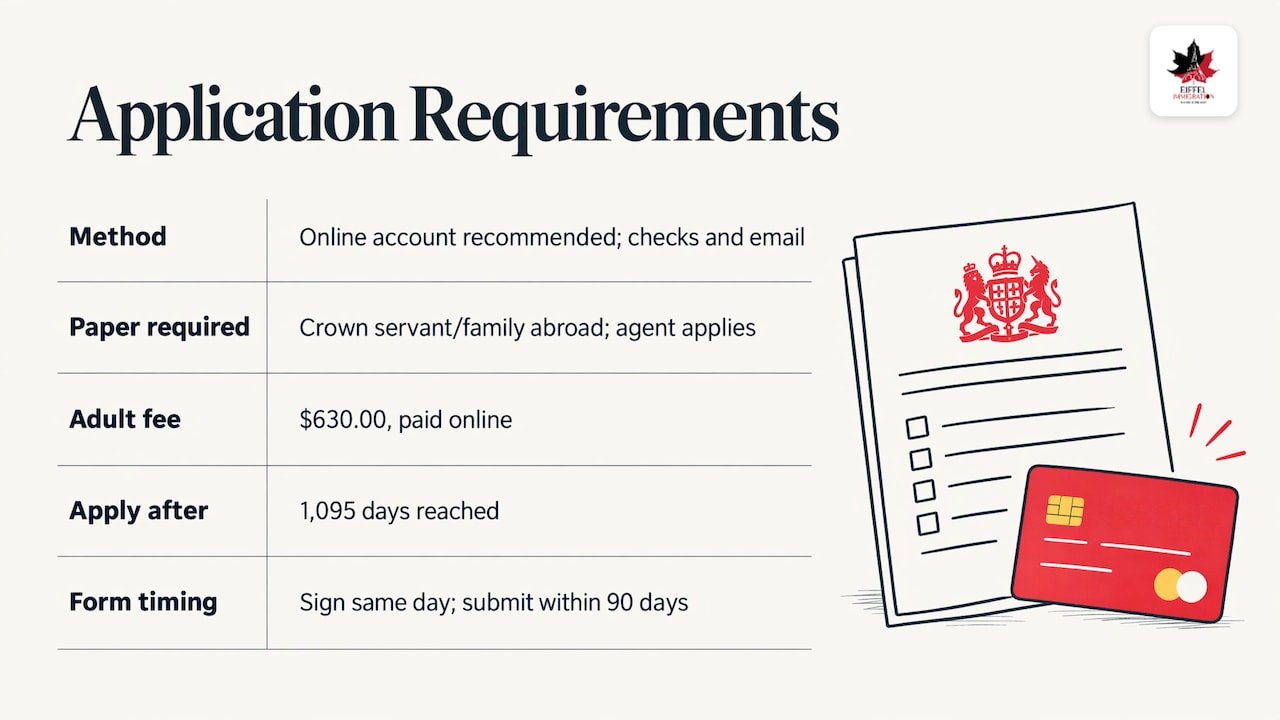
IRCC recommends applying online through your online account. The system runs built-in checks and sends an email confirmation. Paper is required only if your calculation includes time abroad as a Crown servant, or as a family member of one, or if a representative submits the application on your behalf. The official guide sets the adult fee at $630.00, paid online.
Paper applications take longer to start processing, because IRCC must digitize them and check them for completeness. Sign and date the form on the same day. IRCC returns applications that arrive more than 90 days after the date on the form.
A note on timing. Apply only once your count has reached 1,095 days. The law counts the five years back from the application date. Submitting early does not save time, because the file is likely to be refused or returned.
Step 5: What happens after you submit
IRCC’s After you apply page describes the sequence:
- Completeness check. IRCC confirms that every question is answered, every document is attached and the fee is paid. A complete file gets an acknowledgement of receipt (AOR) with your application number and UCI (unique client identifier). An incomplete file is returned, the fee is not processed, and processing time starts again when you resubmit.
- Review of requirements. IRCC checks that you meet the rules.
- Citizenship test, if you are 18 to 54. It covers Canada’s history, geography, economy, government, laws and symbols, and the rights and responsibilities of citizens. Discover Canada says it is usually written but could be an interview. Applicants 55 and over are exempt.
- Interview with an IRCC official. Some applicants are sent to a hearing before a citizenship officer or judge. IRCC’s help centre also notes that a Quality Assurance Program randomly selects files for detailed review, with extra information requests.
- Decision and oath ceremony. If approved, IRCC schedules your in-person oath.
You can check your status online only after you receive the AOR. If you hired a representative, IRCC sends updates to your email until completeness is confirmed, and after that to your representative, who can check the status for you.
Can you travel while you wait?
Yes, but you must stay reachable. You need to be in Canada for the test, interview and ceremony. IRCC also asks you to tell it if you plan to leave Canada for more than two weeks in a row. Contact IRCC as well if you:
- change your address or contact details;
- are charged with a crime;
- need an accommodation or waiver for the test, language proof or oath.
A missed test or interview notice can delay or sink an application, so keep your address current.
How long does it take?
Processing times change with IRCC’s workload, and the pages that rank for this topic quote very different figures from different years. Check IRCC’s own live processing-times tool for the current estimate. We also track movement in our review of IRCC processing times.
What is changing
IRCC’s Citizen Oversight Committee biometrics briefing of 9 June 2025 says citizenship applicants are not currently required to give biometrics. It says that from 2027 the requirement will be expanded to citizenship grant applicants. Before you apply, check IRCC’s page for the rules in force on your application date.
Where applications go wrong
- Miscounted days. Forgetting the half-day rule or the 365-day cap.
- Tax filings. The law requires filing for three of the five years where you were obliged to file, and gaps are easy to miss.
- Missing passport pages. Every passport and travel document from the five-year period counts.
- Wrong package. Using the adult package for a minor, or the reverse.
- Late paper submission. Posting more than 90 days after signing.
- Unreported changes. An old address means missed notices.
If a refusal or return has already happened, see our guides to reconsideration and GCMS notes.
Our perspective
Citizenship looks like a form, but the decision is made on your travel history. Most files that come back to us have the same cause: a day count that nobody checked against passport stamps, or a tax year that was missed.
Every file at Eiffel Immigration is handled by a licensed and accredited consultant, and you get a written fee agreement before you pay. We explain eligibility and risks from the first contact to the final decision, and we support clients in multiple languages.
For families, students who moved on to PR and workers who came through Express Entry, the careful work is done before you click submit. That is where a second pair of expert eyes pays off.
LB
Get a review before you apply
If you want your day count, documents and package checked before submission, book a free consultation with our licensed consultants. We prepare citizenship applications and proof of citizenship files, and we handle refusal review and reapplication. For questions about whether you are already a citizen, see our guide to proof of citizenship and Bill C-3.
FAQ
How do I apply for Canadian citizenship?
Confirm you meet the requirements, calculate your physical presence, gather documents, and submit the adult application with the $630 fee. IRCC recommends applying online. After that come the test, interview and oath.
Do I need a consultant to apply?
No one is required to use one, but IRCC accepts applications from representatives. A licensed consultant can check your day count, tax filings and documents before you submit, which helps avoid a returned application. We offer a free consultation to start.
Do all applicants take the citizenship test?
No. Applicants aged 18 to 54 on the day they sign must pass the test and prove English or French at CLB 4. Applicants 55 and over are exempt from the test.
What if my application is returned?
If IRCC finds it incomplete, it returns the application and does not process the fee. When you resubmit, processing time starts again. Fix the missing item before you send it back.
Sources
- Citizenship Act, section 5
- IRCC: Who can apply
- IRCC: Calculate your physical presence
- IRCC: Forms and documents for adults
- IRCC: Document checklist CIT 0007
- IRCC: Application packages
- IRCC: How to apply
- IRCC: After you apply
- IRCC help centre: What happens after I send in my application?
- Discover Canada: Applying for citizenship
- IRCC Citizen Oversight Committee: Biometrics, 9 June 2025
Recommended
Talk it through with an Eiffel case worker
Eiffel Immigration has helped families come to Canada since 2019. Book a free 15-minute call and a case worker will explain what this change means for you. For a full profile review, ask about our $170 flat-rate consultation.
This article is general information, not legal advice. Confirm details with IRCC or a regulated consultant before you act.