
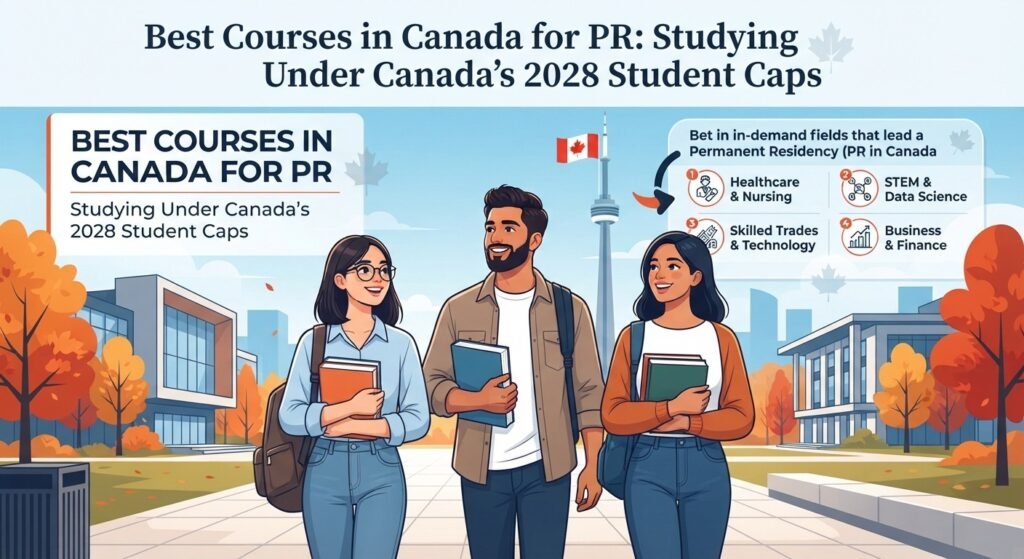
Are you planning to study in Canada for PR?
Do you know which are the Best Courses in Canada for PR ?
Then choosing a college or university based only on fees, location or easy admission may no longer be enough.
Canada’s immigration system has changed significantly. The federal government is reducing new international student arrivals while putting more focus on workers who can fill specific labour shortages.
Under Canada’s 2026–2028 Immigration Levels Plan, the target for new international student arrivals is 155,000 in 2026 and 150,000 in both 2027 and 2028.
This does not mean the student-to-PR pathway is over.
It means students need to choose their education much more strategically.
So, if you are planning to study in Canada in 2026, 2027 or 2028, an important question is:
Which programs can still help build a realistic pathway toward Canadian permanent residence?
Let’s understand it in simple language.
Canada Is Accepting Fewer New International Students but you need to be aware about the Best Courses in Canada for PR
Canada introduced its international student cap in 2024, and the government continues to control the number of new students entering the country.
For 2026, IRCC expects to issue up to 408,000 study permits. This includes approximately 155,000 permits for newly arriving international students and 253,000 extensions for current and returning students.
The international student cap itself limits the number of study permit applications IRCC accepts for processing.
At the same time, Canada is continuing to prioritize economic immigration and workers who have skills needed by the Canadian labour market.
For students, this sends a clear message:
Your Canadian education should ideally connect with a realistic employment opportunity after graduation.
Does Studying in Canada Guarantee PR?
No.
This is probably the most important thing international students need to understand.
There is no course in Canada that automatically gives you permanent residence.
Completing a Canadian program may help you become eligible for a Post-Graduation Work Permit (PGWP). You may then gain skilled Canadian work experience and potentially qualify for programs such as:
- Canadian Experience Class
- Federal Skilled Worker Program
- Provincial Nominee Programs
- Express Entry category-based selection
- Other federal or provincial immigration pathways
But every program has its own eligibility requirements.
Your age, education, language score, occupation, Canadian work experience, CRS score, province and immigration policies at the time you apply can all affect your PR options.
That is why students should think about study + PGWP + occupation + PR pathway together.
Which Programs Should Students Consider for PR?
There is no official IRCC list called “PR courses.”
However, there are fields of study that may provide a stronger connection to occupations currently being prioritized through Canada’s immigration system.
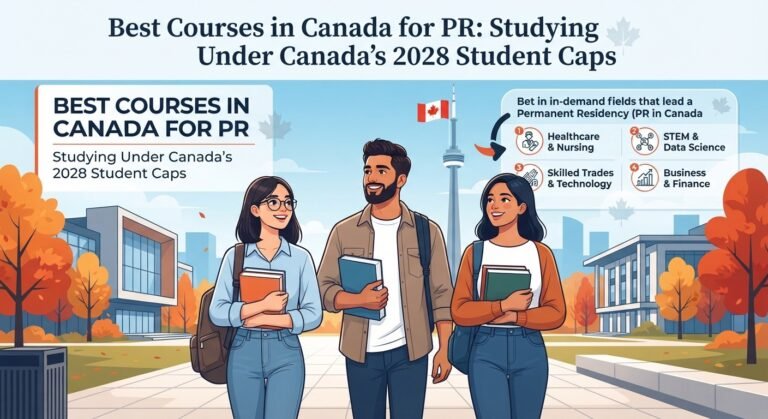
1. Best Courses in Canada for PR: Healthcare and Social Services:Healthcare and Social Services
Healthcare continues to be an important area in Canada’s immigration strategy.
Depending on the exact program and occupation, students may consider programs connected with areas such as:
Nursing, medical laboratory fields, respiratory therapy, dental hygiene, social services and other healthcare-related occupations.
Healthcare and social services are currently included in Express Entry category-based selection.
However, completing a healthcare program does not automatically make someone eligible for a healthcare Express Entry draw. The applicant must meet the applicable Express Entry and occupational work-experience requirements.
SEO takeaway: Healthcare programs can be worth considering when the program leads to a PGWP-eligible qualification and the student can realistically enter an eligible occupation after graduation.
2. Best Courses in Canada for PR: Healthcare and Social Services: STEM Programs
Science, Technology, Engineering and Mathematics—better known as STEM—remains an Express Entry category in 2026.
Examples of study areas may include:
Computer and information sciences, artificial intelligence, engineering-related programs, environmental sciences and certain technology programs.
But there is an important warning.
Simply completing an IT or engineering course does not guarantee a STEM-category invitation.
Express Entry category eligibility is based on factors including your qualifying work experience in an eligible occupation, not simply the name of your Canadian diploma or degree.
So don’t choose a program just because somebody tells you, “IT gives PR.”
Look at where the program can realistically take your career.
3. Best Courses in Canada for PR: Healthcare and Social Services: Trades Programs
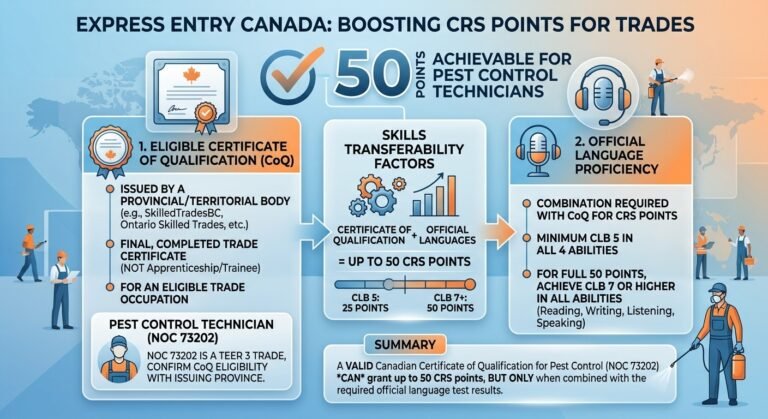
Canada also continues to prioritize certain skilled trades through Express Entry.
Depending on the institution, province, licensing requirements and PGWP eligibility, students interested in hands-on careers may explore training related to eligible trade occupations.
The important part is understanding what happens after graduation.
Ask questions such as:
Will this qualification allow me to work in the occupation?
Does the occupation require provincial certification?
Can I realistically obtain the required licence?
Is the occupation currently eligible under a federal or provincial immigration pathway?
A course may sound attractive, but if you cannot obtain the certification or employment required afterward, your immigration plan can become difficult.
4. Best Courses in Canada for PR: Healthcare and Social Services: Education Programs
Education occupations continue to have their own Express Entry category in 2026.
IRCC’s PGWP field-of-study list also includes numerous education-related CIP codes.
Programs connected with teaching and education may therefore be worth exploring, depending on your previous education and career plans.
Again, remember the difference between a field of study and an Express Entry occupation.
Studying education does not automatically qualify someone for an education-category Express Entry draw. The applicable work-experience requirements still have to be met.
5. Transport-Related Programs
Transport occupations returned as an Express Entry category for 2026.
This could make certain transport-related career paths interesting for students considering their long-term options.
But students should not select a course simply because “transport” appears on an Express Entry list.
You need to check the specific occupation, NOC code, employment requirements, licensing requirements and immigration eligibility.
6. Agriculture and Agri-Food Programs
Agriculture and agri-food also appear among the eligible PGWP fields of study.
Programs can include areas connected with agriculture, agricultural business and related technical fields.
These programs may also connect with opportunities outside Canada’s biggest cities, where certain provincial or regional immigration programs can become relevant.
Your actual PR pathway, however, will depend on the province, occupation and immigration rules applicable when you become eligible.
Bachelor’s, Master’s and PhD Students Have an Important PGWP Advantage
There is an important difference students should understand.
Under the current PGWP rules, graduates of bachelor’s, master’s and doctoral degree programs do not have to meet the PGWP field-of-study requirement.
They still have to satisfy the other PGWP requirements, including the applicable language requirement.
For many college and other non-degree programs, however, the field-of-study requirement can be extremely important.
If the requirement applies to you, your program must have an eligible CIP code.
That is why checking only whether a school is a DLI is not enough.
You should also check:
Is the school and program PGWP eligible?
What is the exact CIP code?
Is that CIP code eligible under the current PGWP rules?
For 2026, IRCC has frozen the PGWP eligible field-of-study list, meaning it will not add or remove eligible fields during the year.
Don’t Confuse PGWP Eligibility With PR Eligibility
This is one of the biggest mistakes students can make.
A program can be PGWP eligible, but that does not mean it guarantees PR.
Think of the process as separate steps:
Step 1: Get admission to an appropriate Canadian program.
Step 2: Obtain your study permit.
Step 3: Complete a PGWP-eligible program and meet the PGWP requirements.
Step 4: Obtain the appropriate work permit, if eligible.
Step 5: Find employment that can help you gain qualifying work experience.
Step 6: Become eligible for an immigration program.
Step 7: Meet the CRS, nomination or other selection requirements applicable at that time.
PR is therefore a pathway, not something attached to a particular diploma.
How to Choose the Best Courses in Canada for PR Before Paying Your College Fees?
Before paying thousands of dollars in tuition, research the complete pathway.
Check the DLI and PGWP eligibility, exact program and CIP code, PGWP field-of-study rules, length of the program, likely occupation after graduation, NOC/TEER classification, licensing requirements, job opportunities, provincial immigration options and current Express Entry categories.
Most importantly, ask yourself:
“If I finish this program, what job am I realistically going to get?”
That question can be much more useful than asking:
“Why Choosing the Best Courses in Canada for PR Matters?”
What Are Canada’s Express Entry Priorities in 2026?
Canada’s 2026 Express Entry categories include:
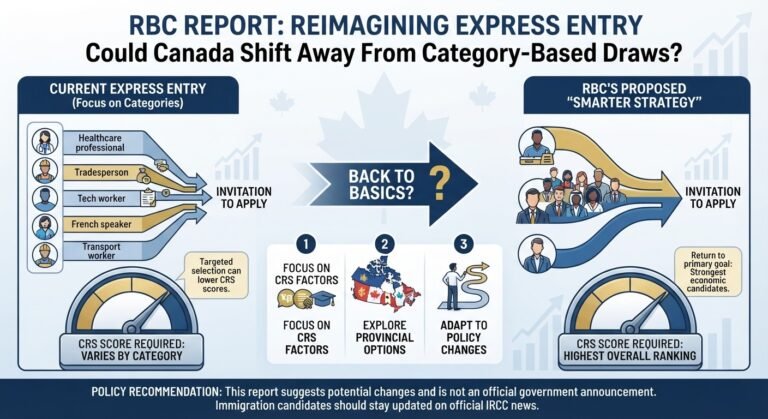
French-language proficiency, healthcare and social services, STEM, trades, education and transport, along with categories for physicians with Canadian work experience, researchers with Canadian work experience, senior managers with Canadian work experience and skilled military recruits.
For the renewed occupation-based categories, IRCC increased the qualifying work-experience requirement to at least 12 months of eligible experience within the previous three years.
This is another reason students need to look beyond their course.
The goal should be to create a realistic bridge between:
Education → PGWP → Skilled Occupation → Immigration Eligibility
Can You Still Study in Canada With the Goal of PR?
Yes—but planning matters much more than before.
Canada is not simply closing the door on international students. It is reducing temporary resident arrivals and increasingly connecting immigration selection with labour-market needs.
Students entering Canada today should therefore avoid choosing a program simply because it is cheap, easy to enter or recommended by a friend.
Your program should make sense for your education, previous experience, career goals and possible immigration pathway.
Final Thoughts from Eiffel Immigration
The old idea of “take any two-year course, get a work permit and PR will follow” is no longer a safe way to plan your future in Canada.
Before selecting a program, look at the entire journey.
Is the program PGWP eligible?
Is your CIP code eligible, if the field-of-study requirement applies to you?
What occupation could you enter after graduation?
Does that occupation connect with current Express Entry or provincial priorities?
Do the Best Courses in Canada for PR Guarantee Permanent Residence?
Will you be able to gain the work experience required for that immigration pathway?
Canada still offers opportunities to international students, but successful planning increasingly means choosing an education that makes sense both academically and professionally.
And remember: immigration policies can change between the day you start studying and the day you become eligible for permanent residence. Always check the latest IRCC and provincial requirements before making a major decision.
Disclaimer: This article provides general information only. Studying in Canada or completing any particular program does not guarantee a work permit, provincial nomination, Express Entry invitation or permanent residence.