
If you have been following Canada’s Express Entry draws in 2026, you have probably noticed something interesting. The Canadian Experience Class (CEC) and Provincial Nominee Program (PNP) have remained two important pathways in Canada’s permanent residence selection system.
But there is another side to the story.
Thousands of candidates have received invitations, yet many applicants with good CRS scores are still waiting.
So, what exactly is happening? Why are some applicants receiving invitations while others remain in the Express Entry pool? And most importantly, what does PNP and CEC Express Entry 2026 mean for your chances of getting Canadian permanent residence?
Let’s break down the numbers in simple language.
1. PNP and CEC Express Entry 2026: What Happened This Year?
Canada has continued holding program-specific Express Entry draws, with CEC providing relatively large invitation rounds and PNP offering a separate route for provincially nominated candidates.
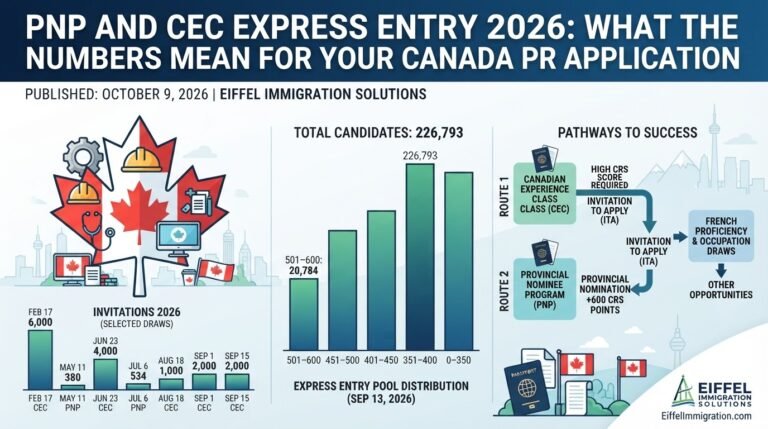
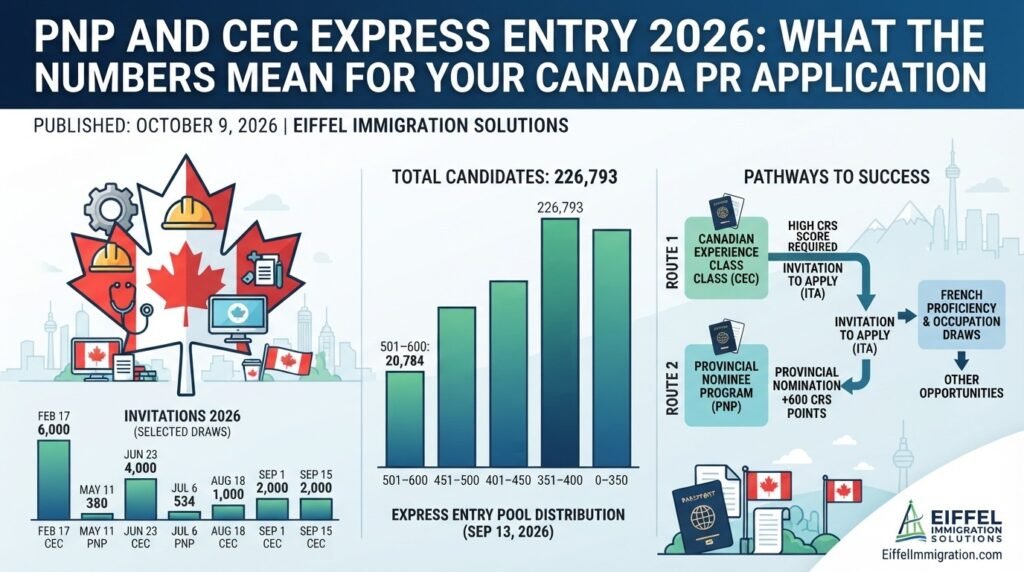
Here are some important examples from 2026:
| Draw date | Category | Invitations | CRS cutoff |
|---|---|---|---|
| February 17 | CEC | 6,000 | 508 |
| May 11 | PNP | 380 | 798 |
| June 23 | CEC | 4,000 | 516 |
| July 6 | PNP | 534 | 708 |
| August 18 | CEC | 1,000 | 523 |
| September 1 | CEC | 2,000 | 521 |
| September 15 | CEC | 2,000 | 519 |
Selected Express Entry rounds, not a complete year-to-date total. Source: IRCC official draw records.
First, Canada continues to invite candidates who have qualifying Canadian work experience.
Second, provincial nominations remain a valuable pathway for candidates who meet a province’s immigration needs.
However, these are not the only opportunities. French-language and occupation-based draws have also played important roles in 2026.
2. Why Are CEC Draws So Important in 2026?
Imagine you have been working in Canada for two years. You completed your education, gained Canadian work experience and created your Express Entry profile.
Your CRS score is 505.
In February, you saw a CEC draw with a cutoff of 508. You were only three points away!
But by August, one CEC draw had reached 523.
This is exactly why many applicants are feeling uncertain.
The PNP and CEC Express Entry 2026 trends show that receiving an invitation depends not only on meeting the program requirements but also on your CRS score, the number of invitations issued and competition in the eligible pool.
CEC remains particularly relevant for eligible skilled workers with Canadian work experience.
But qualifying for CEC does not automatically guarantee an invitation.
3. Why Are CRS Scores Still High?
One of the biggest questions applicants ask is:
“If Canada is inviting thousands of people, why is my CRS score still not enough?”
The answer is competition.
According to IRCC’s Express Entry pool distribution as of September 13, 2026:
Total candidates
226,793
CRS 501–600
20,784
Candidates by CRS range
Excludes the 574 candidates scoring 601–1200 from the chart.
These figures show how crowded the Express Entry pool is.
For example, someone with a CRS score of 490 may have a competitive profile, but they still face thousands of candidates with higher scores.
And when IRCC issues only 1,000 or 2,000 invitations in a CEC draw, the cutoff may remain high.
This is why applicants should avoid relying only on the hope that CRS scores will suddenly drop.
4. PNP and CEC Express Entry 2026: Why Provincial Nomination Matters
Let’s consider another example.
Two applicants have the same CRS score of 450.
Applicant A qualifies for CEC and waits for the next draw.
Applicant B receives an Express Entry-linked provincial nomination.
After accepting the nomination, Applicant B receives an additional 600 CRS points.
Example: Impact of a provincial nomination
Before nomination
450
CRS points
After nomination
1,050
CRS points
+600 additional CRS points
That is a huge difference!
A provincial nomination can significantly improve the likelihood of receiving an Express Entry invitation.
However, there is one important condition: you must qualify for the province’s nomination stream.
Every province has its own selection priorities. Some focus on occupations, while others consider job offers, work experience, language ability or connections to the province.
A nomination is not automatic, and not every PNP stream operates through Express Entry.
5. Does a High PNP CRS Cutoff Mean You Need 700 Points?
Not necessarily.
Many applicants become worried when they see PNP draws with CRS cutoffs of 700 or 800.
But remember, Express Entry-linked provincial nominees receive 600 additional CRS points.
For example, a candidate with 180 base CRS points could reach 780 after receiving a provincial nomination.
Therefore, a PNP cutoff of 780 does not mean every applicant needed 780 points before nomination.
This is an important detail that applicants should understand when comparing PNP and CEC Express Entry 2026 results.
6. What About Applicants With CRS Scores Below 500?
Here is some encouraging news.
A CRS score below 500 does not necessarily mean your Canadian PR journey is over.
Express Entry includes category-based selection rounds that can provide opportunities to eligible candidates with different CRS scores.
For example, on August 19, 2026, IRCC issued 5,000 invitations under the French-language proficiency category, with a CRS cutoff of 382.
This shows why applicants should consider all immigration pathways for which they may qualify.
If your CRS score is 450 or 470, you could explore provincial nomination programs, French-language eligibility or eligible occupation-based categories.
The important point is to meet the specific requirements of the pathway rather than assuming a lower CRS score alone will be sufficient.
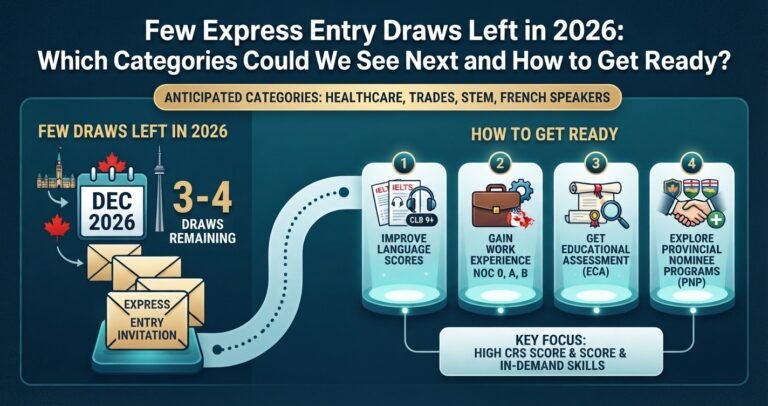
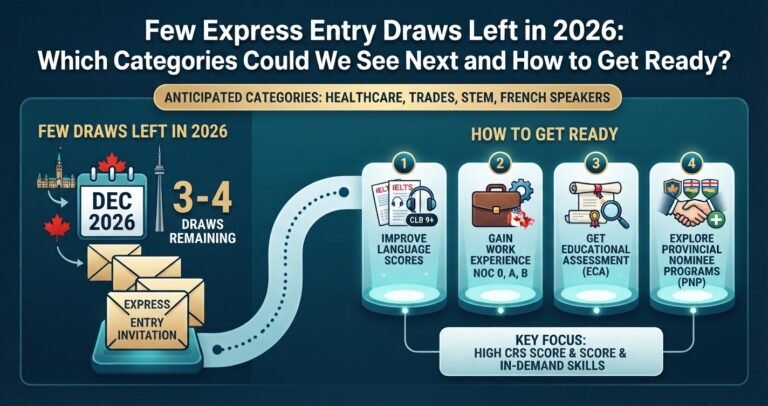
7. Five Things Applicants Should Do Before the Next Express Entry Draw
Instead of checking CRS cutoffs every day, focus on improving what you can control.
-
Improve your language scores: Higher IELTS General, CELPIP General or eligible French test results can improve your CRS score.
-
Explore provincial nominations: Review provinces where your occupation, employment and qualifications may match current requirements.
-
Review your work experience: Make sure your employment history and NOC classification accurately reflect your duties.
-
Check category-based eligibility: Your occupation or French-language proficiency may open additional opportunities.
-
Keep your Express Entry profile updated: Changes in language results, education, employment or other relevant information should be reflected accurately.
Even a small improvement in your CRS score can make a difference when a cutoff is close to your current score.
8. What Can We Expect From PNP and CEC Express Entry in the Rest of 2026?
Looking at the PNP and CEC Express Entry 2026 trends, three developments are worth watching.
CEC draws may continue to provide opportunities for candidates with qualifying Canadian work experience. However, future invitation numbers and CRS cutoffs cannot be guaranteed.
Provincial nominations may remain particularly valuable for candidates whose CRS scores are not competitive in CEC rounds.
At the same time, category-based selection could continue creating opportunities for applicants with specific language abilities and occupational backgrounds.
The biggest lesson is simple: Canada’s Express Entry system is no longer something applicants should approach with only one strategy.
A candidate who qualifies for multiple pathways may have more opportunities than someone who relies entirely on one type of draw.
9. Final Thoughts: What Do the 2026 Numbers Mean for Your PR Application?
The PNP and CEC Express Entry 2026 results highlight an important reality.
Canada is still inviting skilled workers to apply for permanent residence, but competition remains significant.
For some applicants, Canadian work experience and a competitive CRS score may provide a pathway through CEC.
For others, provincial nomination, French-language proficiency or category-based selection may offer a better opportunity.
The key is understanding your eligibility, monitoring official immigration developments and preparing a realistic immigration strategy.
At Eiffel Immigration Solutions, we believe that every immigration journey is different. Your education, employment, language scores and long-term goals all matter when identifying suitable Canadian permanent residence pathways.
Remember: A lower CRS score does not always mean fewer possibilities. Sometimes, it means you need to explore a different eligible pathway.