
General Express Entry Draws 2026: Why Canada Is Moving Away From General Invitations
Canada’s Express Entry system is changing, and if you are planning to apply for permanent residence, you need to understand what is happening.
For years, many applicants believed that having a high Comprehensive Ranking System (CRS) score was the main way to receive an invitation for Canadian permanent residence.
But things are different now.
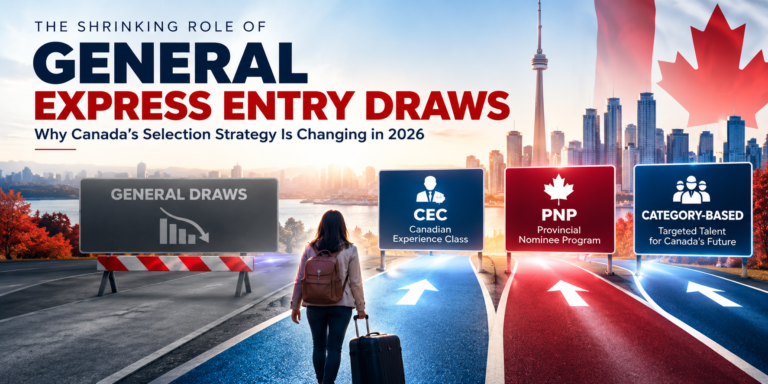
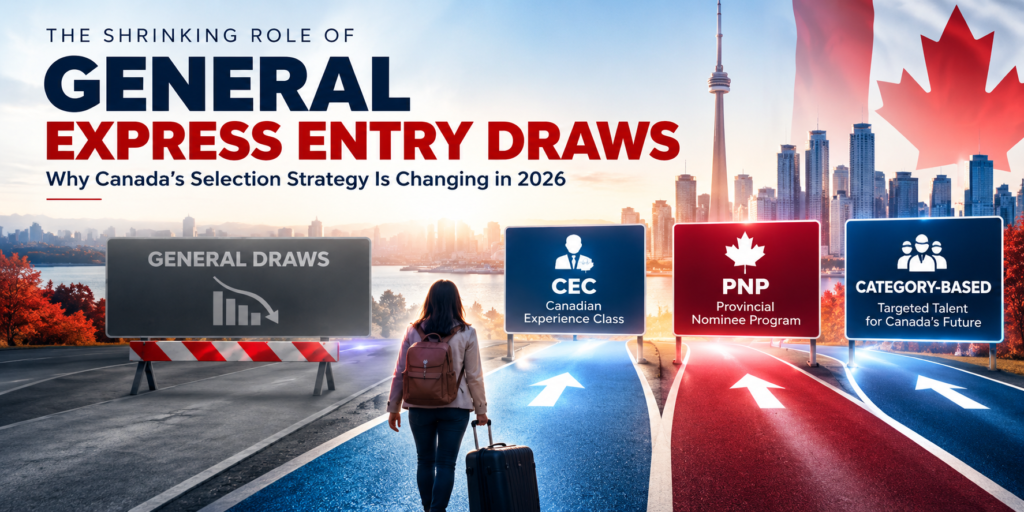
In 2026, General Express Entry Draws have taken a back seat while Canada increasingly focuses on Canadian Experience Class (CEC), Provincial Nominee Program (PNP), and category-based selection.
So, does this mean general draws are disappearing forever? And what happens to applicants who do not qualify for a specific category?
Let’s understand this in simple language.
1. What Are General Express Entry Draws 2026?
Before understanding the changes, let’s look at how general Express Entry draws 2026 work.
In a general draw, Immigration, Refugees and Citizenship Canada (IRCC) invites the highest-ranking eligible candidates from the Express Entry pool, regardless of which of the three federal programs they qualify under.
These programs include:
-
Canadian Experience Class (CEC)
-
Federal Skilled Worker Program (FSWP)
-
Federal Skilled Trades Program (FSTP)
For example, imagine two applicants:
Applicant A has a CRS score of 520 and qualifies under FSWP.
Applicant B has a CRS score of 510 and qualifies under CEC.
In a general draw with a cutoff of 515, Applicant A could receive an invitation while Applicant B would not.
This system largely focused on CRS ranking rather than selecting candidates from a particular program or occupation.
However, the approach to General Express Entry Draws 2026 has become much more targeted.
2. Why Are General Express Entry Draws 2026 Becoming Less Common?
Canada is increasingly using Express Entry to address specific economic and labour market needs.
Instead of inviting candidates only based on their overall CRS ranking, IRCC can conduct draws targeting candidates who meet particular requirements.
For example, Canada may prioritize workers with Canadian experience, French-language proficiency or experience in certain occupations.
IRCC officially recognizes three draw types: general, program-specific and category-based.
This means having a high CRS score remains important, but it is not always enough.
Your eligibility for a particular draw can matter just as much as your CRS score.
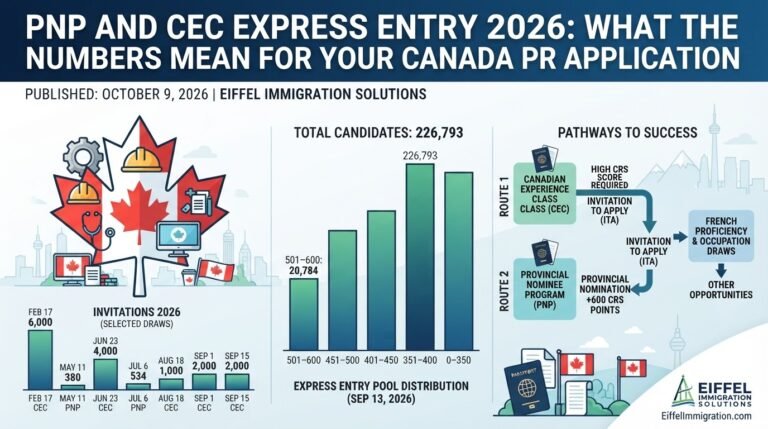
3. General Express Entry Draws 2026: What Do the Numbers Show?
The last general Express Entry draw 2026 listed in historical draw records took place on April 23, 2024, with 2,095 invitations and a CRS cutoff of 529.
In contrast, the 2026 draws through October 1 have focused on specific programs and categories.
Here are some examples:
|
Date |
Draw category |
Invitations |
CRS |
|---|---|---|---|
|
March 3, 2026 |
CEC |
6,000 |
508 |
|
April 2, 2026 |
Trades |
3,000 |
477 |
|
June 25, 2026 |
Healthcare & Social Services |
4,000 |
475 |
|
August 19, 2026 |
French Language |
5,000 |
382 |
|
September 29, 2026 |
CEC |
2,000 |
518 |
|
October 1, 2026 |
Trades |
3,500 |
476 |
Selected 2026 draws, not a complete invitation total.
Notice something interesting?
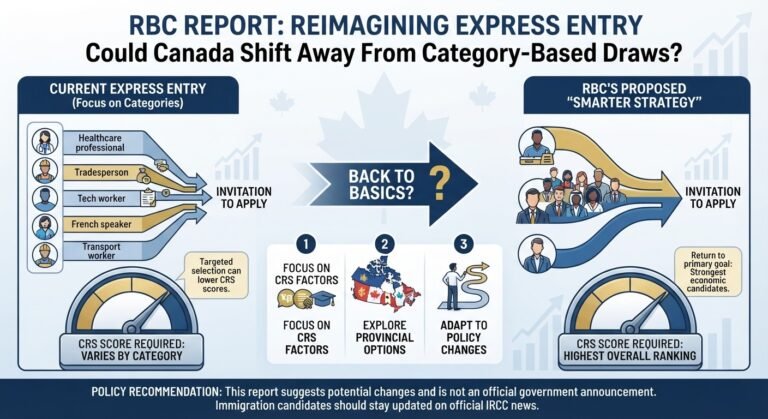
The CRS cutoff varies significantly between categories.
For example, French-language candidates received invitations at a cutoff of 382 in August, while the September 29 CEC cutoff was 518.
This does not mean everyone with a score of 382 could receive an invitation. Candidates had to qualify for the French-language category.
That is the biggest lesson from General Express Entry Draws 2026.
4. What Does This Mean for Federal Skilled Worker Applicants?
This is where many applicants are facing uncertainty.
Imagine you are living in India, have three years of skilled work experience, a master’s degree and excellent IELTS scores.
Your CRS score is 510.
You qualify for the Federal Skilled Worker Program, but you do not have Canadian work experience or eligibility under a targeted category.
Previously, a general draw could have provided an opportunity if the cutoff was below your score.
However, without general draws, your options may be more limited.
You can still remain eligible for Express Entry, but you will need to be selected through a draw for which you qualify.
Important: The Federal Skilled Worker Program has not been cancelled. IRCC confirmed in May 2026 that FSWP, CEC and FSTP remained open while potential Express Entry reforms were being considered.
5. Why Is Canada Focusing More on Category-Based Selection?
Canada is using category-based selection to support particular economic priorities.
IRCC’s published 2026 categories include French-language proficiency, healthcare and social services, trades, education, STEM, transport and certain Canadian-experience occupations.
For example, a qualified healthcare professional may have an opportunity through a healthcare category draw.
Similarly, an eligible French-speaking candidate may benefit from French-language draws even with a CRS score that is not competitive in recent CEC rounds.
However, category eligibility is not automatic simply because your job title appears related to a priority sector.
Applicants must satisfy the exact occupation, work experience, language and other applicable requirements.
6. Is a High CRS Score Still Important in 2026?
Absolutely!
One common misunderstanding is that CRS scores no longer matter because Canada has introduced category-based selection.
That is incorrect.
Even in category-based draws, eligible candidates are ranked using their CRS scores.
For example, if 10,000 candidates qualify for a particular category and IRCC issues 3,000 invitations, candidates still compete based on their ranking.
Therefore, improving your CRS score remains valuable.
The difference is that applicants should now focus on two things:
First: How competitive is my CRS score?
Second: Which Express Entry draw types am I actually eligible for?
This approach is more useful than simply waiting for a general draw.
7. General Express Entry Draws 2026: What Should Applicants Do Now?
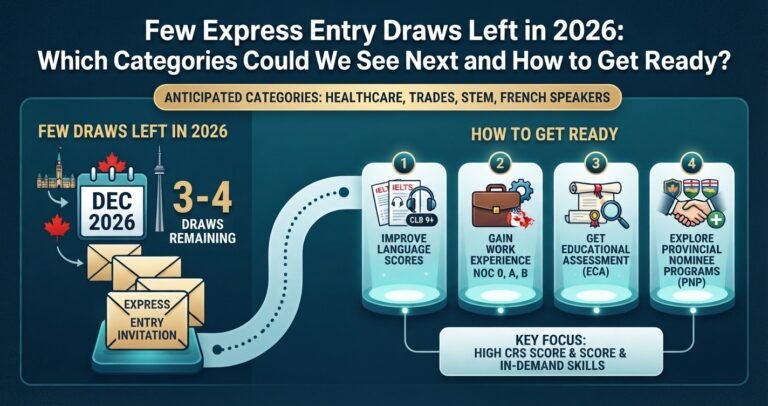
If you are currently in the Express Entry pool, there are several practical steps worth considering.
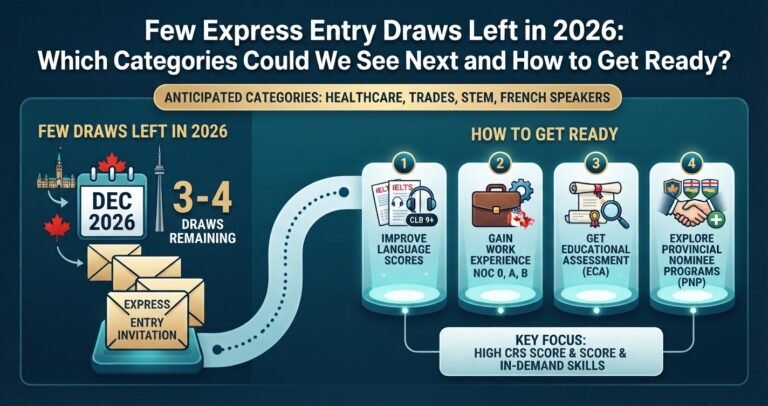
Improve your language results. Higher English or French test scores may increase your CRS points and potentially open additional eligibility options.
Explore Provincial Nominee Programs. An Express Entry-linked provincial nomination adds 600 CRS points after acceptance, although you must first qualify for and receive the nomination.
Review category-based eligibility. Check whether your work experience and qualifications meet an existing category’s requirements.
Check your NOC code carefully. Your occupation must reflect your actual employment duties, not simply a job title selected to match an immigration category.
Keep your profile accurate and updated. Make sure your language results, education, employment and other information remain correct.
Most importantly, do not make major career or education decisions based only on predictions about future Express Entry draws.
8. Will General Express Entry Draws 2026 would Return in 2027?
This is one of the biggest questions applicants are asking.
As of October 2026, there is no confirmed announcement that general Express Entry draws have been permanently eliminated.
IRCC still recognizes general draws as an available selection method.
However, recent invitation patterns suggest that targeted selection has become a central part of Express Entry.
Future draws will depend on immigration priorities, annual admission targets, labour market needs and government decisions.
It is possible that general draws could return, but applicants should not build their entire immigration strategy around that possibility.
9. Final Thoughts: Canada’s Express Entry System Is Becoming More Targeted
The shrinking role of General Express Entry Draws 2026 sends an important message to anyone planning to immigrate to Canada.
Having a strong CRS score is still valuable, but understanding the different immigration pathways is becoming equally important.
Some candidates may benefit from Canadian work experience. Others may qualify for provincial nomination, French-language selection or an occupation-based category.
For applicants outside Canada, the decline in general draws can create additional challenges, particularly if they do not qualify for targeted selection.
But it does not mean every immigration opportunity has disappeared.
At Eiffel Immigration Solutions, we encourage applicants to understand their eligibility, evaluate available pathways and prepare their applications based on current immigration requirements rather than speculation.
The future of Express Entry may be more targeted, but the right immigration strategy begins with understanding where your qualifications fit.