
You’ve received a job offer from a Canadian employer, but the company doesn’t have a Labour Market Impact Assessment (LMIA). Does that mean your opportunity to work in Canada is over?
Not necessarily.
Canada has several immigration pathways that allow eligible foreign nationals to obtain work permits without an LMIA. Some are based on international trade agreements, others support French-speaking workers, multinational companies or activities that provide significant benefits to Canada.
An LMIA exemption in Canada allows a qualifying foreign national to apply under a category where an employer does not need to obtain a Labour Market Impact Assessment from Employment and Social Development Canada (ESDC).
However, an LMIA exemption doesn’t mean that anyone with a job offer qualifies. Each exemption category has specific eligibility requirements, supporting documents and, in many cases, employer obligations.
This guide explains who may qualify for an LMIA-exempt work permit in Canada, the common exemption codes, how employers submit job offers, applicable fees and the application process.
LMIA Exemption Canada: Quick Facts
- Meaning: Certain eligible jobs and workers do not require an LMIA.
- Main program: International Mobility Program (IMP).
- Work permit: Usually still required unless a separate exemption applies.
- Employer compliance fee: Generally CAD $230 unless exempt.
- Worker processing fee: Generally CAD $155.
- Employer Portal: Normally required for employer-specific LMIA-exempt positions, subject to exceptions.
- Approval: Depends on meeting the applicable immigration requirements.
Table of Contents
- What is an LMIA exemption?
- LMIA vs. LMIA exemption
- Who qualifies for an LMIA exemption?
- Common LMIA exemption codes
- Employer requirements
- Documents required
- How to apply for an LMIA-exempt work permit
- Fees and processing times
- Open work permits and LMIA exemptions
- Common mistakes to avoid
- How Eiffel Immigration can help
- Frequently asked questions
1. What Is an LMIA Exemption in Canada?
When a Canadian employer wants to hire a temporary foreign worker, the employer may need a Labour Market Impact Assessment. This assessment helps determine the effect of hiring a foreign national on Canada’s labour market.
In many circumstances, employers apply for an LMIA through the Temporary Foreign Worker Program (TFWP).
However, certain foreign nationals can qualify for employment without an LMIA through the International Mobility Program (IMP).
The IMP includes work permit categories connected to Canada’s international agreements, economic interests, social or cultural benefits and other public policy objectives.
For example, an eligible multinational company may transfer a qualified employee to its Canadian operations under an applicable intra-company transfer category.
Similarly, an eligible French-speaking foreign national with a Canadian job offer outside Quebec may qualify through Francophone Mobility.
These exemptions do not eliminate the need to satisfy the relevant immigration requirements.
Official reference: IRCC International Mobility Program.
2. LMIA vs. LMIA Exemption: What’s the Difference?
The difference between an LMIA-based work permit and an LMIA-exempt work permit depends primarily on the legal immigration category under which the foreign national is hired.
| Feature | LMIA-Based | LMIA-Exempt |
|---|---|---|
| Program | Temporary Foreign Worker Program | Generally International Mobility Program |
| LMIA requirement | Generally required | Not required for eligible categories |
| Employer Portal | Not ordinarily used for the LMIA-based offer | Generally required for employer-specific IMP permits |
| Work permit | Normally required | Normally required unless separately exempt |
| Processing time | Varies by LMIA and permit application | Varies by exemption category and application |
An LMIA-exempt application may avoid the separate LMIA process, but it is not necessarily approved or processed faster.
3. Who Qualifies for an LMIA Exemption in Canada?
There is no single eligibility test that covers every LMIA-exempt work permit.
The correct category depends on the applicant’s employment history, proposed occupation, nationality where relevant, employer circumstances and the applicable immigration provisions.
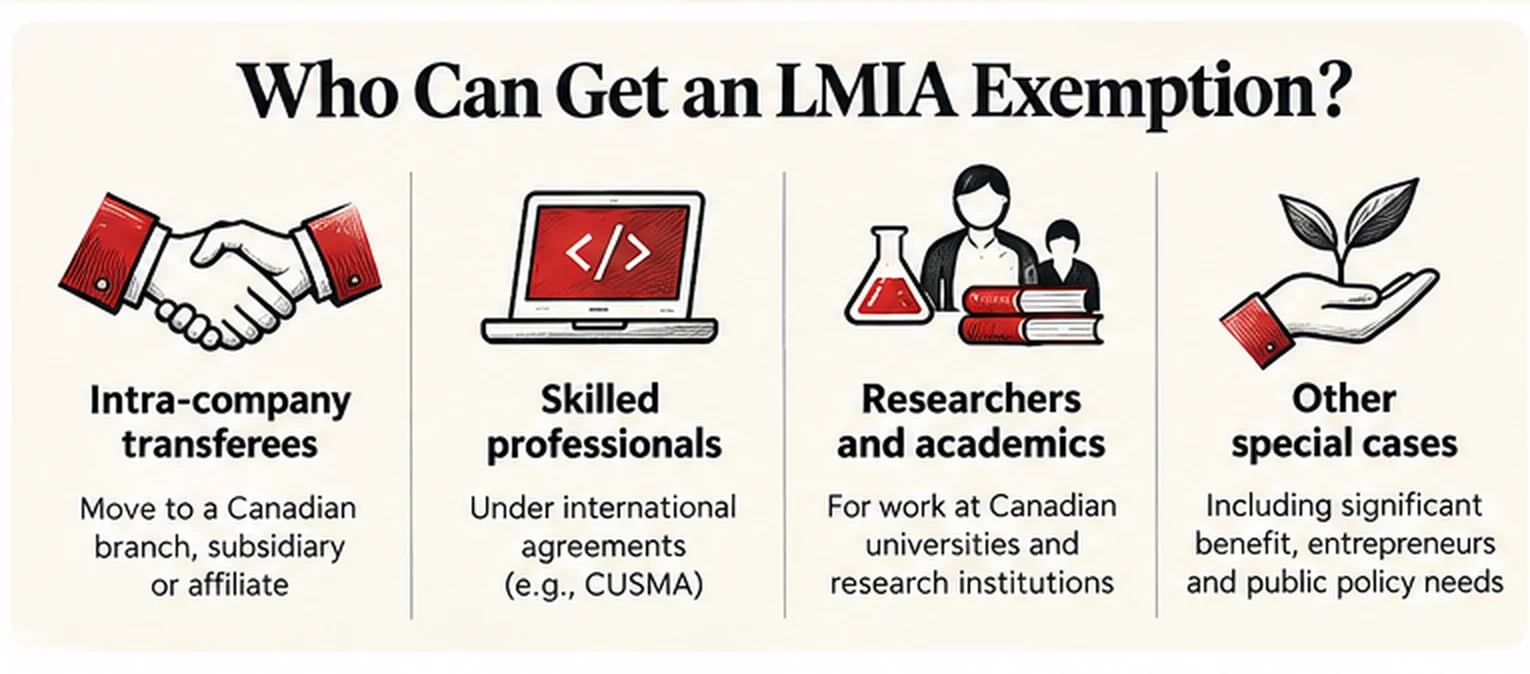
Intra-Company Transferees
Eligible foreign nationals employed by multinational companies may qualify for a transfer to a related Canadian business.
Depending on the applicable category, the applicant may need to demonstrate executive or managerial responsibilities, specialized knowledge or other qualifying employment characteristics.
The employer may need to provide documents proving the relationship between the foreign and Canadian entities.
A company operating in more than one country does not automatically qualify every employee for an intra-company transfer.
Professionals Under International Trade Agreements
Canada participates in international trade agreements that contain provisions for certain temporary business entrants.
For example, the Canada–United States–Mexico Agreement (CUSMA) provides LMIA-exempt options for certain eligible professionals, traders, investors and intra-company transferees.
Each agreement has its own requirements concerning nationality, occupation, qualifications and the intended activity in Canada.
Francophone Mobility Applicants
Francophone Mobility supports certain French-speaking foreign nationals who intend to work outside Quebec.
Eligible applicants generally must demonstrate French speaking and listening ability equivalent to at least NCLC level 5.
Most NOC TEER categories can qualify, although some primary agriculture occupations in TEER 4 and 5 are excluded.
The employer must normally submit the offer of employment under the appropriate Francophone Mobility exemption code.
Researchers and Academics
Some researchers and academic workers may qualify under specific LMIA exemptions, depending on the position, institution and nature of their work.
Other academic activities may fall under separate work-permit exemptions. Applicants must confirm the correct category rather than assuming that all research-related work is exempt.
Significant-Benefit Applicants
Some applicants may qualify where their work is expected to create a significant economic, social or cultural benefit for Canada.
These applications require persuasive evidence demonstrating the anticipated benefit.
Depending on the circumstances, supporting records may include business plans, achievements, employment history, financial documents, professional recognition and evidence explaining how the proposed activities will benefit Canada.
For more information about eligible categories, read IRCC’s International Mobility Program eligibility guidance.
4. Common LMIA Exemption Codes in Canada
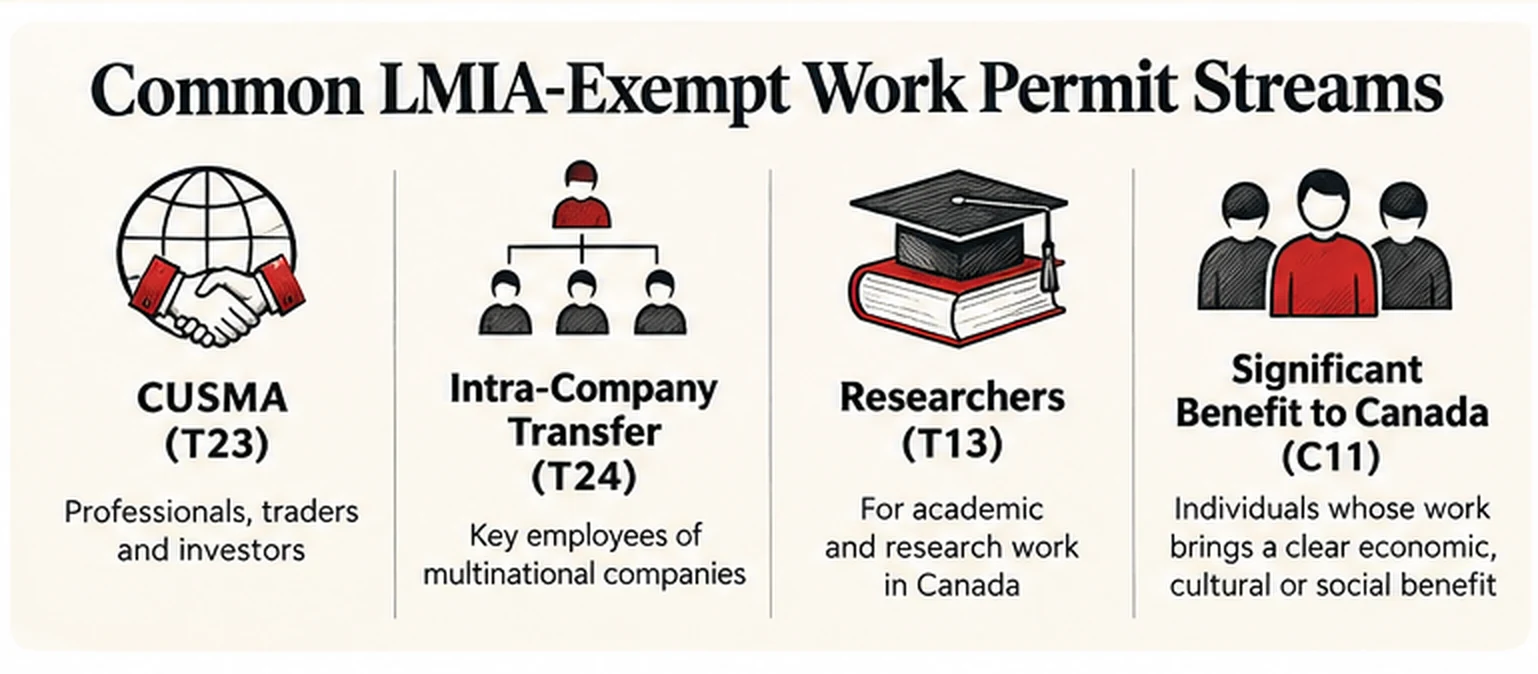
LMIA exemption codes identify the specific immigration provisions under which certain foreign nationals may apply for work authorization without an LMIA.
Not every exemption code is suitable for every job. The employer and applicant must meet the conditions attached to the selected category.
| Code | Category | Key Consideration |
|---|---|---|
| C16 | Francophone Mobility | Eligible French-speaking workers outside Quebec |
| T23 | CUSMA professionals | Specified eligible occupations and professional qualifications |
| T24 | CUSMA intra-company transferees | Qualifying company relationship and employee role |
| C10 | Significant benefit | Evidence of significant economic, social or cultural benefit |
These codes are examples, not an exhaustive list. Some exemptions have additional operational requirements and eligibility restrictions.
IRCC may update program instructions. Always confirm the applicable current requirements before submitting an offer or work permit application.
5. Employer Requirements for LMIA-Exempt Work Permits
One of the most common misunderstandings is that an LMIA exemption means the employer has no immigration responsibilities.
For most employer-specific LMIA-exempt work permits, the employer must complete specific steps before the employee submits an application.
Confirm the Exemption Category
The employer should establish that the position meets the requirements of the relevant LMIA exemption.
This may involve reviewing the applicant’s qualifications, job duties, business structure and any additional program-specific requirements.
Submit the Offer Through the Employer Portal
In most employer-specific cases, the employer must use IRCC’s Employer Portal to submit the offer of employment and related information.
The employer must select the appropriate exemption code and provide accurate details about the proposed position.
Pay the Employer Compliance Fee
Employers hiring foreign workers under employer-specific IMP categories generally pay a CAD $230 employer compliance fee unless an exemption applies.
This is separate from the worker’s work permit processing fee.
Provide the Offer of Employment Number
Following successful submission, the employer receives an offer of employment number that generally starts with the letter A followed by seven digits.
The employee uses this number in the work permit application when the Employer Portal process applies.
Comply With Employment Conditions
Employers must respect the applicable employment conditions and Canadian employment laws.
IRCC may inspect employers for compliance. An LMIA exemption does not remove these obligations.
Official resource: IRCC Employer Portal.
6. Documents Required for an LMIA-Exempt Work Permit
Documentation requirements vary by immigration category and the applicant’s individual circumstances.
However, applicants commonly need:
- Valid passport: To establish identity and relevant travel details.
- Employment offer: Details about duties, salary, employer and work location.
- Offer of employment number: When required for an employer-specific application.
- Employment records: Evidence of relevant professional experience.
- Educational qualifications: Degrees, credentials or licences where applicable.
- Exemption evidence: Documents demonstrating eligibility for the chosen category.
- Language evidence: Where the specific program requires language proficiency.
- Other supporting records: Medical examinations, biometrics or other documents where required.
For an intra-company transfer, supporting records may need to demonstrate the relationship between the businesses and the applicant’s previous employment.
For Francophone Mobility, the applicant must establish the required French-language ability.
For significant-benefit applications, supporting evidence must demonstrate why the proposed work meets the applicable significant-benefit criteria.
7. How to Apply for an LMIA-Exempt Work Permit in Canada
Step 1: Identify the Correct LMIA Exemption
Begin by determining which immigration provision matches the proposed work, employer and applicant’s circumstances.
Do not choose an exemption code merely because another applicant used it successfully.
Step 2: Confirm Employer Eligibility
The employer should review the relevant program requirements and determine whether the Employer Portal submission and compliance fee apply.
Step 3: Obtain Supporting Documents
Collect the employment agreement, credentials, work history and documents supporting the exemption.
Review all forms and records for consistency before submission.
Step 4: Complete the Work Permit Application
Applicants must follow the appropriate IRCC application process based on their location, category and eligibility.
Some eligible applicants may apply at a port of entry, while others must apply online. Not all foreign nationals are eligible to apply from within Canada.
Step 5: Pay the Applicable Government Fees
The standard work permit processing fee is generally CAD $155. Additional fees may apply depending on the applicant’s circumstances.
Step 6: Monitor the Application
After submission, monitor IRCC messages and respond to any requests within the specified deadlines.
Approval is not guaranteed simply because the employer has completed its obligations.
Step 7: Confirm Authorization Before Working
Do not begin working in Canada unless you are legally authorized under the applicable rules.
Applicants should review their work permit conditions carefully after approval.
For further details, see IRCC’s employer-specific work permit guidance.
8. LMIA-Exempt Work Permit Fees and Processing Times
| Fee | Amount |
|---|---|
| Work permit processing | CAD $155 |
| Employer compliance fee | Generally CAD $230, unless exempt |
| Open work permit holder fee | Generally an additional CAD $100 when applicable |
| Biometrics | Additional fee if required |
Processing times vary based on application location, work permit category and IRCC’s workload.
While avoiding the LMIA process can remove one step from employer recruitment, it does not guarantee that the immigration application will be processed faster.
For current information, consult the official IRCC fee schedule and processing-time tool.
9. Are Open Work Permits Also LMIA-Exempt?
Yes, eligible open work permit holders generally do not need an LMIA or an employer-specific job offer.
However, an open work permit and an employer-specific LMIA-exempt permit are not the same thing.
An employer-specific permit ordinarily restricts the worker to the employment conditions listed on the permit.
An open work permit generally provides greater flexibility to work for different employers, subject to the permit’s conditions and applicable restrictions.
Examples of people who may qualify for open work permits include:
- Eligible post-graduation work permit applicants.
- Eligible spouses or partners under certain immigration programs.
- Applicants qualifying for bridging open work permits.
- Eligible International Experience Canada participants.
Open work permit eligibility depends on the relevant immigration program and current IRCC rules.
Read the official open work permit guidance.
10. Common LMIA Exemption Mistakes to Avoid
Even where an applicant may qualify for an LMIA exemption, incorrect assumptions or weak supporting documents can create serious problems.
Assuming Every Job Offer Is LMIA-Exempt
The employer’s willingness to hire does not establish an exemption. A qualifying immigration provision must apply.
Using the Wrong Exemption Code
Exemption categories have different eligibility requirements. Selecting the wrong code may lead to a refusal or further requests for clarification.
Skipping Employer Portal Requirements
Many employer-specific LMIA-exempt applications require an offer submission and employer compliance fee before the worker applies.
Submitting Inconsistent Employment Records
Job duties, employment dates and qualifications should be consistent across the application and supporting documents.
Assuming LMIA-Exempt Means Automatic Approval
IRCC still assesses eligibility, admissibility and the supporting evidence for the selected work permit category.
Starting Employment Without Authorization
Submitting a work permit application does not automatically permit someone to begin working in Canada.

If you have already received a refusal, read Eiffel Immigration’s Canada Work Permit Refusal: Reasons, Options and Next Steps.
11. Example: Hiring a French-Speaking Worker Without an LMIA
Consider a hypothetical employer in Ontario who wants to hire a qualified French-speaking foreign worker.
If the applicant meets the requirements of Francophone Mobility, including the necessary French speaking and listening proficiency, the position may qualify under exemption code C16.
In most cases, the employer would submit the offer through the Employer Portal and pay the applicable employer compliance fee.
The applicant would then apply for the appropriate work permit and provide evidence supporting their eligibility.
The final decision would depend on IRCC’s assessment of the application.
This example demonstrates why the correct exemption category, employer documentation and applicant eligibility must all align.
12. How Eiffel Immigration Solutions Can Help
Many applicants find LMIA exemptions confusing because several categories appear similar but have different immigration requirements.
At Eiffel Immigration Solutions, our team helps applicants and employers understand Canadian immigration pathways and the documents required for eligible applications.
Our services include reviewing immigration profiles, exploring potential work permit categories, identifying supporting documents and assisting with applicable work permit processes.
Applicants facing previous refusals or complicated immigration histories may also benefit from a detailed case assessment.
To understand the difference between professional service charges and government fees, read our Immigration Consultant Fees in Canada guide.
EIFFEL IMMIGRATION SOLUTIONS
Not Sure If Your Job Qualifies for an LMIA Exemption?
Understand your immigration options before submitting an application. Our team can help you identify the information and documents relevant to your circumstances.
Start with a free introductory 15-minute phone consultation with a case manager, or book a detailed consultation with a regulated immigration consultant.
Call 905-606-0363
Frequently Asked Questions About LMIA Exemption in Canada
What is an LMIA exemption in Canada?
An LMIA exemption allows an eligible foreign worker to apply under a category that does not require the employer to obtain a Labour Market Impact Assessment. The relevant immigration requirements must still be satisfied.
Can I get a work permit in Canada without an LMIA?
Yes. Applicants who qualify under an LMIA-exempt category, or for an eligible open work permit, may be able to obtain work authorization without an employer obtaining an LMIA.
Does an LMIA exemption mean I can work without a work permit?
No. LMIA exemptions and work permit exemptions are different. Most LMIA-exempt foreign workers still need a valid work permit.
What are common LMIA exemption codes in Canada?
Examples include C16 for Francophone Mobility, T23 for eligible CUSMA professionals, T24 for certain CUSMA intra-company transferees and C10 for significant-benefit cases.
How much does an LMIA-exempt work permit cost?
The usual worker processing fee is CAD $155. For most employer-specific applications under the International Mobility Program, the employer must also pay a CAD $230 compliance fee unless exempt. Other fees may apply.
Is Francophone Mobility LMIA-exempt?
Yes. Eligible French-speaking foreign nationals with qualifying employment outside Quebec may apply under Francophone Mobility without an LMIA.
Does the employer need to use the Employer Portal?
For most employer-specific LMIA-exempt applications, yes. However, certain exemptions and special processes apply.
Is LMIA-exempt work permit processing faster?
Not necessarily. Avoiding the LMIA process does not guarantee a faster IRCC decision.
Can an LMIA-exempt work permit help with permanent residence?
In some cases, qualifying Canadian work experience may support eligibility for a permanent residence program. However, an LMIA-exempt work permit does not automatically establish permanent residence eligibility or provide CRS points.
What should I do if my LMIA-exempt work permit is refused?
Review the refusal letter and officer decision notes where available. Depending on your circumstances, options may include a stronger reapplication, a reconsideration request or legal advice about judicial review. Status and deadlines are important.
Official Government Sources
- IRCC — International Mobility Program
- IRCC — Who Can Be Hired Through the IMP
- IRCC — Employer Portal
- IRCC — Employer-Specific Work Permits
- IRCC — Open Work Permits
- IRCC — Application Fees
Related Reading
Disclaimer: This article provides general immigration information and does not replace advice tailored to individual circumstances. Immigration requirements may change. IRCC is responsible for determining eligibility and making immigration decisions.
Talk it through with an Eiffel case worker
Eiffel Immigration has helped families come to Canada since 2019. Book a free 15-minute call and a case worker will explain what this change means for you. For a full profile review, ask about our $170 flat-rate consultation.
This article is general information, not legal advice. Confirm details with IRCC or a regulated consultant before you act.