
If your Canadian work permit was refused, you usually have four options: reapply with new information, ask for reconsideration, challenge the decision in Federal Court, or restore your status if you are in Canada and it has lapsed. The right one depends on the reason in your refusal letter, whether you are inside or outside Canada, and how many days have passed. This guide explains each route, the deadlines that matter and what you can and cannot do in the meantime.
TL;DR
-
Read the refusal letter and the officer’s notes first. They state the reasons, and every next step depends on them.
-
IRCC lets you apply again at any time unless the letter says otherwise, but you should only do so with information you did not include before.
-
If you are in Canada and lost your status, you generally have 90 days to apply for restoration, and you must not work until it is granted and a new permit is issued.
-
Reconsideration is discretionary and not a formal appeal. Federal Court judicial review has very short deadlines, so speak to a lawyer immediately.
-
A refusal is not always the end of the road. A clear fix for the stated reason, usually better evidence, is what turns a second application around.
Table of Contents
Why work permits get refused
IRCC publishes the grounds on which an officer may refuse a work permit. According to IRCC’s guidance on what happens after you apply, refusal reasons include:
-
you are not eligible for the permit category you applied under
-
you are inadmissible to Canada
-
the application is incomplete
-
you lack sufficient funds
-
the job offer is not genuine
-
you did not show enough proof of the skills or education the job needs
-
the stream was discontinued or the policy revoked
-
you gave untruthful answers
-
you broke the conditions of an earlier permit
-
you overstayed
The Canadian Immigration Lawyers Association adds that refusal concerns commonly involve the purpose of travel, financial support, family or economic ties to your country of residence, whether you will leave when your stay ends, and insufficient or inconsistent documents.
In practice these cluster into a few patterns.
Incomplete or inconsistent documents
The most avoidable cause. IRCC says an incomplete application may be refused after the processing centre checks whether all required documents were supplied. Inconsistency is just as damaging: a job title on the offer letter that does not match the duties on your reference letter, or dates that do not line up between your resume and your pay records.
Doubts about the job or the employer
Officers look at whether the offer is genuine and whether the duties fit the occupation code used. A vague offer letter, a wage that does not fit the role or a mismatch between the job and your background invites questions.
Not enough proof you can do the work
The burden is on you. In Sangha v. Canada, 2020 FC 95, the Federal Court confirmed that the applicant must provide enough evidence to show they can perform the proposed work. The Court upheld a refusal where the evidence did not adequately establish skills and language ability for long-haul truck driving. Certificates, reference letters on company letterhead and proof of language ability all belong in the file when the job requires them.
Funds, ties and intent to leave
For temporary permits, officers must be satisfied that you will leave Canada when your authorized stay ends. Weak ties to your home country, unclear financial support or an unexplained gap in your history can all feature in the reasons.
Admissibility and past compliance
A criminal or medical issue, misrepresentation, a past overstay or working outside permit conditions can lead to refusal. These cases need careful handling, and in some, other tools such as a temporary resident permit may be relevant. See our guide to the TRP for inadmissible applicants.
Read the refusal letter and the officer’s notes
Before deciding anything, work out exactly why the officer said no. Since July 29, 2025, IRCC says most refused temporary resident applications, including work permits and extensions, receive the refusal letter together with the officer’s notes explaining the reasons. Some portions may be removed for security, privacy or other reasons.
When you read both, do three things:
-
Identify the exact ground cited (eligibility, genuineness, funds, documents, admissibility).
-
Compare it with your submitted file. Was the evidence missing, or was it there and overlooked?
-
Check whether the letter places any restriction on reapplying.
If you want to understand the wider record, our article on how GCMS notes help your case explains what those notes contain and how they are used.
Can you keep working after a refusal?
This is the question that carries the most risk if you get it wrong.
If your temporary resident status has expired, you lose authorization to work, and working without a required work permit is illegal. Working while your extension application was pending is only lawful in specific situations, and a refusal ends it.
Post-graduation work permit applicants are a clear example. IRCC’s guidance says an eligible graduate may work while the application is processing only if conditions are met, including holding a valid study permit when applying, completing the program and having been eligible to work off campus. If the permit is refused, you must stop working on the day IRCC gives notice.
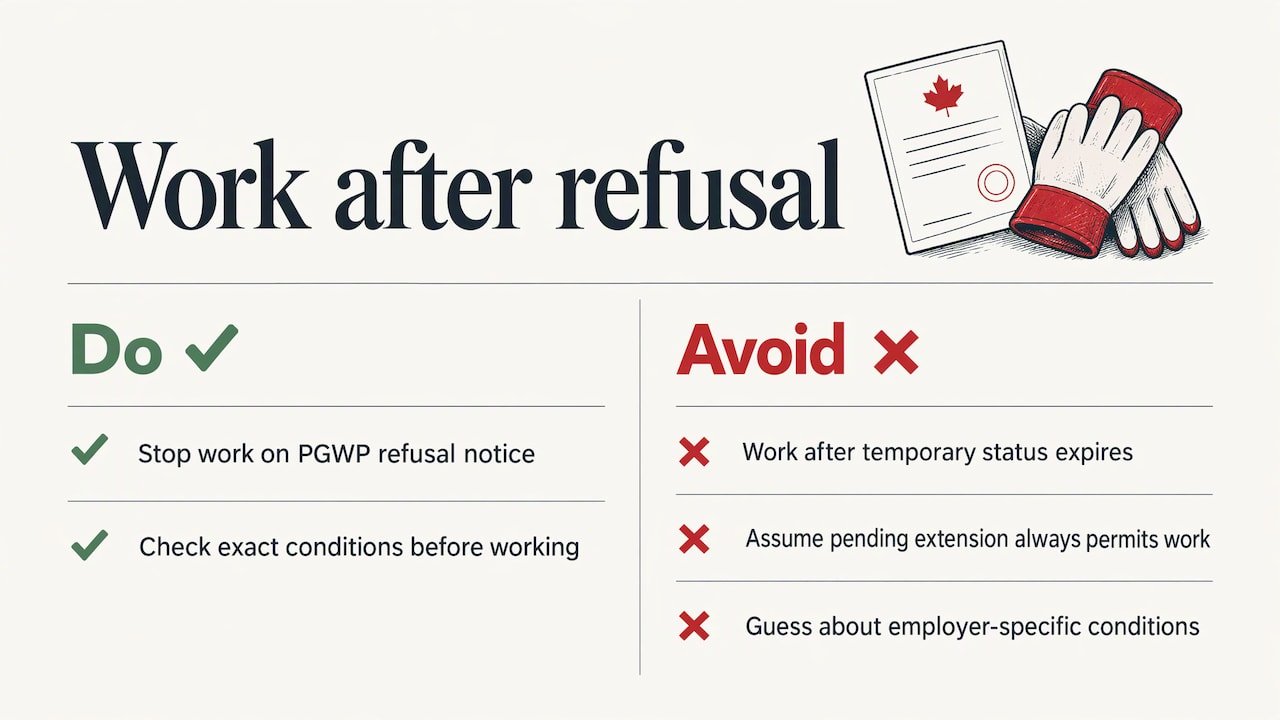
If you applied to extend an employer-specific permit before it expired, your situation depends on the exact conditions of your stay. Do not guess. Our guide on working in Canada without a work permit covers the situations in which work is and is not allowed. If you may qualify for a bridging permit before a refusal happens, read about the bridging open work permit.
Your options after a refusal
| Option | Best when | Key point |
|---|---|---|
| Reapply | The refusal reason can be fixed with new evidence | Allowed at any time unless the letter says otherwise |
| Restoration of status | You are in Canada and your status has lapsed | Generally within 90 days |
| Reconsideration request | The record shows a clear factual or legal error | Discretionary, not a formal appeal |
| Federal Court judicial review | The decision was unreasonable or procedurally unfair | Leave required, very short deadlines |
Option 1: Reapply with stronger evidence
IRCC says that if it refuses your application, you can apply again at any time unless your decision letter says you cannot. It also says you should only reapply if you can include information you did not include before. Resubmitting the same record usually produces the same result.
A practical way to prepare a second application:
-
Write the refusal reason in one sentence.
-
List the documents that directly answer it.
-
Fix inconsistencies between forms, letters and supporting records.
-
Add a clear explanation letter where something in your history needs context.
-
Confirm that the stream you are applying under is still open.
Officers may also request an interview, a medical exam, a police certificate or additional information before deciding, so keep those documents current and ready. For a step-by-step walkthrough, see our guide to reapplying after a visa refusal.
Option 2: Restore your status if you are in Canada
If you lost temporary resident status, IRCC generally allows restoration within 90 days if you meet the restoration conditions. You may normally stay while the application is processed, but you must not work until status is restored and a new work permit is issued. If restoration is refused, you must leave Canada. After the 90-day period, you generally must leave and reapply from outside the country.
The timing detail matters: IRCC says an online restoration application must be submitted before midnight Coordinated Universal Time on the 90th day. Paper applications are dated when the case processing centre receives them. Do not leave this to the last evening.
IRCC’s Help Centre gives the same pattern for a work permit that expired without a timely extension: you may apply to restore within the first 90 days, may remain while waiting for instructions, but must stop working until a restored permit arrives.
A related trap: IRCC says an application rejected as incomplete is treated as never submitted. That means maintained status is not preserved, and a later application after your permit expires may require restoration.
Option 3: Ask for reconsideration
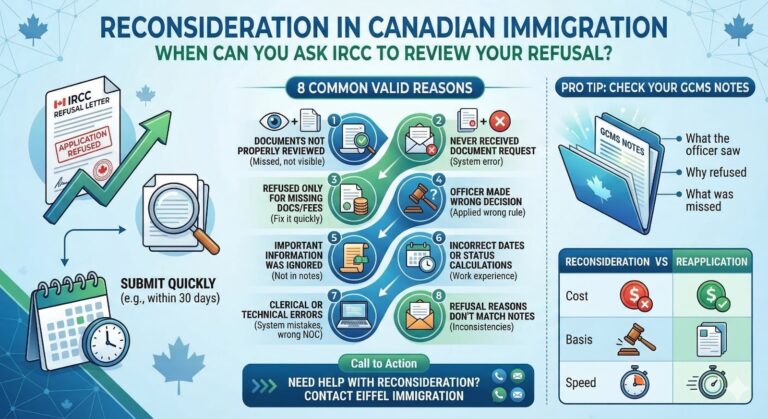
A reconsideration request is discretionary and is not a formal appeal. According to the Canadian Immigration Lawyers Association, it is most relevant where the record shows a clear factual or legal error, overlooked evidence or a misunderstanding of material circumstances. It is not a second chance to add documents you forgot. Our reconsideration guide explains when it is worth requesting.
Option 4: Federal Court judicial review
Judicial review is not a new work permit application. The Court looks at whether the decision was lawful, reasonable and procedurally fair. It does not substitute its own view of the evidence, and disagreement with the officer’s assessment is not, by itself, a ground. Sangha makes that point directly.
Deadlines are short. They are reported as 15 days for decisions arising in Canada and 60 days for decisions arising outside Canada, and a reconsideration request does not safely pause the clock. Because the time is so limited, speak to a lawyer about judicial review as soon as you receive the refusal. Our article Refusal Letter: Resubmit Or Appeal? helps you compare the routes.
Which route fits which reason
| Reason in the letter | Typical response |
|---|---|
| Missing documents | Reapply with a complete, indexed file |
| Inconsistent information | Align forms, letters and records, explain any gap, then reapply |
| Job offer not genuine or duties unclear | Obtain a detailed offer letter and employer documents that match the role |
| Insufficient proof of skills or language | Add certificates, references and test results that match the job requirements |
| Insufficient funds | Provide clear, recent proof of funds and support |
| Ties or intent to leave | Document your home-country ties and your plans for the end of the stay |
| Stream closed or policy changed | Look for a different permit category or pathway |
| Inadmissibility | Get a case assessment before any new filing |
If the stream itself changed, check current policy before you refile. Our page on why low-wage LMIA applications are being refused shows how a policy change can end a route entirely.
Mistakes that make a second refusal likely
-
Reapplying within days with the same documents. IRCC’s own advice is to include new information.
-
Working while status is lapsed. This can create inadmissibility problems that are harder to solve than the original refusal.
-
Waiting to read the notes. The reasons are usually in the file you already have.
-
Changing the story. A second application that contradicts the first raises misrepresentation questions.
-
Missing the 90-day restoration limit or a court deadline. These cannot be extended by good intentions.
-
Relying on forum advice. Public threads often suggest tactics that jeopardize status. Your facts are specific to you.
Our perspective
We read refusal letters every week, and the pattern is consistent: most refusals trace back to a gap between what the applicant could prove and what the officer needed to see. The applicant often qualified in substance but did not show it on paper.
That is why we start with the refusal reasons and the officer’s notes, then rebuild the file around them. Every file at Eiffel Immigration Solutions is handled by a licensed and accredited consultant, and we provide a written fee agreement before you pay anything.
We also tell you the risks plainly. Some refusals call for a stronger reapplication, some for restoration within 90 days, and some for a lawyer and the Federal Court. Knowing which one applies in the first week is worth more than any single document.
LB
How Eiffel Immigration Solutions can help
We are a licensed immigration consultancy in the Greater Toronto Area. Our services include a full profile review, work permit applications (LMIA and LMIA-exempt, spousal open work permits and post-graduation work permits) and refusal review and reapplication. The first consultation is free, and we explain your options and the risks before any retainer is signed.
Book a free consultation through our full profile review page, or see all the programs we handle on our services page. Bring your refusal letter and the officer’s notes, along with your original application.
What to do in the first week
-
Day 1: Save the refusal letter and officer’s notes. Note the date IRCC gave notice.
-
Day 1: If you are working, confirm whether you may legally continue. If in doubt, stop and get advice.
-
Days 2 to 3: Compare the reasons with your file and list what was missing or unclear.
-
Days 3 to 5: Decide the route: reapply, restore, request reconsideration or consult a lawyer on judicial review.
-
Before day 15: If a court challenge is possible and you are in Canada, make sure a lawyer has reviewed the case.
-
Within 90 days: If you need restoration, file well before the deadline.
FAQ
How soon can I reapply after a work permit refusal?
IRCC says you can apply again at any time unless your decision letter says you cannot. It also advises reapplying only when you can include information you did not provide before. Fix the reason for refusal first, then file.
Can I work in Canada after my work permit is refused?
Not if your status has expired or your authorization depends on the refused application. IRCC says working without a required permit is illegal, and PGWP applicants must stop working on the day they are notified. If you are restoring status, you must wait until a new permit is issued.
Is a work permit refusal the same as a rejection?
No. IRCC treats an application rejected as incomplete as if it was never submitted, which affects maintained status. A refusal is a decision on the merits with reasons attached. The difference changes your next steps, so check the wording in your letter.
Can I appeal a work permit refusal?
There is no formal appeal. You can ask for discretionary reconsideration, reapply, or seek judicial review in the Federal Court, which looks at the legality and fairness of the decision rather than re-deciding your case. Court deadlines are very short, so see a lawyer quickly.
Sources
-
IRCC Help Centre: If my application is refused, do I have to wait?
-
IRCC: Explaining application refusals, officer decision notes
-
IRCC Help Centre: My work permit expired and I did not apply to extend it
Recommended
Talk it through with an Eiffel case worker
Eiffel Immigration has helped families come to Canada since 2019. Book a free 15-minute call and a case worker will explain what this change means for you. For a full profile review, ask about our $170 flat-rate consultation.
This article is general information, not legal advice. Confirm details with IRCC or a regulated consultant before you act.