
Canada has officially introduced a new Comprehensive Ranking System (CRS) scoring structure for Express Entry. Effective November 3, 2026, the changes reward eligible Canadian work experience in high-wage occupations and qualifying job offers, while removing the LMIA requirement for Express Entry job offers.
For thousands of candidates waiting in the Express Entry pool, the changes could affect their CRS ranking and permanent residence strategy.
But there is an important catch: earning a high salary does not automatically qualify someone for additional points. The new system evaluates occupations using their National Occupational Classification (NOC) codes and wage categories.
Here is what changed, how the new points are calculated and what Express Entry candidates should check now.
The new Labour Market Integration factor awards points for eligible Canadian work experience or a qualifying high-wage job offer. If a candidate qualifies under both options, IRCC uses whichever produces the higher score. The points cannot be added together.
New CRS Points System 2026: What Changed on November 3?
The new CRS points system places additional emphasis on candidates who have established themselves in Canada’s labour market or have qualifying job offers in eligible high-wage occupations.
Three major changes have taken effect:
- High-wage Canadian work experience: Eligible candidates may receive 20, 40 or 70 additional CRS points.
- Qualifying job offers: Job offers in eligible high-wage occupations may provide 50, 70 or 100 CRS points.
- LMIA requirements: A Labour Market Impact Assessment is no longer required for Express Entry job-offer eligibility or CRS job-offer points.
IRCC is also recalculating existing Express Entry profiles to reflect the changes. This process could take up to two weeks, and invitation rounds are temporarily paused during the transition.
What Counts as a High-Wage Job Under the New CRS?
One of the biggest misconceptions about the new Express Entry system is that a candidate’s individual salary determines eligibility for high-wage points.
That is not how the updated system works.
IRCC evaluates the national median wage associated with an occupation’s five-digit NOC code and compares it with the average median wage of the Canadian workforce.
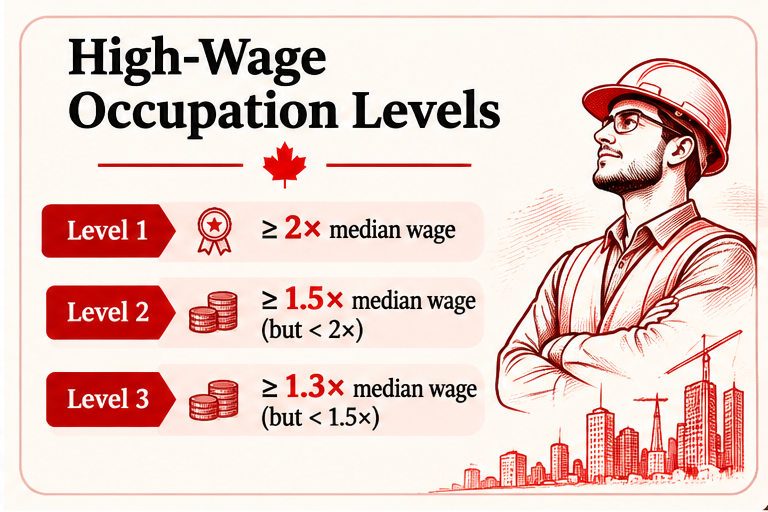
The high-wage occupation list has three levels.
| High-wage level | Occupation wage threshold |
|---|---|
| Level 1 | At least 2 times the benchmark median wage |
| Level 2 | At least 1.5 times but below 2 times |
| Level 3 | At least 1.3 times but below 1.5 times |
For example, someone earning $100,000 annually will not automatically qualify if their occupation is not included on IRCC’s official high-wage occupation list.
Before estimating your new CRS points, verify the correct NOC code and its classification using the
official IRCC high-wage occupation list.
New Canadian Work Experience CRS Points in 2026
Canadian work experience remains an important part of Express Entry. Under the new system, candidates can receive points based on the duration of eligible Canadian work experience, along with a possible bonus for working in qualifying high-wage occupations.
Canadian Work Experience Length Points
| Canadian experience | Without spouse | With spouse |
|---|---|---|
| Less than 1 year | 0 | 0 |
| 1 year | 40 | 35 |
| 2 years | 53 | 46 |
| 3 years | 64 | 56 |
| 4 years | 72 | 63 |
| 5 years or more | 80 | 70 |
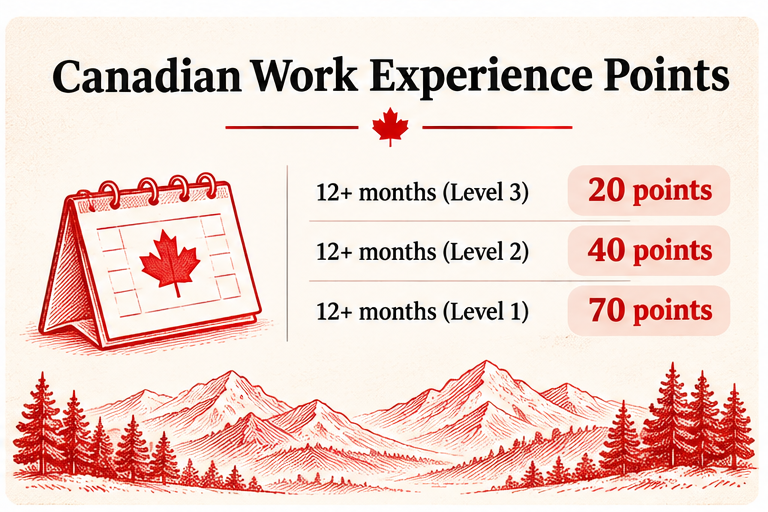
Candidates with at least 12 months of qualifying Canadian experience in eligible high-wage occupations may receive bonus points.
Additional High-Wage Work Experience Bonus
| Qualifying experience | Additional CRS points |
|---|---|
| At least 12 months in Level 1 occupations | 70 |
| At least 12 months at Level 2 or above, if not eligible for 70 points | 40 |
| At least 12 months at Level 3 or above, if not eligible for 40 or 70 points | 20 |
| Less than 12 months of qualifying high-wage experience | 0 bonus points |
Eligible experience generally must have been acquired in Canada during the previous 10 years in a qualifying TEER 0, 1, 2 or 3 occupation. Specific exceptions and conditions may apply.
Example: How Canadian Work Experience Points Are Calculated
Consider an Express Entry candidate without an accompanying spouse who has completed one year of eligible Canadian work experience in a Level 2 high-wage occupation.
- Canadian work-length points: 40
- High-wage occupation experience bonus: 40
- Total Labour Market Integration points: 80
These 80 points are part of the candidate’s overall CRS score, which also considers factors such as language ability, education and skill transferability.
Candidates without an accompanying spouse can receive up to 150 points for eligible Canadian work experience under the Labour Market Integration factor. The maximum is 140 for candidates with an accompanying spouse.
New Job Offer CRS Points: 50, 70 or 100
Another major change is the reintroduction of CRS points for qualifying job offers.
Unlike the previous approach, the updated scoring system considers the high-wage category of the offered occupation rather than simply awarding points for holding a job offer.
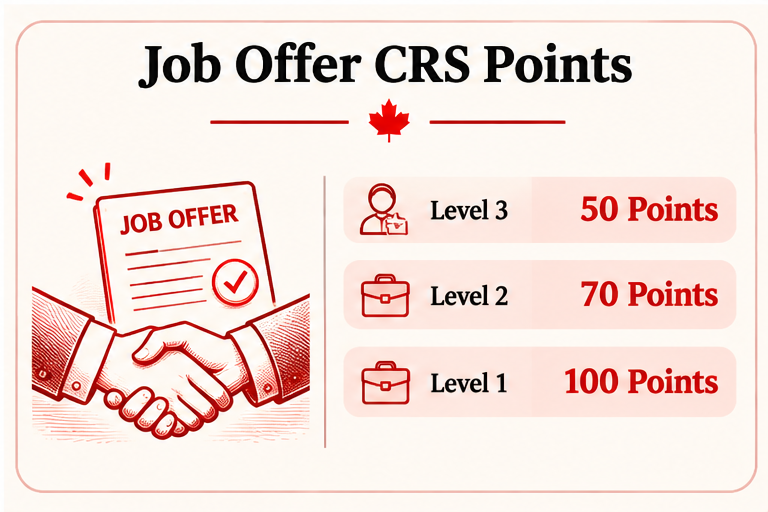
| Occupation category | Job-offer CRS points |
|---|---|
| Level 1 — at least 2 times the median wage | 100 |
| Level 2 — at least 1.5 times the median wage | 70 |
| Level 3 — at least 1.3 times the median wage | 50 |
| Occupation outside the high-wage list | 0 |
A qualifying job offer generally must be for full-time, continuous work in Canada for at least one year after the candidate becomes a permanent resident.
Additional requirements may apply to certain occupations and Express Entry programs.
Can You Combine Job Offer and Work Experience Points?
No. The new Labour Market Integration factor compares the points available through eligible Canadian work experience against those available through a qualifying job offer.
For example, if a candidate qualifies for 80 points through Canadian work experience and 70 points through a job offer, IRCC awards 80 points under this factor.
The candidate does not receive 150 points by adding the two options together.
Is an LMIA Still Required for Express Entry in 2026?
As of November 3, 2026, an LMIA is no longer required for a qualifying Express Entry job offer to establish program eligibility or receive applicable CRS points.
Having an LMIA also does not provide additional CRS points or priority within the Express Entry pool.
However, this does not mean every employment offer automatically qualifies.
IRCC officers must still determine whether the job offer is genuine. They may consider whether:
- The employer is actively operating a legitimate business.
- The offered position meets a reasonable business need.
- The employer can fulfill the employment terms.
- The employer has complied with employment and recruitment laws.
- The candidate is qualified and able to perform the work.
These Express Entry changes do not eliminate LMIA requirements that may apply under other Canadian temporary foreign worker processes.
Why Did My CRS Score Change After November 3, 2026?
Candidates who already have Express Entry profiles may notice changes to their CRS scores as IRCC recalculates points under the new system.
IRCC has indicated that this transition could take up to two weeks. Invitation rounds are temporarily paused during the recalculation.
If your score changes unexpectedly, review the information in your Express Entry profile before assuming the new score is final.
What If the Express Entry Portal Still Asks for an LMIA?
IRCC has acknowledged that some online fields have not yet been updated to reflect the removal of LMIA requirements.
Applicants with qualifying job offers should follow IRCC’s current instructions for completing the relevant fields, even where the portal continues to display older LMIA questions.
For the latest instructions, visit the
official Express Entry CRS criteria page.
Which Occupations Qualify for High-Wage CRS Points?
IRCC’s high-wage occupation list includes selected positions across management, healthcare, engineering, technology, education and skilled trades.
However, not every occupation within these industries qualifies.
Candidates should verify their exact NOC code, job duties and official high-wage classification before claiming or estimating additional CRS points.
You can also explore Eiffel Immigration’s
Self-Immigration Toolkit
for helpful immigration resources and official government links.
What Should Express Entry Candidates Do Now?
- Verify your NOC code. Make sure your actual employment duties correspond to the correct occupation.
- Check your high-wage level. Confirm whether the occupation is listed at Level 1, Level 2 or Level 3.
- Review Canadian work experience. Calculate eligible work duration and ensure your records are accurate.
- Review any job offer. Confirm whether it meets the updated Express Entry requirements.
- Check your recalculated CRS score. Review the profile after IRCC’s transition is completed.
- Prepare supporting documentation. Maintain accurate employment letters, work-history records and other evidence.
Remember that receiving additional CRS points does not guarantee an Invitation to Apply. Candidates must still meet applicable program requirements and the cut-off score of an invitation round.
How Eiffel Immigration Can Help
The new CRS points system creates opportunities for some Express Entry candidates, but it also makes accurate occupation classification, work-experience records and job-offer information more important.
At Eiffel Immigration Solutions, our team can review your immigration circumstances, help you understand potential Express Entry eligibility and explain available permanent residence options.
Could the New CRS System Improve Your Express Entry Score?
Not sure whether your Canadian work experience or job offer qualifies for additional points? Get professional guidance before making important changes to your immigration profile.
Frequently Asked Questions About the New CRS Points System
When did the new CRS points system take effect?
The changes came into effect on November 3, 2026.
How many extra CRS points can Canadian work experience provide?
Eligible high-wage work experience may provide 20, 40 or 70 additional CRS points. These are awarded in addition to applicable Canadian work-length points.
How many CRS points can I receive for a job offer?
A qualifying job offer in an eligible high-wage occupation can provide 50, 70 or 100 points depending on the occupation’s wage category.
Can I combine job-offer points and Canadian work-experience points?
No. IRCC compares the eligible totals and awards whichever option provides the higher Labour Market Integration score.
Do I still need an LMIA for Express Entry?
An LMIA is no longer required for qualifying Express Entry job offers as of November 3, 2026. However, other job-offer and program eligibility requirements still apply.
Does a high personal salary automatically qualify for CRS bonus points?
No. The occupation must appear on IRCC’s high-wage list. The classification is based on national occupational wage data rather than the candidate’s individual salary.
Will every Express Entry candidate receive more CRS points?
No. The effect depends on each candidate’s qualifying Canadian work experience, occupation classification, job-offer eligibility and other CRS factors.
Will Express Entry draws resume after recalculation?
IRCC has stated that invitation rounds will resume once the profile recalculation is complete. Candidates should monitor official IRCC announcements for confirmation.
Official Government Sources
IRCC — Changes to Canadian Work Experience and Job Offer Points
IRCC — High-Wage Occupations and Eligibility
IRCC — Express Entry Job Offer Requirements
IRCC — Official High-Wage Express Entry Announcement
Last updated: November 6, 2026. This article provides general immigration information and should not be treated as personalized legal advice. Immigration requirements and government policies may change.
Talk it through with an Eiffel case worker
Eiffel Immigration has helped families come to Canada since 2019. Book a free 15-minute call and a case worker will explain what this change means for you. For a full profile review, ask about our $170 flat-rate consultation.
This article is general information, not legal advice. Confirm details with IRCC or a regulated consultant before you act.