

Canada immigration levels plan comparison reveals an important shift in the country’s immigration strategy. The newer 2027-2029 plan increases permanent residence targets for 2027 while substantially reducing the target for new international student arrivals.
The original 2025-2027 plan, released by Immigration, Refugees and Citizenship Canada (IRCC) in October 2024, projected 365,000 permanent resident admissions in 2027.
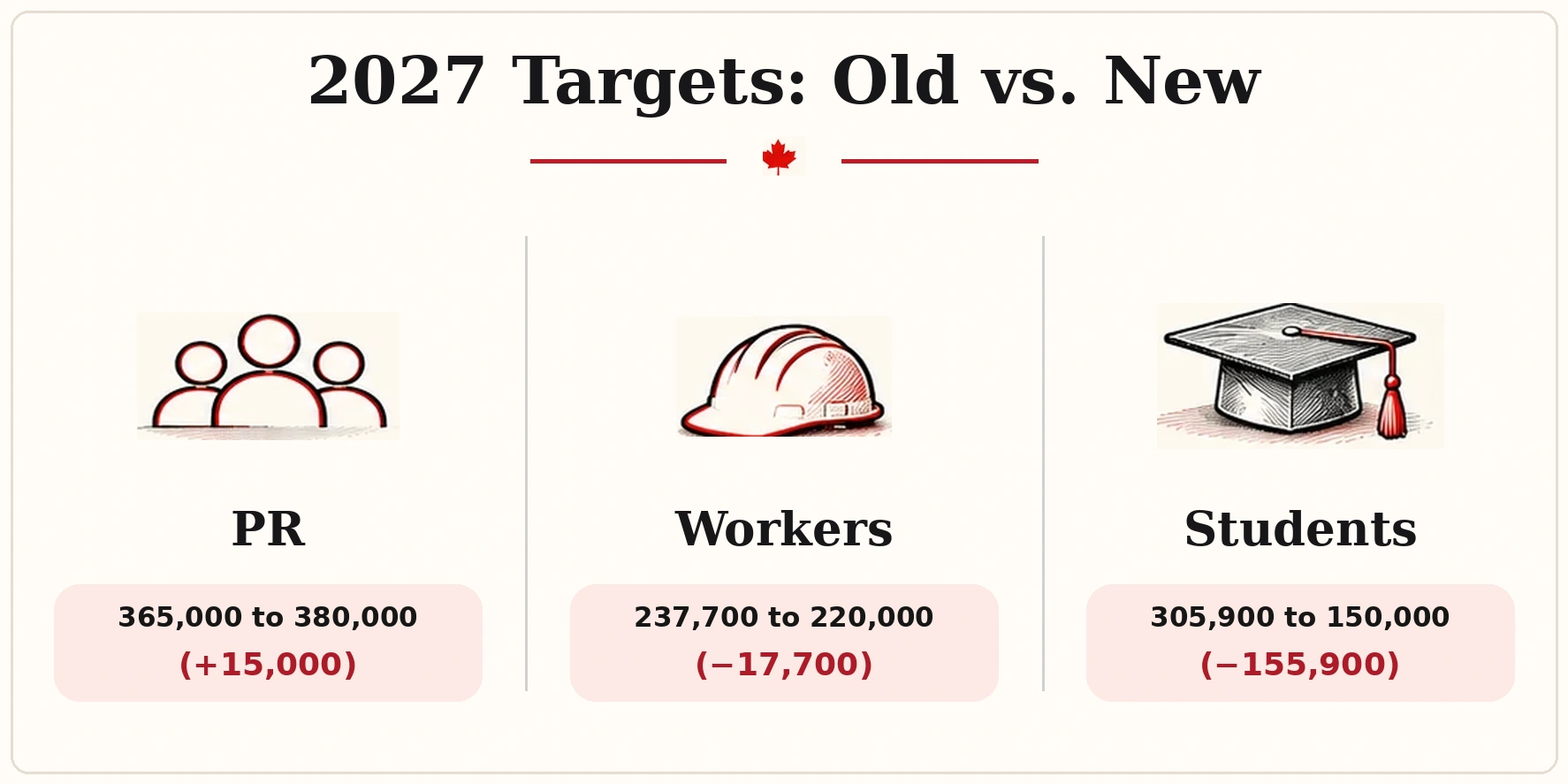
The newer 2027-2029 plan sets the permanent residence target for the same year at 380,000, an increase of 15,000 planned admissions.
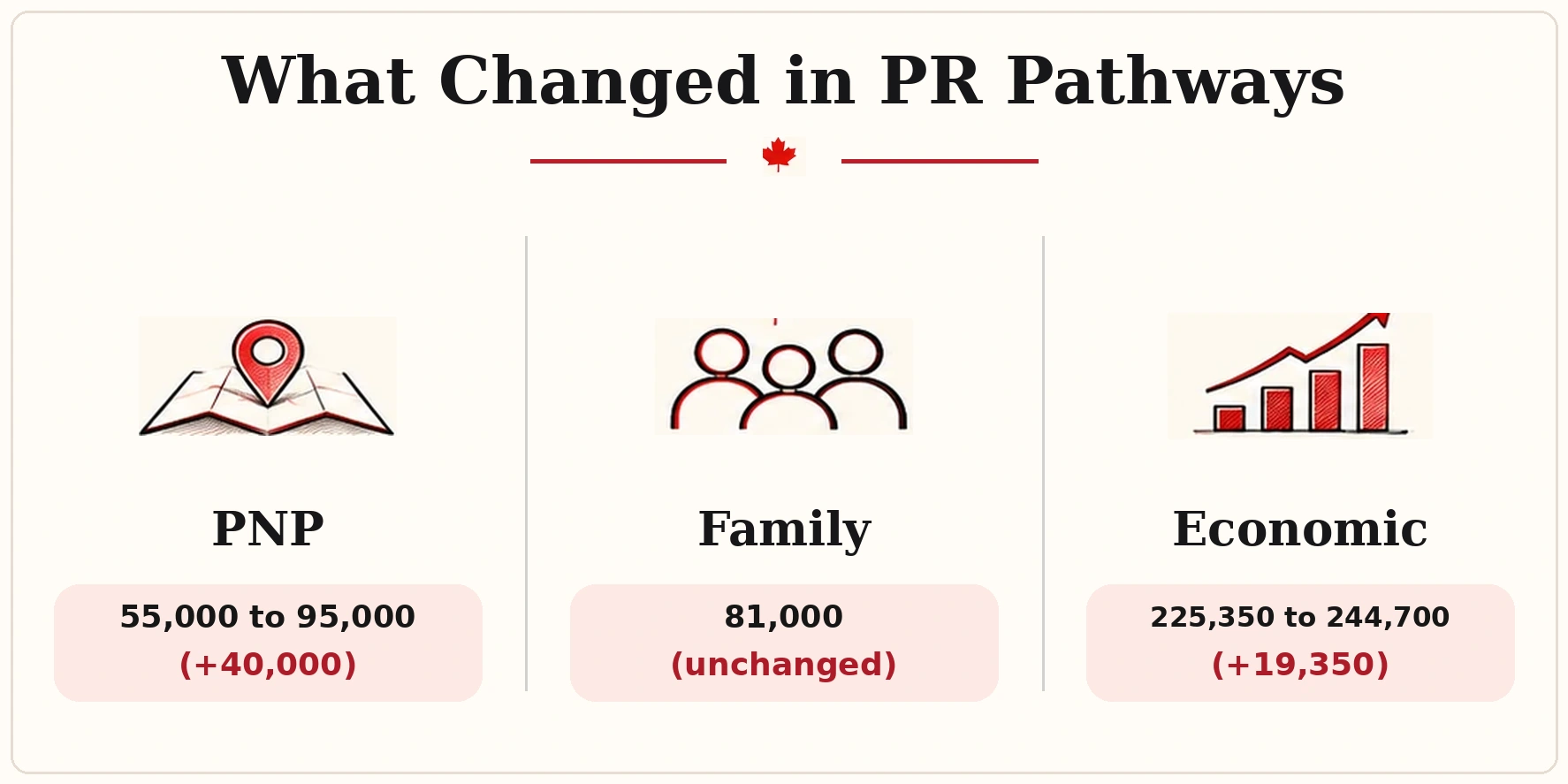
But the most significant changes are elsewhere. The Provincial Nominee Program (PNP) target increases from 55,000 to 95,000, while the target for new international student arrivals decreases from 305,900 to 150,000.
So, is Canada increasing immigration or reducing it? The answer depends on which immigration category you are discussing.
This Canada immigration levels plan comparison focuses on the 2027 targets shared by both plans, making it easier to understand which immigration categories are expanding and which have lower planned admissions or arrivals.
In this guide, Eiffel Immigration Solutions compares both official plans, explains the differences and outlines what these changes may mean for permanent residence applicants, foreign workers, international students and families.
7 Major Changes at a Glance
- Permanent residents: 365,000 to 380,000 (+15,000).
- Economic immigration: 225,350 to 244,700 (+19,350).
- Provincial nominees: 55,000 to 95,000 (+40,000).
- Family immigration: 81,000 in both plans.
- New temporary workers: 237,700 to 220,000 (-17,700).
- New international students: 305,900 to 150,000 (-155,900).
- Overall new temporary arrivals: 543,600 to 370,000 (-173,600).
All figures compare the two plans’ published targets for 2027, not actual admissions.
Table of Contents
- Understanding the two immigration plans
- 2027 immigration targets compared
- Permanent residence changes
- Provincial Nominee Program changes
- Express Entry implications
- Permanent residence categories
- International student reductions
- Temporary foreign worker targets
- Family sponsorship changes
- French-speaking immigration
- What applicants should do next
- Frequently asked questions
1. Canada Immigration Levels Plan Comparison: Understanding the Two Plans
Canada publishes an immigration levels plan to outline annual targets for permanent resident admissions and new temporary resident arrivals.
The 2025-2027 Immigration Levels Plan was published on October 24, 2024. It introduced temporary resident targets alongside permanent residence targets and outlined the government’s objectives for managing population growth and immigration.
The 2027-2029 Immigration Levels Plan provides updated targets and priorities for the following three years.
Both plans contain targets for 2027, making that year the most useful point of comparison.
Why Compare the Same Year?
Comparing 2025 figures with 2029 figures would mix changes over time with changes in government planning. Comparing the 2027 numbers published in each plan shows how the government’s expectations for the same calendar year have changed.
These figures are planning targets. They do not represent actual arrivals, approved applications or guaranteed invitations to apply.
2. Canada’s 2027 Immigration Targets: Old vs New
The following table compares the original 2027 targets from the 2025-2027 plan with the revised targets from the 2027-2029 plan.
| Immigration Category | Old 2027 Target | New 2027 Target | Difference |
|---|---|---|---|
| Permanent residents | 365,000 | 380,000 | +15,000 |
| Economic immigration | 225,350 | 244,700 | +19,350 |
| Provincial Nominee Program | 55,000 | 95,000 | +40,000 |
| Family immigration | 81,000 | 81,000 | Unchanged |
| Refugees and protected persons | 54,350 | 49,300 | -5,050 |
| Humanitarian and compassionate and other | 4,300 | 5,000 | +700 |
| New temporary resident arrivals | 543,600 | 370,000 | -173,600 |
| New temporary workers | 237,700 | 220,000 | -17,700 |
| New international students | 305,900 | 150,000 | -155,900 |
The biggest reduction is in the target for new international students, while the biggest increase among the major permanent residence pathways is in provincial nominations.
The revised plan therefore reflects a shift in the composition of immigration rather than a simple increase or decrease across every program.
3. Permanent Residence Targets Increase to 380,000
For permanent residence applicants, the Canada immigration levels plan comparison highlights an increase in overall PR admissions, alongside stronger emphasis on economic immigration and provincial nominations.
The original plan projected 365,000 permanent resident admissions for 2027. The revised plan targets 380,000.
That represents approximately a 4.1% increase over the older projection.
Economic immigration remains the largest category, increasing from 225,350 to 244,700 planned admissions.
This suggests a continued focus on attracting workers who can contribute to the Canadian economy, fill labour shortages and support regional development.
However, higher national targets do not automatically mean that every applicant will find it easier to obtain permanent residence.
Individual eligibility, immigration program requirements, processing and selection criteria still apply.
4. Provincial Nominee Program: A Major Increase
One of the most important findings in the Canada immigration levels plan comparison is the 40,000 increase in planned Provincial Nominee Program admissions for 2027.
The original 2027 target was 55,000 admissions.
The revised plan targets 95,000 admissions, an increase of approximately 72.7%.
This makes provincial immigration a particularly important area for applicants to monitor.
PNP programs allow participating provinces and territories to nominate eligible candidates based on regional economic and labour-market needs.
Different provincial streams may consider employment, occupation, education, language ability, previous experience or connections to the province.
For some candidates, an eligible provincial nomination can provide a pathway to permanent residence even when their federal Express Entry CRS score is not highly competitive.
However, a larger national PNP admissions target does not mean that every province will have the same number of nomination spaces or that all streams will remain open.
5. What Changed for Express Entry Candidates?
Both plans prioritize skilled immigration, but the way federal economic targets are presented has changed.
The older plan divided part of federal skilled immigration between Federal Economic Priorities and In-Canada Focus categories.
For 2027, those two categories had targets of 47,800 and 70,930 respectively.
The newer plan lists 100,000 Federal High Skilled admissions for 2027.
These categories should not be treated as directly interchangeable because the program groupings and planning framework differ.
The 100,000 target is also not a promise that IRCC will issue exactly 100,000 Express Entry invitations.
An admission target and an invitation to apply are different measurements.
For candidates, the practical priorities remain understanding program eligibility, maintaining accurate profiles, monitoring invitation rounds and considering additional immigration pathways where appropriate.
For help preparing an Express Entry profile, read our Express Entry Profile: How to Create and Submit It guide.
6. How Permanent Residence Categories Changed
Provincial nominations and economic immigration have increased, while total family admissions remain unchanged.
| Category | Old Target | New Target |
|---|---|---|
| Provincial Nominee Program | 55,000 | 95,000 |
| Economic immigration | 225,350 | 244,700 |
| Family immigration | 81,000 | 81,000 |
The numbers suggest stronger emphasis on provincial and economic selection within the overall permanent residence system.
7. International Student Targets: A Significant Reduction
The Canada immigration levels plan comparison also identifies a substantial reduction in new international student arrival targets, from 305,900 to 150,000.
For people planning to study in Canada, this is one of the most important changes.
The original plan projected 305,900 new international student arrivals in 2027.
The revised plan lowers that target by 155,900, or approximately 51%.
The reduction reflects a more restrictive approach to new temporary resident arrivals.
However, students should understand what the number represents.
It is a target for new arrivals, not the total number of international students already living in Canada.
It also does not count every application for a study permit extension or change of immigration status.
Prospective students should review current eligibility requirements, designated learning institution rules, financial requirements and applicable study permit restrictions before applying.
Students already in Canada should monitor their permit validity and make plans based on their own academic and immigration circumstances.
8. Temporary Foreign Worker Targets Also Change
For employers and foreign workers, the Canada immigration levels plan comparison shows a different distribution of temporary worker targets under the International Mobility Program (IMP) and Temporary Foreign Worker Program (TFWP).
The overall target for new temporary worker arrivals decreases from 237,700 to 220,000 for 2027.
| Worker Program | Old 2027 Target | New 2027 Target |
|---|---|---|
| International Mobility Program | 155,700 | 170,000 |
| Temporary Foreign Worker Program | 82,000 | 50,000 |
The International Mobility Program target increases, while the Temporary Foreign Worker Program target decreases.
The IMP includes various LMIA-exempt work permit streams. The TFWP generally involves employers obtaining a Labour Market Impact Assessment.
These targets do not represent all work permits issued in Canada and exclude certain categories and in-Canada permit extensions.
Applicants and employers must still satisfy the current requirements of the relevant program.
9. Family Sponsorship: Overall Target Remains Unchanged
Another finding from the Canada immigration levels plan comparison is that total family immigration remains at 81,000 admissions, although allocations between family categories have changed.
| Family Category | Old Target | New Target |
|---|---|---|
| Spouses, partners and children | 61,000 | 66,000 |
| Parents and grandparents | 20,000 | 15,000 |
| Total family immigration | 81,000 | 81,000 |
The revised plan allocates 5,000 additional admissions to spouses, partners and children, while reducing parents and grandparents admissions by 5,000.
These are admissions targets, not announcements of application intake dates or sponsorship invitations.
10. French-Speaking Immigration Outside Quebec
Francophone immigration outside Quebec remains an important federal priority.
The older plan targeted 10% French-speaking permanent resident admissions outside Quebec in 2027.
The newer plan sets a 9.5% target for 2027, followed by 10.5% in 2028 and 12% in 2029.
This shows a slightly lower percentage target for the overlapping year, alongside a planned increase in subsequent years.
For eligible candidates with French-language ability, it remains worthwhile to review applicable immigration programs and their language requirements.
However, Francophone admissions targets do not guarantee invitations under any particular immigration stream.
11. What Should Immigration Applicants Do Next?
Immigration targets demonstrate how Canada’s priorities and program allocations can change over time.
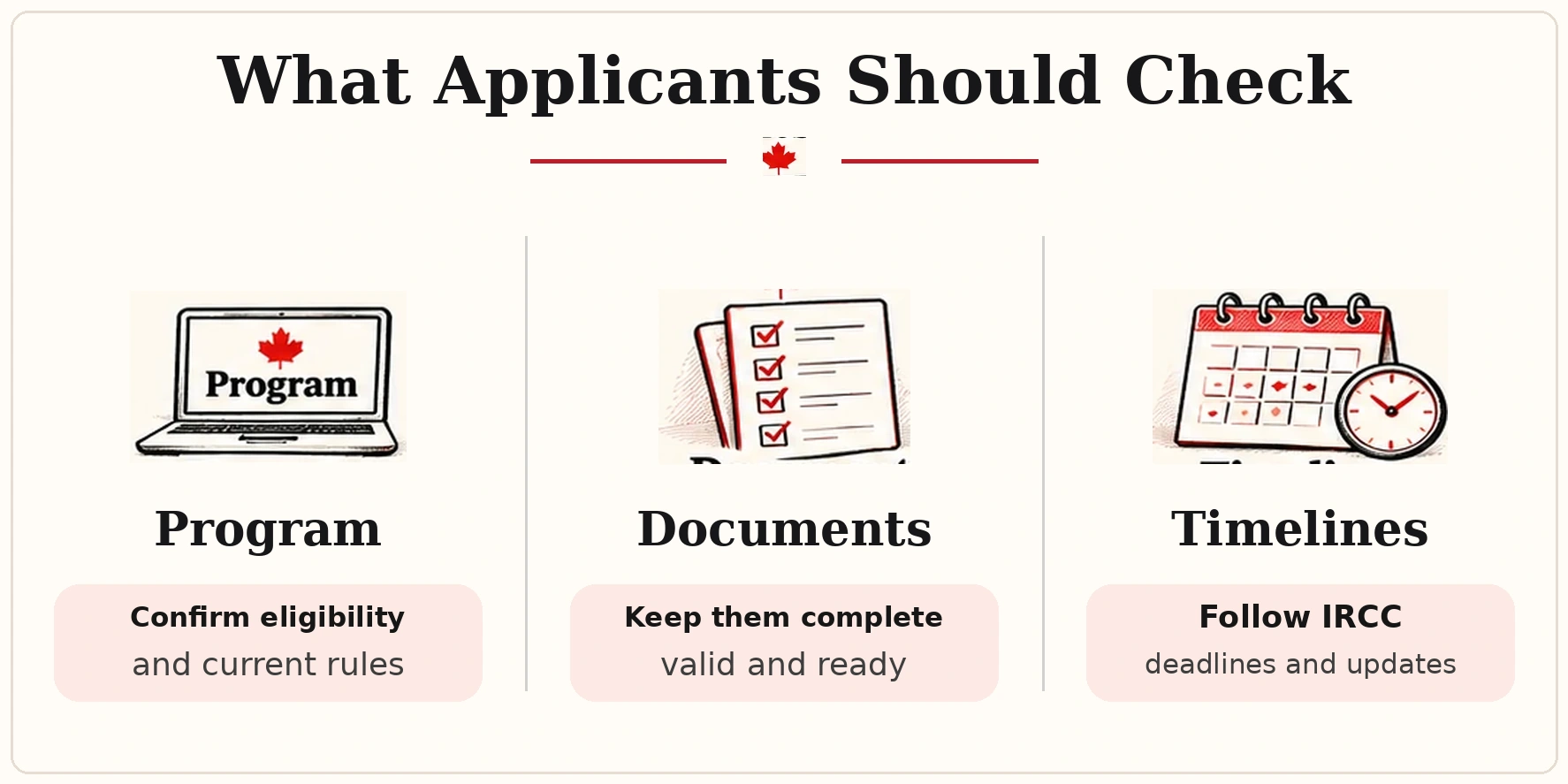
Instead of making decisions based solely on a national target, applicants should assess their own eligibility and available pathways.
For Express Entry Candidates
Check your eligibility, review your CRS score and maintain accurate language, education and work experience records.
Consider whether a provincial nominee stream may be relevant to your situation.
For Provincial Nominee Candidates
Monitor provincial program announcements and nomination criteria. A higher national PNP admissions target does not guarantee eligibility in an individual province.
For International Students
Confirm school and program eligibility, study permit requirements and financial documentation before applying.
Students already in Canada should monitor permit expiry dates and any rules affecting their current status.
For Temporary Foreign Workers
Review whether the proposed employment falls under the IMP, TFWP or another applicable authorization category.
Do not assume that a change in annual targets automatically changes current work permit conditions.
For Family Sponsorship Applicants
Check the rules and application intake procedures for your specific sponsorship category.
Family admission targets do not establish an individual right to sponsorship approval.
12. How Eiffel Immigration Solutions Can Help
Understanding national immigration targets is useful, but identifying an appropriate pathway requires a review of your personal circumstances.
At Eiffel Immigration Solutions, our team helps individuals and families understand their Canadian immigration options, relevant application requirements and supporting documentation.
Whether you are considering Express Entry, a provincial nomination, a work permit, a study permit or family sponsorship, professional guidance can help you make informed decisions.
EIFFEL IMMIGRATION SOLUTIONS
Not Sure Which Immigration Pathway Fits Your Situation?
Explore your Canadian immigration options and understand the requirements relevant to your circumstances.
Call 905-606-0363
13. Frequently Asked Questions
This Canada immigration levels plan comparison provides a starting point for understanding Canada’s changing priorities, but individual immigration decisions should always be based on current IRCC eligibility requirements.
What is the biggest difference between the 2025-2027 and 2027-2029 immigration plans?
For the overlapping year 2027, the newer plan increases permanent residence and PNP targets while substantially reducing new international student arrival targets.
Did Canada’s permanent residence target increase for 2027?
Yes. The original target was 365,000. The newer plan sets a target of 380,000, an increase of 15,000.
How much did the Provincial Nominee Program target increase?
The PNP admissions target for 2027 increases from 55,000 to 95,000, a difference of 40,000.
Why does the newer plan have fewer international students?
The revised plan supports a lower level of new temporary resident arrivals. The international student target for 2027 falls from 305,900 to 150,000.
Does a higher PNP target mean applicants will get permanent residence more easily?
Not necessarily. Applicants must meet the requirements of an available provincial stream and the relevant federal permanent residence process.
What happened to the family sponsorship target?
The total stays at 81,000 in both plans for 2027. However, admissions allocated to spouses, partners and children increase, while the parents and grandparents allocation decreases.
Will Express Entry CRS scores decrease because of the new immigration plan?
The plan does not predict future CRS cut-offs. Scores depend on candidates in the pool, invitation category, program requirements and the number of invitations issued.
Are immigration levels targets the same as approved applications?
No. Levels-plan targets are planning figures. Actual admissions, application approvals and Express Entry invitations are different measures.
Are the 2028 and 2029 immigration targets final?
No. The newer plan describes these years as notional, meaning future annual plans may confirm or adjust the targets.
Official IRCC Sources
-
IRCC: Supplementary Information for the 2025-2027 Immigration Levels Plan
-
IRCC: Supplementary Information for the 2027-2029 Immigration Levels Plan
Related Eiffel Immigration Resources
-
Express Entry Profile: How to Create and Submit It
-
Self-Immigration Toolkit
-
Book an Immigration Consultation
Disclaimer: This article provides general immigration information based on published IRCC immigration levels plans. Immigration targets, program eligibility and selection requirements may change. Individual applications are assessed under current Canadian immigration laws and policies.
This article is general information, not legal advice. Confirm details with IRCC or a regulated consultant before you act.