

Canada PR 2027 includes a one-year measure that could help up to 200,000 people already living in Canada become permanent residents. It adds extra admissions space for eligible workers, their families and certain humanitarian applicants.
Many temporary residents are asking what the measure means, who it covers and whether they need to apply again. This guide answers those questions.
The short version: Canada has not opened a new 200,000-person PR application pathway. The government is making extra room in 2027 to finalize applications under specific existing programs.
Canada PR 2027: what is the 200,000 PR measure?
Immigration, Refugees and Citizenship Canada (IRCC) has announced a time-limited measure that adds permanent residence admission space in 2027.
These spaces sit outside the regular targets in Canada’s 2027–2029 Immigration Levels Plan.
The measure is for people who are already in Canada and working or settled in their communities. That includes certain workers, family members and people with pending humanitarian applications.
The regular 2027 levels plan has a target of 380,000 permanent resident admissions. The one-year measure adds space on top of that target.
Important: 200,000 is an upper limit, not a promise of approval. IRCC says the measure is not a new immigration pathway and will not raise annual admissions on a recurring basis.
Who qualifies for the Canada PR 2027 measure?
The extra spaces are split into two cohorts. Whether you are included depends on your immigration program, your circumstances and where your application stands.
First cohort: workers already in Canada
The first cohort covers workers living in communities outside Quebec, plus their eligible family members.
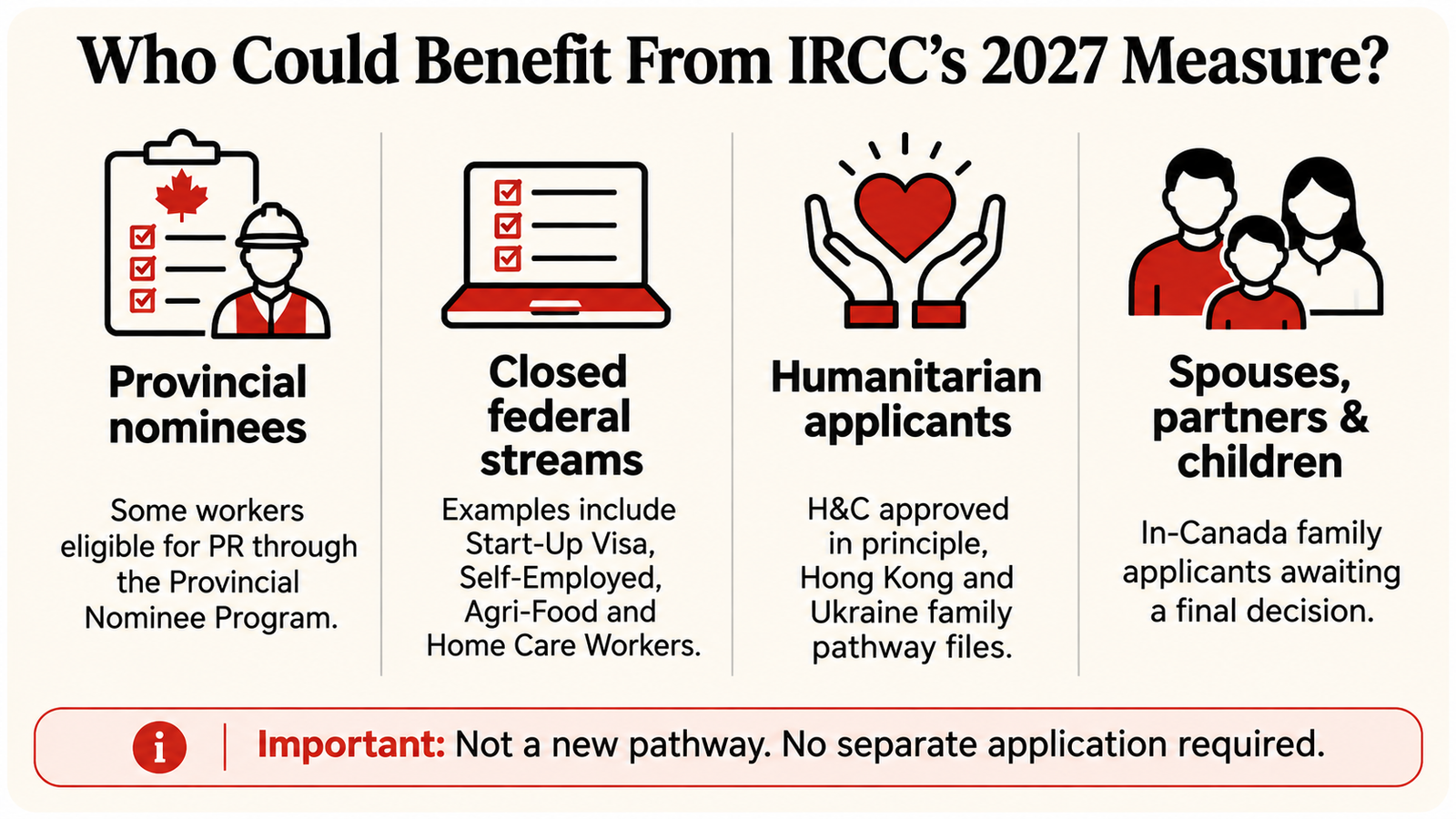
Workers may be included if they are waiting for a decision under certain federal programs that are closed to new applications, or if they are eligible to apply for PR through a Provincial Nominee Program.
Workers under closed federal PR programs
IRCC names these programs among those covered by the worker cohort:
- Start-Up Visa Program applicants whose permanent residence applications are already submitted and awaiting a decision.
- Self-Employed Persons Program applicants with eligible applications already in the processing inventory.
- Agri-Food Pilot applicants waiting for decisions on qualifying permanent residence files.
- Home care worker pathway applicants who are eligible under the relevant caregiver programs.
Being in one of these programs does not mean automatic approval. Applicants still have to meet all program requirements.
Provincial Nominee Program applicants
The measure also covers workers who are eligible to apply for permanent residence through the Provincial Nominee Program (PNP).
Federal and provincial governments will work together on regional labour needs by supporting eligible workers who are already settled in Canadian communities.
This does not mean every work permit holder qualifies for a provincial nomination. Each province sets its own criteria, program rules and nomination process.
Canada PR 2027: humanitarian applicants included
The second cohort has up to 100,000 additional PR spaces for specific humanitarian groups already living in Canada.
These are people who have been waiting for a final permanent residence decision under certain family and humanitarian pathways:
- Spouses, common-law partners and children of Canadian citizens or permanent residents who have already submitted a qualifying PR application and are waiting for a final decision.
- Applicants with remaining files under the Hong Kong permanent residence pathways, which closed on August 31, 2026.
- Applicants under the permanent residence pathway for Ukrainian nationals with family in Canada, which closed on October 22, 2024.
- In-Canada humanitarian and compassionate (H&C) applicants whose PR applications have already received approval in principle.
By finalizing applications in these groups, IRCC aims to give more stability to people who already have homes and family in Canada.
Is Canada introducing a new PR pathway in 2027?
No. The announcement mentions up to 200,000 additional spaces, but it does not create a new permanent residence program.
IRCC describes the measure as extra admissions capacity for specific groups of people already in Canada.
Applicants with a qualifying pending PR application do not need to submit a separate application for this measure.
A worker who is eligible through the PNP but has not applied yet still has to go through the regular nomination and permanent residence process.
Remember: There is no separate application form for the 200,000-space measure. Be careful with anyone who claims they can guarantee you one of these spaces.
Does Canada PR 2027 mean 580,000 PR admissions?
Canada’s regular 2027 target for permanent resident admissions stays at 380,000.
The one-year measure adds space for up to 200,000 people outside that target.
Added together, the two maximums come to 580,000. That number is not a guaranteed total for 2027, and it is not a new yearly target.
IRCC has said the measure is temporary and will not increase admissions on a recurring basis.
How will the 2027 measure affect PR processing?
The extra capacity is meant to let IRCC finalize more eligible applications in 2027.
If you have been waiting under one of the named programs, this could move your application forward.
It does not guarantee an approval date, and you still have to meet program eligibility and admissibility rules.
Keep checking your application status and answer any IRCC request on time.
What should temporary residents do now?
If you live or work in Canada and plan to apply for permanent residence, start by checking whether your situation fits one of the groups IRCC has named. Then:
- Confirm your category. Check whether you have an eligible pending application under one of the named programs.
- Review your PNP options. Look at the provincial nomination streams you may qualify for.
- Monitor your application. Log in to your IRCC account and respond quickly to document or information requests.
- Keep your legal status. A PR application in progress does not automatically extend your temporary resident permit.
- Watch for official updates. IRCC may publish more implementation details during 2027.
For links to IRCC services, see the Eiffel Immigration Self-Immigration Toolkit.
Canada PR 2027 frequently asked questions
Can any temporary worker apply under the 200,000 PR measure?
No. The measure only covers specified groups. Holding a work permit on its own does not make you eligible.
Are Express Entry candidates automatically included?
No. Being in the Express Entry pool does not by itself qualify you for the time-limited measure. You must meet the requirements of one of the included categories or programs.
Are international students included?
International students do not qualify just because they study or live in Canada.
Do applicants need to apply again?
No separate application is needed to be considered under the one-year measure. If you have not yet applied through an eligible existing pathway, you still need to follow that pathway’s normal application process.
Can applicants with H&C applications benefit?
Yes, in some cases. IRCC includes in-Canada humanitarian and compassionate applicants whose applications have already been approved in principle.
Is permanent residence guaranteed?
No. The extra spaces do not guarantee approval. Every application must still meet the applicable immigration requirements.
Key points on Canada’s 200,000 PR measure
The Canada PR 2027 measure is a one-year initiative to help eligible people already living in Canada get permanent residence.
The government is adding admissions space. It is not launching a new application pathway.
Workers eligible through the PNP, applicants under certain closed federal programs and specific humanitarian groups may benefit, depending on their individual situation.
Check the exact eligibility rules and follow official IRCC updates before making any decisions.
Not sure whether you could qualify?
At Eiffel Immigration Solutions, we help individuals and families understand their immigration options, review application requirements and plan next steps.
If you have a pending PR application or want to explore a Provincial Nominee Program, our team can review your situation and guide you.
Official government sources
- IRCC backgrounder: Building a stronger Canada through a well-managed, predictable immigration system
- IRCC: Immigration system measures
- IRCC: Canada’s immigration levels
Disclaimer: Information is current as of November 6, 2026. Immigration rules and implementation procedures may change. This article is general information and should not be considered individual immigration or legal advice.
Talk it through with an Eiffel case worker
Eiffel Immigration has helped families come to Canada since 2019. Book a free 15-minute call and a case worker will explain what this change means for you. For a full profile review, ask about our $170 flat-rate consultation.
This article is general information, not legal advice. Confirm details with IRCC or a regulated consultant before you act.