

Canada is already planning what Express Entry 2027 could look like, and applicants who are hoping to get Canadian permanent residence should start paying attention now.
Immigration, Refugees and Citizenship Canada (IRCC) recently completed public consultations on the economic priorities and categories that could be used for Express Entry category-based selection in 2027.
The consultation ran from August 4 to September 1, 2026. Importantly, the categories for Express Entry 2027 have not yet been finalized. IRCC is reviewing feedback, labour-market information and previous category-based selection results before deciding what categories will ultimately be used.
However, the consultation gives us an important early indication of where Express Entry 2027 may be heading.
What Is Canada Considering for Express Entry 2027?
IRCC identified three broad economic priorities while consulting on the 2027 categories:
1. Addressing long-term labour shortages
2. Attracting and retaining top international talent
3. Supporting Francophone immigration outside Quebec
IRCC also indicated that it is considering expanding its approach to highly skilled international workers while potentially narrowing the number or eligibility of some labour-shortage categories.
That last point is particularly important for Express Entry 2027 candidates.
It means applicants should not automatically assume that every occupation or category prioritized today will receive exactly the same treatment in 2027.
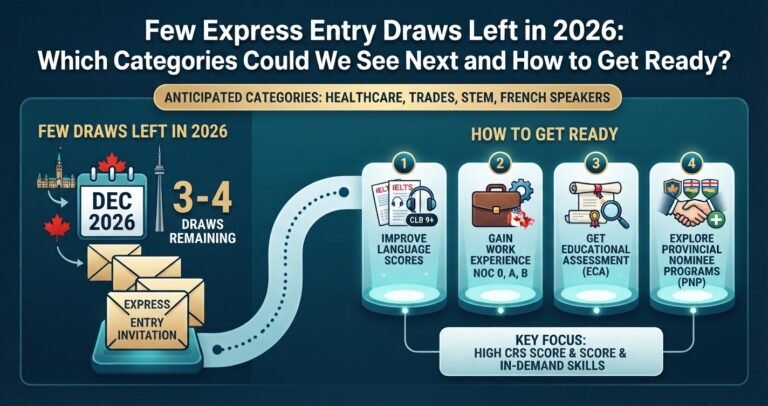
1. Healthcare, Trades, Education, STEM and Transport Remain Important
Canada has been using Express Entry categories to address long-term shortages in areas such as:
- Healthcare
- Skilled trades
- Education
- STEM
- Transport
IRCC says shortages in these sectors continue to have a significant impact across Canada. The government specifically connects these labour needs with priorities such as increasing housing supply and maintaining access to healthcare and education.
But there is an important warning.
IRCC says the limited number of immigration spaces available could require the government to become more selective about which labour shortages are addressed through federal immigration selection.
In simple words, Canada may continue occupation-based Express Entry draws, but the government could focus more narrowly on the occupations it considers most important.
What should applicants do?
If your occupation currently falls under an Express Entry 2027 category, don’t rely only on the category name.
Keep checking:
- your exact NOC code;
- whether your occupation remains on the eligible list;
- how much qualifying experience is required;
- when that experience must have been obtained; and
- whether IRCC changes the category criteria for 2027.
A category existing today does not guarantee that every occupation within it will remain eligible next year.
2. Highly Skilled Global Talent Could Become More Important
One of the biggest signals in the Express Entry 2027 consultation is Canada’s increased focus on attracting highly skilled international talent.
IRCC says it is considering how Express Entry could help Canada attract and retain workers with expertise that supports economic growth.
Several government initiatives are specifically mentioned.
International Talent Attraction Strategy
IRCC’s International Talent Attraction Strategy is intended to help Canada attract and retain talent in priority sectors such as emerging technologies, healthcare and skilled trades.
An important part of this strategy is also identifying clearer pathways to permanent residence for talent Canada wants to retain.
This suggests that Express Entry 2027 may increasingly be connected not simply to filling vacancies, but also to Canada’s broader competition for highly skilled global workers.
3. Researchers Could Continue to Receive Attention
Researchers are another group applicants should watch closely.
Canada’s Global Impact+ Research Talent Initiative is designed to attract leading international researchers in critical fields and strengthen Canada’s position in research and innovation.
IRCC specifically included this initiative when discussing what could influence Express Entry 2027 category-based selection in the year 2027.
Researchers are already part of Canada’s current category-based Express Entry system. As of September 2026, IRCC lists researchers with Canadian work experience as one of the current Express Entry categories.
For people working in research, science and innovation, this is therefore an area worth following carefully for Express Entry 2027.
4. AI and Technology Talent Are on Canada’s Radar
Artificial intelligence could also play a bigger role in Canada’s talent strategy.
IRCC’s consultation specifically refers to Canada’s National Artificial Intelligence Strategy and the expansion of the Global Talent Stream to make it easier to bring highly skilled AI talent to Canada.
This does not mean that Canada has officially announced a separate “AI Express Entry category” for 2027.
That distinction is important.
What it does tell us is that AI and advanced technology talent are being considered within Canada’s broader strategy for attracting skilled workers, and IRCC is assessing how these strategies could influence Express Entry 2027 category selection.
Therefore, professionals working in areas such as AI, machine learning and other advanced technologies should closely monitor the final 2027 announcement.
5. H-1B Visa Holders Are Another Group to Watch
Another interesting development involves H-1B visa holders in the United States.
IRCC’s consultation points to the government’s commitment to develop an accelerated pathway for H-1B visa holders working in specialty occupations.
According to the consultation, the objective is to attract talent in areas including:
- STEM;
- healthcare;
- research;
- advanced industries; and
- other strategically important sectors.
IRCC specifically says this initiative is among the strategies being considered when determining how Express Entry category-based selection could operate in 2027.
Again, this should not be interpreted as confirmation that there will be an H-1B Express Entry category.
For now, it is a policy direction under consideration.
6. French Could Remain One of the Most Important Express Entry Strategies
French-language proficiency continues to be a major part of Canada’s immigration planning.
IRCC says category-based selection remains a primary mechanism for supporting Francophone immigration outside Quebec. The 2026–2028 Immigration Levels Plan sets the target for French-speaking permanent residents outside Quebec at 9% in 2026, 9.5% in 2027 and 10.5% in 2028.
Because of these targets, IRCC says it is considering maintaining its focus on Francophone immigration through category-based selection in 2027.
For Express Entry candidates, this means French should not be ignored.
Applicants who have enough time to improve their language profile may want to explore whether learning French is realistic for them. French can potentially help through both CRS factors and eligibility for French-language category-based selection, depending on the candidate’s circumstances and the rules in place when invitations are issued.
Could Some Express Entry Categories Be Narrowed in 2027?
Possibly.
This is one of the most important points from IRCC’s consultation.
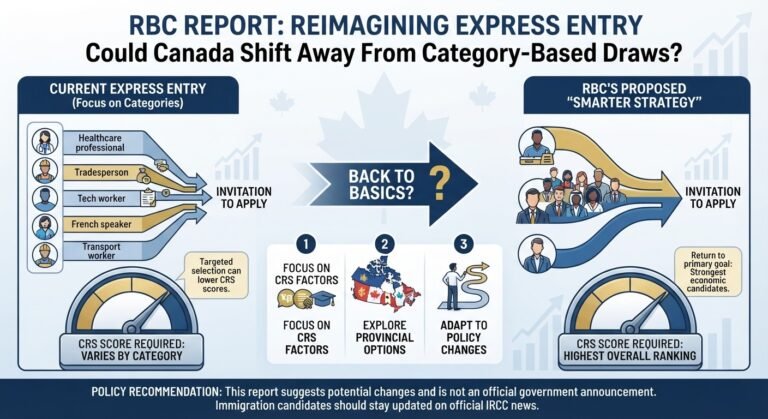
The department says it is considering narrowing the number or eligibility of categories aimed at addressing labour shortages so that immigration selection can have a more strategic focus.
This does not confirm that any particular category will be removed.
But it does mean candidates should avoid assuming that the 2026 category structure will simply continue unchanged into 2027.
An occupation eligible today could potentially be removed, while other occupations or types of talent could receive greater priority.
Express Entry Itself Could Also Change
There is another development happening separately from the 2027 category review.
Earlier in 2026, IRCC held consultations on potentially making broader changes to Express Entry and the Comprehensive Ranking System.
One major proposal was to consider replacing the existing Canadian Experience Class, Federal Skilled Worker Program and Federal Skilled Trades Program with a single Federal High Skilled program.
IRCC also looked at ways to simplify eligibility requirements and better align the CRS with factors associated with economic outcomes. These were consultation proposals and should not be treated as finalized changes.
This means 2027 could be important not only because categories may change, but also because the broader Express Entry system itself is under review.
What Should Express Entry Applicants Do Now?
If you are planning for Canadian PR in 2027, waiting until the final categories are announced may leave you with less time to improve your profile.
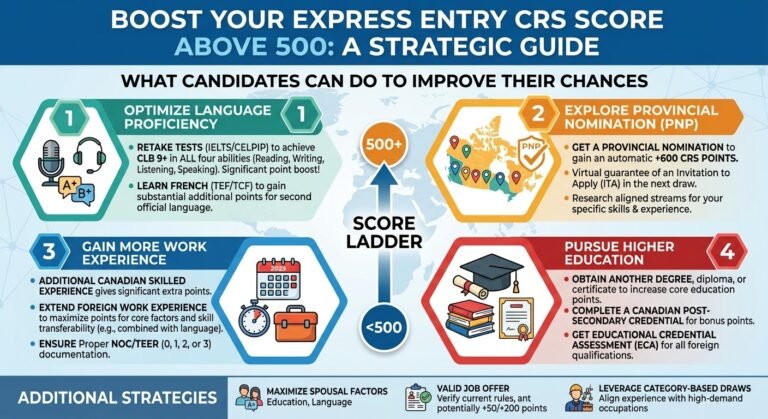
Instead, start preparing around factors that can strengthen your Express Entry profile more generally.
Check your NOC and work experience carefully. Make sure your job duties actually correspond with the NOC you are claiming.
Work on your language scores. Improving IELTS, CELPIP, PTE Core, TEF Canada or TCF Canada results can make a significant difference depending on your profile.
Consider French if it is realistic for you. Canada’s Francophone immigration targets continue to rise.
Keep your Educational Credential Assessment (ECA) valid if you need one.
And most importantly, don’t choose a career, course or job simply because it appears in today’s Express Entry category list. Immigration categories can change according to Canada’s labour-market and economic priorities.
What Does This Mean for Express Entry 2027?
The direction is becoming clearer, even though the final categories have not been announced.
Canada is looking at long-term labour shortages, French-speaking immigration and the attraction of highly skilled international talent. Researchers, AI and advanced-technology professionals, H-1B holders and workers in strategically important sectors are all connected to initiatives IRCC specifically referenced while consulting on its 2027 priorities.
At the same time, IRCC has warned that limited immigration spaces may require more focused selection.
So Express Entry 2027 may become more targeted rather than simply broader.
For applicants, the key is to prepare early while remembering that consultations are not final policy. The actual 2027 categories and their eligibility requirements will only be certain once IRCC officially announces them.
Eiffel Immigration Solutions will continue following official Express Entry developments as Canada finalizes its immigration priorities for 2027.