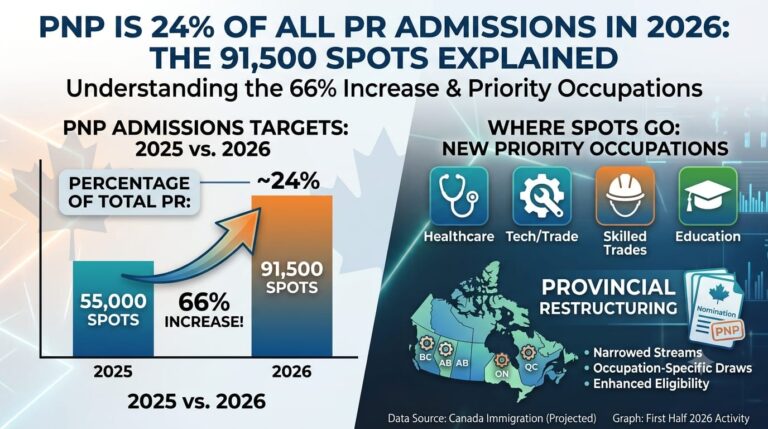

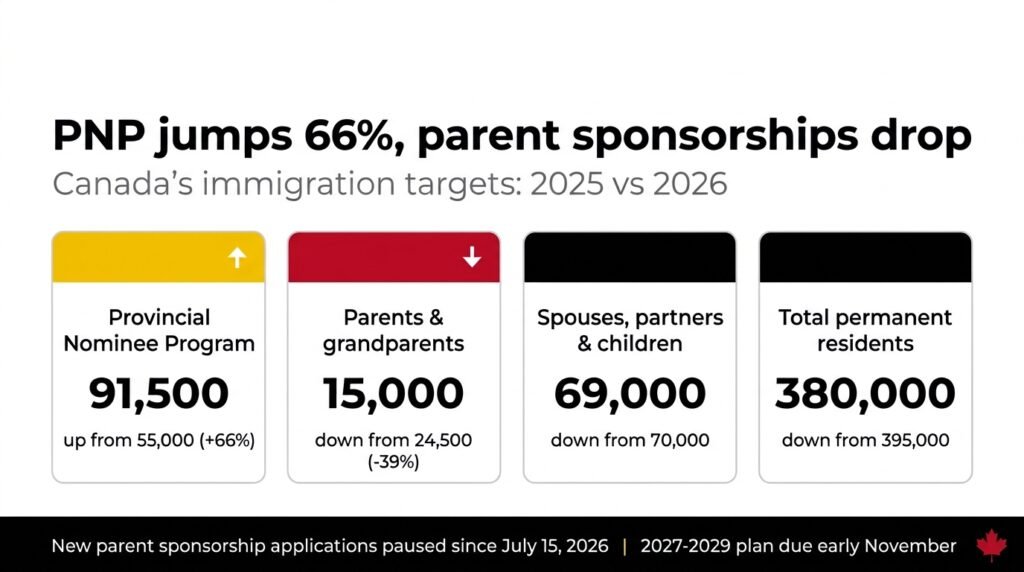
Canada’s current immigration levels plan moves a large share of permanent resident spots to the provinces. The Provincial Nominee Program (PNP) target rose from 55,000 in 2025 to 91,500 in 2026, a 66% jump, and it climbs again to 92,500 in 2027 and 2028. Parents and grandparents went the other way. Their target fell from 24,500 to 15,000 a year, and new applications have been on hold since July 15.
Ottawa has to table the next immigration levels plan, covering 2027 to 2029, in the first days of November. Here is what today’s numbers mean for workers and families in the GTA before that happens.
- PNP admissions are set at 91,500 for 2026, up 66% from 55,000 in 2025.
- Parents and grandparents have 15,000 spots a year, down from 24,500, and new applications are paused.
- Total permanent residents stay at 380,000 a year from 2026 to 2028.
- The 2027-2029 plan is due in early November and may change the 2027 and 2028 figures.
What the 2026-2028 immigration levels plan changed
These are the lines that moved most between the 2025 targets and the 2026 targets.
| Category | 2025 target | 2026 target | Change |
|---|---|---|---|
| Provincial Nominee Program | 55,000 | 91,500 | +66% |
| Parents and grandparents | 24,500 | 15,000 | -39% |
| Spouses, partners and children | 70,000 | 69,000 | -1% |
| All family sponsorship | 94,500 | 84,000 | -11% |
| Total permanent residents | 395,000 | 380,000 | -4% |
The immigration levels plan holds total admissions at 380,000 in each of 2026, 2027 and 2028. Inside that total, economic immigration grows from 239,800 in 2026 to 244,700 in 2027, while family sponsorship shrinks from 84,000 to 81,000. Measured against the 92,500 planned for 2027, the PNP increase over 2025 reaches 68%.
Why the PNP got the biggest share
The PNP lets each province nominate people whose skills fit local shortages. In Ontario that is the Ontario Immigrant Nominee Program (OINP). The 2025 plan had cut the PNP to 55,000, and the provinces pushed back. At a June 2026 meeting, provincial and territorial immigration ministers asked Ottawa for stable and larger PNP allocations in the next immigration levels plan.
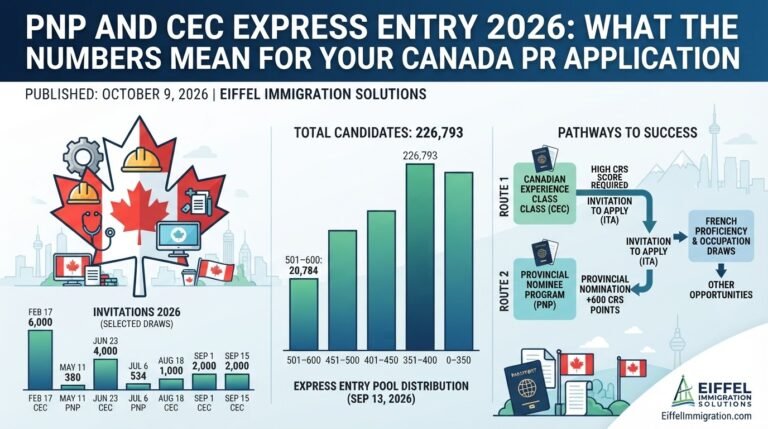
The 2026 PNP target sits in a range of 82,000 to 105,000, so the final count can move with demand. More PNP room means more nominations, and a nomination adds 600 points to an Express Entry profile. That is why the two PNP draws in October needed 772 and 761 points. You can follow every provincial round on our PNP draws tracker and every federal round on our Express Entry draws page.
Parents and grandparents under the immigration levels plan
The target is 15,000 a year for 2026, 2027 and 2028, within a range of 13,000 to 19,000. That is 39% below the 24,500 planned for 2025.
On July 15, 2026, IRCC paused intake of new Parents and Grandparents Program (PGP) applications. It is still processing files already in its queue and plans to approve up to 15,000 people this year. IRCC has not said when intake will reopen.
The Super Visa lets a parent or grandparent stay up to five years per entry, with multiple entries on a visa valid for up to 10 years. You need to meet the minimum income requirement and buy Canadian medical insurance for them. If you want your parents here soon, apply for a Super Visa now and keep your tax records in order in case the PGP reopens with a short window.
Spouses, partners and children
Spousal and dependent child sponsorship has 69,000 spots in 2026 and 66,000 in 2027 and 2028. Applications are open. The cut is small, but a complete application on the first try still saves months.
Other immigration levels plan numbers worth knowing
- Federal High Skilled admissions, the people invited through Express Entry, are set at 109,000 in 2026 and 111,000 in 2027 and 2028.
- A one-time measure will move up to 33,000 work permit holders to permanent residence across 2026 and 2027.
- French-speaking admissions outside Quebec are targeted at 9% in 2026, 9.5% in 2027 and 10.5% in 2028, with a goal of 12% by 2029.
- New study permit arrivals are capped at 155,000 in 2026 and 150,000 after that.
The French targets explain why French-language draws are now the biggest rounds in Express Entry. Two of them invited 10,000 people this month, as our October Express Entry draws roundup shows.
This month's drawsOctober Express Entry draws: 7 essential CRS resultsWho gains and who waits
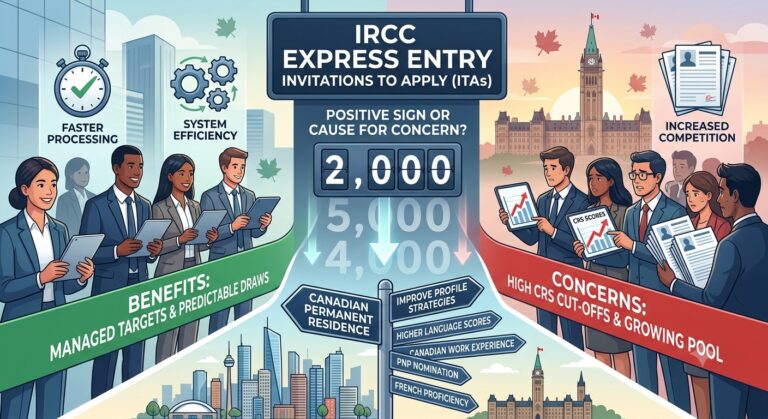
The case for the plan: provinces track their own job markets, so routing more spots through the PNP should place newcomers where employers need them. Keeping the total at 380,000 also eases pressure on housing and services after several years of fast population growth.
The case against: families carry the cost. Parents and grandparents lost almost 40% of their spots, and with intake paused, many sponsors cannot get in line at all. PNP rules also differ from province to province, which makes the system harder to follow for anyone who moves between them.
When the 2027-2029 immigration levels plan arrives
The Immigration and Refugee Protection Act sets November 1 as the deadline to table the immigration levels plan. That date is a Sunday this year, so the plan is expected when the House of Commons next sits. Prime Minister Mark Carney has spoken of a “controlled increase,” and Immigration Minister Lena Metlege Diab said in mid-October that levels could rise. The Conservatives say they should fall.
When the new numbers land, compare the PNP line with 92,500, the parents and grandparents line with 15,000, Express Entry with 111,000 and the overall total with 380,000. We will post the new figures on our IRCC updates page the day the new immigration levels plan is tabled.
What to do now
- On a work permit in Ontario? Check whether your occupation fits an OINP stream. Our Find your NOC tool gives you the right code.
- In the Express Entry pool with a lower score? A provincial nomination adds 600 points. Also check whether your job is on the high-wage occupations list, which adds new points from November 3.
- Want your parents in Canada? Apply for a Super Visa instead of waiting for the PGP to reopen.
- Sponsoring a spouse or partner? File now with a complete set of documents.
Immigration levels plan questions we hear most
How many PNP spots does Canada have in 2026?
The 2026 target is 91,500, within a range of 82,000 to 105,000. That is up from 55,000 in 2025. It rises to 92,500 in 2027 and 2028.
Is the Parents and Grandparents Program open in 2026?
No. IRCC paused new applications on July 15, 2026. It is still processing applications already in its queue and plans to approve up to 15,000 people this year.
Can my parents still come to Canada while the PGP is paused?
Yes, through the Super Visa. It allows stays of up to five years per entry, with multiple entries over up to 10 years.
When will the 2027-2029 immigration levels plan be released?
The legal deadline is November 1. Because that is a Sunday in 2026, the plan is expected when the House of Commons next sits in early November.
Does a provincial nomination guarantee permanent residence?
No. A nomination adds 600 CRS points in Express Entry, which makes an invitation very likely. You still need a complete application and must pass medical, security and admissibility checks.
Sources
- IRCC: Supplementary information for the 2026-2028 Immigration Levels Plan
- IRCC notice: Canada takes steps to responsibly manage the Parents and Grandparents Program (July 15, 2026)
- IRCC committee briefing: Immigration Levels Plan (May 4, 2026)
- IRCC committee briefing: 2026-2028 permanent resident targets and ranges
Talk it through with an Eiffel case worker
Eiffel Immigration has helped families come to Canada since 2019. Book a free 15-minute call and a case worker will explain what this change means for you. For a full profile review, ask about our $170 flat-rate consultation.
This article is general information, not legal advice. Confirm details with IRCC or a regulated consultant before you act.