

An LMIA exemption means a Canadian employer can hire a foreign worker without first obtaining a Labour Market Impact Assessment. Under the International Mobility Program (IMP), this applies when the hire supports Canada’s economic, social and cultural priorities. The worker still needs a work permit in most cases. This guide explains who qualifies, what the employer must submit, how the worker applies and where files commonly go wrong.
Key Takeaways
- An LMIA exemption removes the employer’s LMIA requirement. It does not remove the worker’s need for a work permit, unless a separate work-permit exemption applies.
- Exemptions sit under the International Mobility Program. Eligibility depends on a specific category, such as a free trade agreement, Mobilité Francophone, the Global Skills Strategy or International Experience Canada.
- In most cases the employer pays a $230 CAD employer compliance fee and submits an offer of employment through the IRCC Employer Portal, quoting the right exemption code.
- Some categories are fee exempt, and workers who already hold an open work permit need no offer of employment from the new employer.
- Choosing the wrong category is a common cause of refusals, so a profile review before filing is worth the time.
Table of Contents
- What an LMIA exemption actually is
- LMIA-exempt versus LMIA-required: the practical differences
- Who is eligible for an LMIA-exempt work permit
- What the employer must do
- What the worker must do
- Mistakes that cost applicants time
- Our perspective
- How we can help
- FAQ
- Sources
What an LMIA exemption actually is
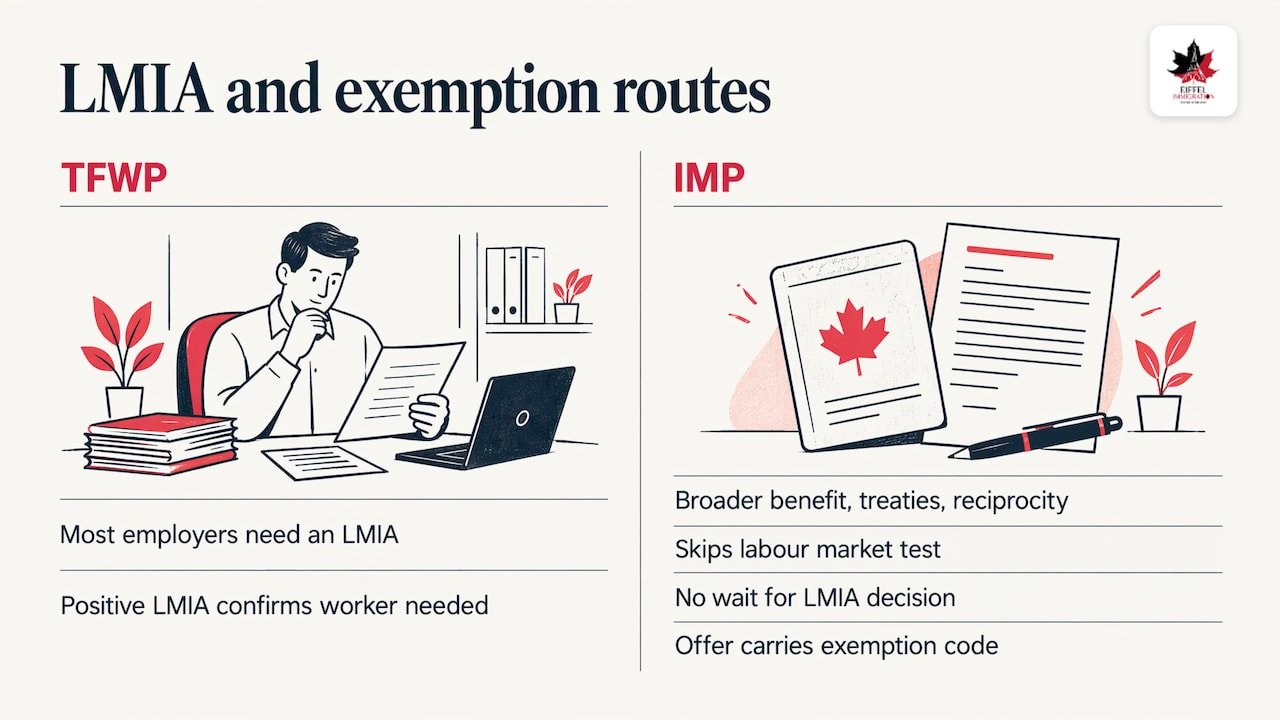
Most employers need an LMIA before they can hire a temporary foreign worker. A positive LMIA confirms that no Canadians or permanent residents are available to do the job and that a foreign worker is needed. That process is the Temporary Foreign Worker Program (TFWP).
The International Mobility Program works differently. It covers situations where the worker’s presence brings a broader benefit to Canada, or where reciprocity, treaties or policy goals justify skipping the labour market test. The result is a more direct route: the employer does not wait for an LMIA decision, and the worker applies for a work permit using an offer of employment that carries an exemption code.
If you want the TFWP side of the picture, our guides on the LMIA work permit and its wage thresholds and the 2026 LMIA rule changes cover it. For a category-by-category view of the exempt route, see our LMIA-exempt work permit guide.
LMIA-exempt versus LMIA-required: the practical differences
IRCC’s guidance sets out the logic plainly. If an exemption applies, the employer hires without an LMIA but the worker needs a work permit. If none applies, the employer needs an LMIA and the worker needs a work permit.
| Point | LMIA-required (TFWP) | LMIA-exempt (IMP) |
|---|---|---|
| Labour market test | Yes, a positive LMIA is needed | No |
| Employer’s first step | Apply for the LMIA | Confirm the category and submit an offer of employment |
| Exemption code in offer | Not applicable | Yes, the correct code is required |
| Employer compliance fee | Not applicable | $230 CAD in most cases, with exceptions |
| Worker’s work permit | Required | Required, unless a work-permit exemption applies |
| Typical basis | Employer shows no Canadian is available | Worker fits a treaty, policy or reciprocity category |
Two terms are often confused. An LMIA exemption is about the employer’s obligation. A work-permit exemption is about the worker. IRCC is clear that a separate work-permit exemption means the worker does not need a work permit. Do not assume the two always come together.
Who is eligible for an LMIA-exempt work permit
There is no single test. Eligibility depends on the category. IRCC’s page on who you can hire under the IMP lists the groups of workers who do not need an LMIA. They include workers with work-permit exemptions, open work permit holders, and workers eligible for employer-specific LMIA-exempt permits.
Employer-specific LMIA-exempt permits
These permits tie the worker to one employer. IRCC names several examples:
- French-speaking workers outside Quebec. Mobilité Francophone uses exemption code C16.
- Global Skills Strategy applicants, for certain high-skilled roles.
- International Experience Canada (IEC) participants, under youth exchange arrangements.
- Workers under a free trade agreement, such as professionals covered by a trade deal.
Each category has its own requirements on occupation, qualifications, nationality or language. Meeting one does not mean you meet another.
Open work permit holders
Some workers already hold an open work permit, which lets them work for any Canadian employer. IRCC states that when an employer hires such a worker, no offer of employment form or compliance fee is needed. Examples that often come up in our practice include spouses of certain workers and students, and graduates holding a post-graduation permit. If your permit is close to expiry, read our strategies for expiring work permits and our bridging open work permit guide.
Fee-exempt categories
Some categories are exempt from the employer fee, though they are still LMIA exempt. IRCC’s employer compliance exemptions page lists these among others:
- non-trade international agreements (R204(a))
- reciprocal employment (R205(b))
- work related to a research program (R205©(i))
- unremunerated charitable or religious work (R205(d))
Asking IRCC whether an exemption applies
When it is unclear, an employer can ask the International Mobility Workers Unit for an opinion. IRCC says the request must be sent at least 45 days before the worker plans to enter Canada. The worker must be outside Canada, eligible to apply at the port of entry, and from a visa-exempt country. That last condition means the route will not suit every nationality.
What the employer must do
The employer’s steps are the same in most IMP cases. IRCC’s how to hire page sets them out.
- Confirm the position or worker qualifies. Identify the exact category and its exemption code before anything else.
- Pay the employer compliance fee. In most cases it is $230 CAD.
- Submit the offer of employment through the Employer Portal. It must include information about the business, the worker, the job details, the wage and the benefits.
- Give the worker the offer number. The portal produces a 7-digit number the worker needs for the permit application.
For Mobilité Francophone, IRCC’s info sheet says the employer submits the offer under code C16, pays the $230 fee, and gives the candidate the offer number and a duly signed contract.
When the fee does not apply
If the employer or worker falls under a fee-exempt program, agreement or category, the employer does not pay the $230. Under IRCC’s exemption rules, the employer selects the option stating it is exempt from paying fees for this offer and uploads proof. A higher fee also exists in one case: $690 for a group of three or more entertainers offered at the same time.
What the worker must do
Once the employer has submitted the offer, the worker receives the 7-digit offer number and can complete and submit the work permit application. The employer must include the LMIA exemption code in the offer, and the application should match it.
A practical checklist for the worker:
- the offer of employment number and the signed contract
- evidence that you meet the category, such as credentials, language results or proof of nationality
- a valid passport and the other documents the application guide requests
- consistency between the job described in the offer, your résumé and your reference letters
Applications are refused for mismatches more often than for missing documents. Our guide to work permit rejections in Canada covers the common reasons.
Mistakes that cost applicants time
Treating “exempt” as “easy”. Skipping the LMIA does not skip the eligibility test. Each category has its own conditions, and IRCC expects the file to prove them.
Using the wrong code. The exemption code in the offer has to match the worker’s real situation. A plausible-looking code that does not fit the facts invites a refusal.
Confusing work-permit exemption with LMIA exemption. Some workers do not need a work permit at all. Others need a permit but not an LMIA. The two rules are separate.
Paying a fee that is not owed, or skipping one that is. Check the fee-exempt list before submitting. If the exemption applies, the proof must be uploaded.
Leaving too little time. If the employer wants an IMWU opinion, 45 days before entry is the minimum. Add time for the work permit decision on top.
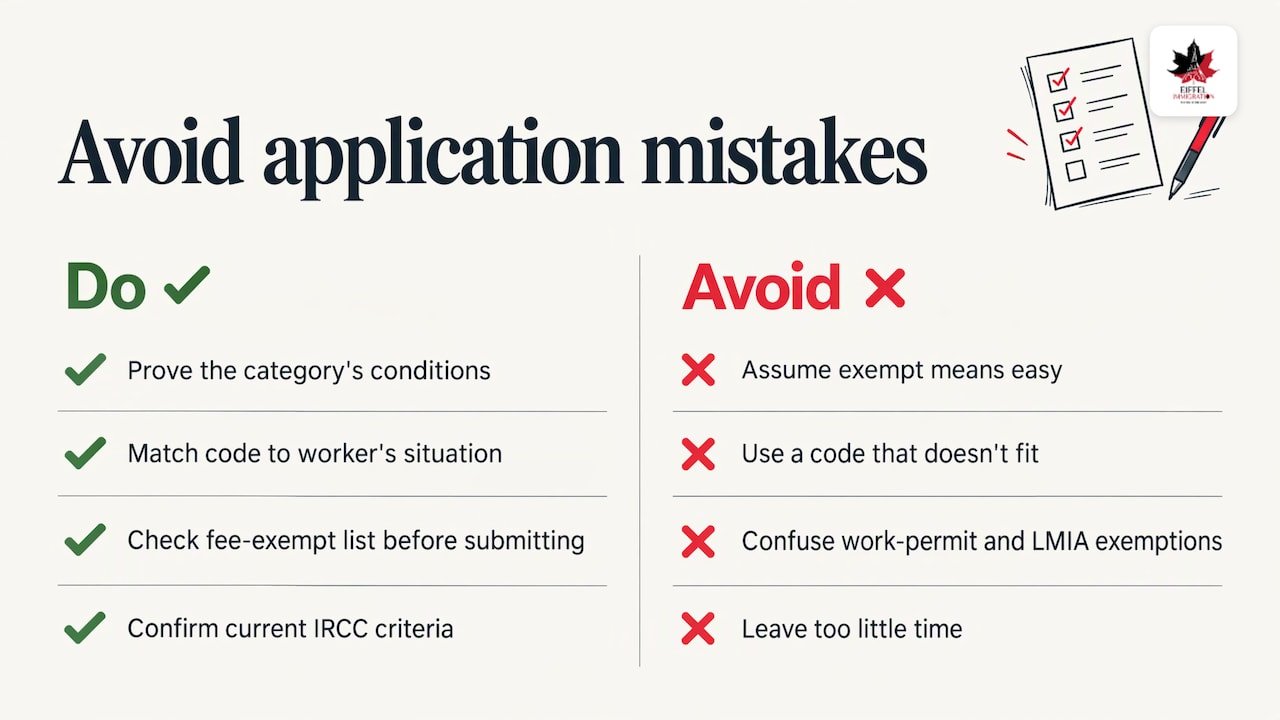
Ignoring a recent policy shift. IMP categories are reviewed from time to time. Confirm the current criteria on the official IRCC page before you file, and see our work permits in Canada overview for context.
Our perspective
Most of the files we see go wrong at the very start: the category was chosen from a list instead of from the person’s facts. An exemption is only useful when the worker’s profile, the employer’s offer and the exemption code all tell the same story.
We start every file with a licensed consultant reviewing the whole profile: work history, credentials, language ability, nationality and the employer’s role. Only then do we decide whether an LMIA-exempt route, an LMIA route or another pathway fits best. Where more than one route is open, we explain the trade-offs, including the risks, in writing before any fee agreement is signed.
We also look past the permit. A work permit can be a stepping stone to permanent residency, so we check how the chosen route interacts with options such as Express Entry or a provincial nominee program. Our clients come from India, the Philippines, Nigeria and many other countries, and we support them in multiple languages so every step is understood.
LB
How we can help
If you are a worker or an employer weighing an LMIA-exempt route, our licensed consultants can assess your situation and prepare the offer and permit application. Initial consultations are free. Book a free profile review or see the full list of services, which includes LMIA-exempt and LMIA work permits, spousal open work permits and the Post-Graduation Work Permit.
FAQ
What is an LMIA-exempt work permit in Canada?
It is a work permit issued for a job where the employer does not need a Labour Market Impact Assessment. These permits mostly fall under the International Mobility Program, which serves Canada’s economic, social and cultural priorities. The employer usually submits an offer of employment with an exemption code, and the worker then applies for the permit.
Does an LMIA exemption mean I do not need a work permit?
No. An LMIA exemption lets the employer hire without an LMIA, but the worker still needs a work permit. Only a separate work-permit exemption means you can work without one. Confirm which rule applies to your situation before you travel.
Does the employer always pay the $230 fee?
In most cases, yes. The $230 employer compliance fee is paid when the offer of employment is submitted. It does not apply if the worker holds an open work permit or the category is fee exempt, in which case the employer uploads proof of the exemption.
How far ahead should an employer prepare?
If the employer asks the International Mobility Workers Unit for an opinion, the request must be sent at least 45 days before the worker’s planned entry. Allow additional time for the offer submission and the work permit application itself.
Can a free trade agreement or Mobilité Francophone replace an LMIA?
Yes, both are named among the employer-specific LMIA-exempt routes under the IMP. Mobilité Francophone is for French-speaking workers outside Quebec and uses code C16. Each route has its own eligibility rules, so check the worker’s profile against them.
Sources
- Hire through the International Mobility Program, Canada.ca
- Who you can hire under the International Mobility Program, Canada.ca
- How to hire under the International Mobility Program, Canada.ca
- Who needs a labour market impact assessment, Canada.ca
- Employer compliance exemptions, Canada.ca
- International Mobility Workers Unit: Help for employers, Canada.ca
- Mobilité Francophone info sheet, IRCC
Recommended
Talk it through with an Eiffel case worker
Eiffel Immigration has helped families come to Canada since 2019. Book a free 15-minute call and a case worker will explain what this change means for you. For a full profile review, ask about our $170 flat-rate consultation.
This article is general information, not legal advice. Confirm details with IRCC or a regulated consultant before you act.