


You can get a free immigration consultation in Canada from several places: licensed immigration consultancies (including ours), lawyer referral services that offer a free 30-minute call, legal information lines, community legal clinics, and IRCC’s own online resources. They differ in what they cover. Some give general legal information, some assess your profile, and only an authorized representative can advise on your file and act for you. This guide explains each option, who is allowed to give immigration advice, and how to choose.
Key Takeaways
- A free consultation is a first step. It can tell you which program fits your situation, but paid work such as preparing and submitting an application requires an authorized representative.
- Free options include lawyer referral services (up to 30 minutes), Ontario’s free legal information meeting, legal aid in six provinces for eligible people, and settlement services for permanent residents.
- Only members in good standing of the College of Immigration and Citizenship Consultants, a law society or the Chambre des notaires du Québec can be paid for immigration advice.
- Eiffel Immigration Solutions offers free consultations, and every file is handled by a licensed and accredited consultant with a written fee agreement before payment.
Table of Contents
- What a free immigration consultation actually covers
- Where to get free immigration help in Canada
- Which option fits which applicant
- Who is allowed to give immigration advice
- How to choose an immigration consultant
- How to prepare for a free consultation
- Book a free consultation with Eiffel Immigration
- FAQ
- Sources
What a free immigration consultation actually covers
A free consultation is usually a short conversation, by phone, video or in person, where someone reviews your situation and explains your options. Typical topics are:
- Which program suits your profile, such as Express Entry, a provincial nominee program, a study permit, a work permit or family sponsorship.
- Whether you appear to meet the basic eligibility requirements.
- What documents and steps come next.
- The risks in your file, such as a previous refusal or a gap in your history.
What it does not usually include is the preparation of your forms, the submission of your application, or communication with the government on your behalf. That is the paid, representative stage. Under Canada.ca’s overview, representatives can explain your options, help choose the best program, fill out and submit applications, and communicate with the government for you. The same page states that if you pay or compensate a representative in any way, the work is considered paid and the person must be authorized.
Where to get free immigration help in Canada
IRCC’s own resources
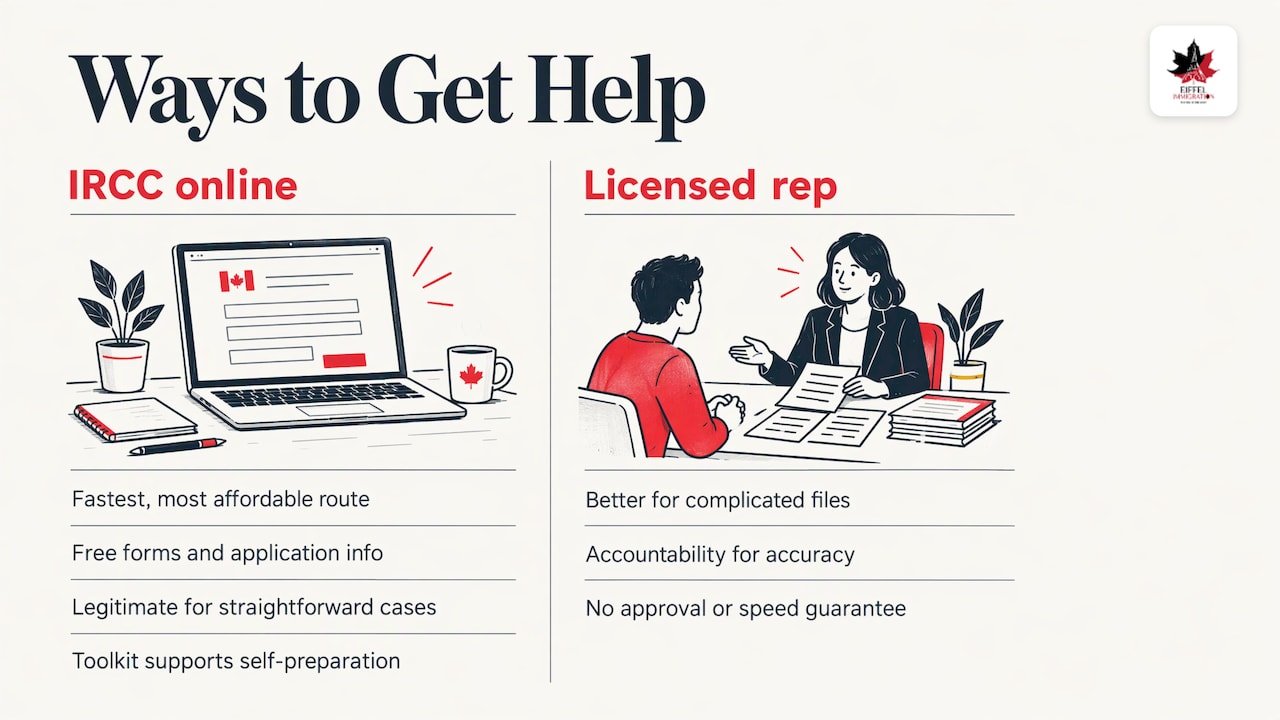
IRCC says the fastest and most affordable way to get help is to use its online resources. It also states that you don’t need to hire a representative and can get all the forms and information to apply for free on its website, and that hiring someone does not guarantee approval or faster processing. If your case is straightforward, this is a legitimate route. If your file has complications, or you want someone accountable for accuracy, a licensed representative is the better fit. Our Self Immigration Toolkit is a starting point for people who want to prepare on their own.
Lawyer referral and legal information lines
Steps to Justice, a Government of Canada-supported legal information site, describes two Ontario options:
- The Law Society Referral Service lets you fill out an online request form and get the name of a lawyer you can speak with for free, for up to 30 minutes. You can ask for a lawyer who speaks your language or accepts legal aid certificates.
- The Ontario Legal Information Centre offers anyone in Ontario a 30-minute meeting with a lawyer by phone or online, in English or French. This is legal information, not representation.
These sessions are short. They suit a specific question, such as whether a refusal can be challenged, more than a full review of your options.
Legal aid and community clinics
If you cannot afford a lawyer, legal aid may help. The IRB does not offer legal aid or pay for counsel. Six provinces offer immigration and refugee legal aid for eligible people: British Columbia, Alberta, Manitoba, Ontario, Quebec, and Newfoundland and Labrador. Contact the legal aid office in your province for eligibility details.
Steps to Justice also notes that other organizations may help if you do not qualify for Legal Aid Ontario. Examples include community legal clinics for low-income newcomers in specific regions, and targeted services such as Pro Bono Ontario’s free hotline for Ukrainians arriving in Canada, where callers can speak to a lawyer and get referrals.
Free settlement and pre-arrival services
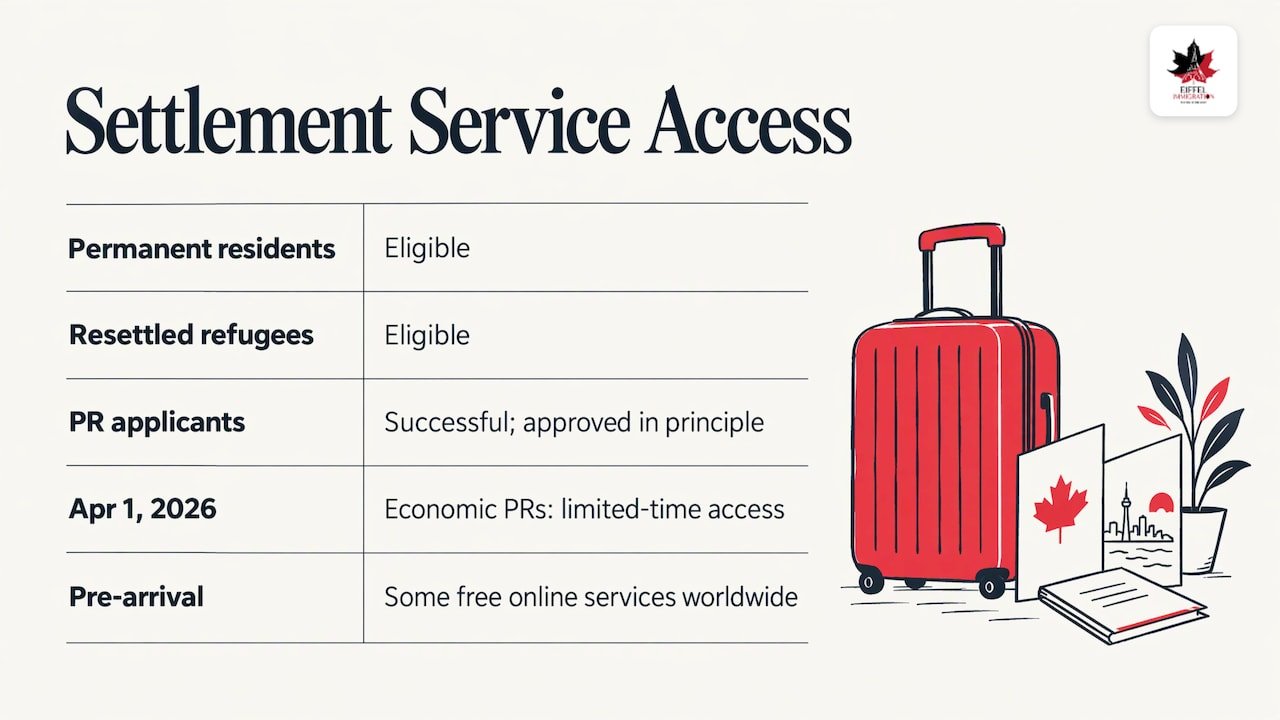
These services help with settling in, not with choosing a program or filing. IRCC’s finder says eligibility includes permanent residents, resettled refugees and successful permanent residence applicants approved in principle. It also notes that starting April 1, 2026, economic class permanent residents can only access newcomer services for a limited time. Before you arrive, some programs offer free online services worldwide, including the Active Engagement and Integration Project (AEIP).
Licensed immigration consultancies
Many licensed consultancies offer a free first consultation as a way to assess your case and explain the process and fees. This is where you can get an assessment tied to your own documents, and where the person you speak to may also be the one who handles your file. Ours is described below.
Which option fits which applicant
| Your situation | Useful free starting point | When to move to a representative |
|---|---|---|
| Straightforward application, comfortable with forms | IRCC website, free forms and guides | If you hit eligibility questions or a refusal |
| One specific legal question | Lawyer referral service or Ontario Legal Information Centre | If the question turns into a full application |
| Low income, refugee or legal status issue | Provincial legal aid or a community legal clinic | If you do not qualify for aid |
| Not sure which program fits | Free consultation with a licensed consultancy | When you want the file prepared and submitted |
| Already a permanent resident | IRCC settlement services | For citizenship applications or proof of citizenship |
International students
Students often need to decide between a study permit, an extension, and a path to a Post-Graduation Work Permit and later PR. A consultation helps you see how those steps connect before you commit. Read our guides on study permit to PR and Canada’s study permit cuts to prepare questions.
Skilled workers
Workers usually need to compare Express Entry streams, provincial nominee programs and employer-supported permits. Bring your résumé, language test results and education credentials to the call. Our Express Entry guide explains the main streams.
Families
Sponsorship questions center on who can be sponsored, whether to apply from inside or outside Canada, and what proof is needed. See our guides on spousal sponsorship and family sponsorship.
Citizenship applicants
Citizenship applicants need to confirm eligibility, including time spent in Canada, and those proving existing citizenship need the right documents. Our pages on Canadian citizenship and proof of citizenship cover both.
Who is allowed to give immigration advice
This matters more than the price of the first call. Canada.ca explains that consultants must be members of the College of Immigration and Citizenship Consultants; lawyers or notaries must belong to a provincial or territorial law society or the Chambre des notaires du Québec; and Ontario paralegals must be members of the Law Society of Ontario. It advises that you should not use anyone who is not a member in good standing, and that most law societies let you check membership online.
The scope differs by type of representative, according to Steps to Justice:
- Lawyers can give legal advice and services in all immigration and refugee law matters and represent you in any application, hearing or appeal.
- Paralegals can only help with immigration or refugee matters directly tied to an Immigration and Refugee Board hearing where they represent you. They cannot represent you in a Federal Court judicial review.
- Licensed consultants can help depending on their licence, and the Regulated International Student Immigration Advisors (RISIAs) advise international students on study permits and temporary resident visas.
The same page directs you to the Law Society of Ontario directory or the CICC registry to verify status.
How to choose an immigration consultant
Use the free consultation as an interview. A good one leaves you clearer about your case, not pressured.
- Verify the licence first. Ask for the full name and licence number, then check the public register of the relevant regulator.
- Ask who will handle your file. The person you speak to should be the one accountable for it.
- Ask for a written fee agreement before paying. It should list what is included and how payments are scheduled.
- Expect honest eligibility advice. Representatives cannot guarantee approval, and IRCC itself states that hiring someone does not guarantee approval or faster processing.
- Check language support. You should be able to ask questions in a language you are comfortable in.
- Look at communication. Ask how often you will get updates and who answers your questions.
For more on this, see our guides on choosing the right consultant near you and what immigration consultant fees look like.
How to prepare for a free consultation
A 30-minute call goes further when you arrive prepared. Gather:
- Your passport and any current permit or status documents.
- Language test results, if you have them.
- Education credentials and work history with dates.
- Any previous applications and refusal letters.
- Details of family members who would be included.
- A short list of questions ranked by priority.
Write down your timeline too. If your permit expires soon, say so at the start, since that changes the advice.
Our perspective on free consultations
We think a free consultation should do real work. It should tell you which program fits your profile, what the risks are, and what the process will involve, before you commit to anything.
That is why every file at Eiffel Immigration Solutions is handled by a licensed and accredited consultant, and why we provide written fee agreements before payment. Clients come to us from India, the Philippines, Nigeria and many other countries, and we support them in multiple languages so nothing is lost in translation.
Our approach is built on transparency: clear guidance on eligibility and risks from the first contact to the final decision, with regular updates along the way. Across study permits, work permits, permanent residence, family sponsorship and citizenship, we aim for you to understand every step of your own application.
LB
Book a free consultation with Eiffel Immigration
We are a licensed immigration consultancy based in the Greater Toronto Area, working on study permits, work permits, permanent residence (Express Entry, provincial nominee programs and family sponsorship), citizenship and refusal reviews. Our consultations are free, and our full services are billed under a written agreement. You can see everything we handle on our services page, or book your free consultation directly.
FAQ
Is a free immigration consultation really free?
The consultation itself is free with the providers described above. What follows, such as application preparation and representation, is paid work. Ask for the fee structure in writing before you agree to anything.
Do I need a representative to apply to immigrate to Canada?
No. IRCC states that you can get all the forms and information you need on its website for free. A representative can help when your file is complex, but hiring one does not guarantee approval or faster processing.
Can I get free immigration advice from a lawyer?
Yes, in limited form. The Law Society Referral Service in Ontario can connect you with a lawyer for up to 30 minutes at no charge. The Ontario Legal Information Centre offers a free 30-minute meeting for legal information. Legal aid is available in six provinces for eligible people.
How do I check that a consultant is licensed?
Canada.ca says consultants must be members of the College of Immigration and Citizenship Consultants, and lawyers must be members of a law society. Check the public register for the regulator, and do not use anyone who is not a member in good standing.
What should I bring to a free consultation?
Bring your passport, current status documents, language results, education and work history, and any earlier applications or refusal letters. A clear list of questions helps you use the time well.
Sources
- IRCC: How can I get help with my immigration or citizenship application?
- Canada.ca: Learn about representatives
- Canada.ca: Find out if your representative is authorized
- Steps to Justice: Get other free or lower cost legal services
- Steps to Justice: Find a licensed representative to help you
- IRB: List of legal aid offices
- IRCC: Find free newcomer services near you
- Canada.ca: Pre-arrival services
- Pro Bono Ontario: Canadian Legal Support for Ukrainians
Recommended
Talk it through with an Eiffel case worker
Eiffel Immigration has helped families come to Canada since 2019. Book a free 15-minute call and a case worker will explain what this change means for you. For a full profile review, ask about our $170 flat-rate consultation.
This article is general information, not legal advice. Confirm details with IRCC or a regulated consultant before you act.