

Family sponsorship lets a Canadian citizen or permanent resident bring certain relatives to Canada as permanent residents. A sponsor must be at least 18 and live in Canada. Spouses, partners and dependent children are the most common cases, and most of those have no income requirement. Parents and grandparents are sponsored through a capped, invitation-based intake that is currently paused. This guide covers who you can sponsor, who can sponsor, income rules, fees, processing times and what you commit to once your relative lands.
Key Takeaways
- You can sponsor a spouse, common-law partner, conjugal partner, dependent child, parent, grandparent and, in narrow cases, an orphaned relative or one “other relative”.
- In most spouse, partner and dependent child cases there is no income requirement. It applies in limited situations, and it applies to parents and grandparents.
- Both applications, the sponsorship and the sponsored person’s permanent residence application, go in together.
- Timelines differ sharply by category: about a year for most spouse and partner files, and much longer for parents and grandparents and for Quebec-bound files.
- The Parents and Grandparents Program is paused for new interest to sponsor forms. Check the official page for its current status.
Table of Contents
- Who you can sponsor
- Who can be a sponsor
- Income requirements
- How to apply
- Fees
- Processing times
- Parents and grandparents: where the program stands
- What you commit to as a sponsor
- Our perspective
- Talk to a licensed consultant
- FAQ
- Sources
Who you can sponsor
The Family Class has several categories, each with its own rules.
Spouse, partner and dependent children
You can sponsor a spouse, a common-law partner, a conjugal partner or a dependent child. The definitions matter, because most refusals in this category come from relationships that do not clearly fit one of them.
- Common-law partner: according to IRCC’s guidance on who you can sponsor, your partner must have lived with you for at least 12 consecutive months in a conjugal relationship, without long periods apart. Time away should have been short and temporary.
- Conjugal partner: the same IRCC page describes a person outside Canada who has been in an exclusive, mutually interdependent relationship with you for at least one year, and who cannot live with you or marry you in their country for legal, immigration, social, cultural, religious or other reasons.
- Dependent child: we cover the age and dependency rules, and the fees, in our guide to sponsoring your child to Canada.
For a full walk-through of inland and outland spousal files and the proof of relationship that officers look for, see our spousal sponsorship guide.
Parents and grandparents
Parents and grandparents are sponsored through a separate program with annual caps. It is paused for new interest to sponsor forms at the time of writing, so the section below explains how it works and what to do while you wait.
Other relatives
The rules for siblings, nephews, nieces and grandchildren are narrow. According to IRCC’s page on sponsoring relatives:
- You can sponsor an orphaned brother, sister, nephew, niece or grandchild only if they are related to you by blood or adoption, are under 18, both their parents have died, and they are single.
- You may sponsor one relative of any age (an “other relative”) if you are related by blood or adoption, you have no living relative in the standard categories you could sponsor instead, and you have no relatives who are Canadian citizens, permanent residents or registered Indians.
If you are asking whether you can bring a brother or sister, our article on sponsoring a brother or sister explains how these rules apply in practice.
Who can be a sponsor
The sponsor requirements are set by IRCC and the regulations. In summary, per IRCC’s eligibility page for spouses, partners and children, you must:
- be at least 18 years old;
- be a Canadian citizen, a permanent resident or a person registered under the Indian Act;
- live in Canada;
- sign an undertaking and a sponsorship agreement.
For relatives other than spouses, partners and children, IRCC states that your primary address must be in Canada when you submit and until a decision is made.
Situations that can block a sponsorship
The same IRCC pages list circumstances in which you may not be able to sponsor. They include:
- being in prison;
- having declared bankruptcy without a discharge;
- receiving social assistance for a reason other than disability;
- being behind on an immigration loan, a performance bond or court-ordered family support payments;
- having defaulted on a previous sponsorship;
- a conviction for a violent crime or sexual offence;
- being subject to a removal order.
Two extra limits apply to spouse and partner sponsorship. You may be ineligible if you became a permanent resident less than five years ago after being sponsored by a spouse or partner. You may also be ineligible if you signed an undertaking for a former spouse or partner and it has not yet been three years since they became a permanent resident. The same five-year rule appears in section 130 of the Immigration and Refugee Protection Regulations.
If any of these may apply to you, get a licensed consultant or lawyer to review your situation before you file. A returned or refused application costs time and fees.
Income requirements
Many readers assume every sponsor must prove a minimum income. That is not the case for the most common category.
IRCC says that in most cases there is no income requirement to sponsor a spouse, partner or dependent child. It applies only if you are sponsoring a dependent child who has one or more dependent children of their own, or a spouse or partner who has a dependent child with children of their own.
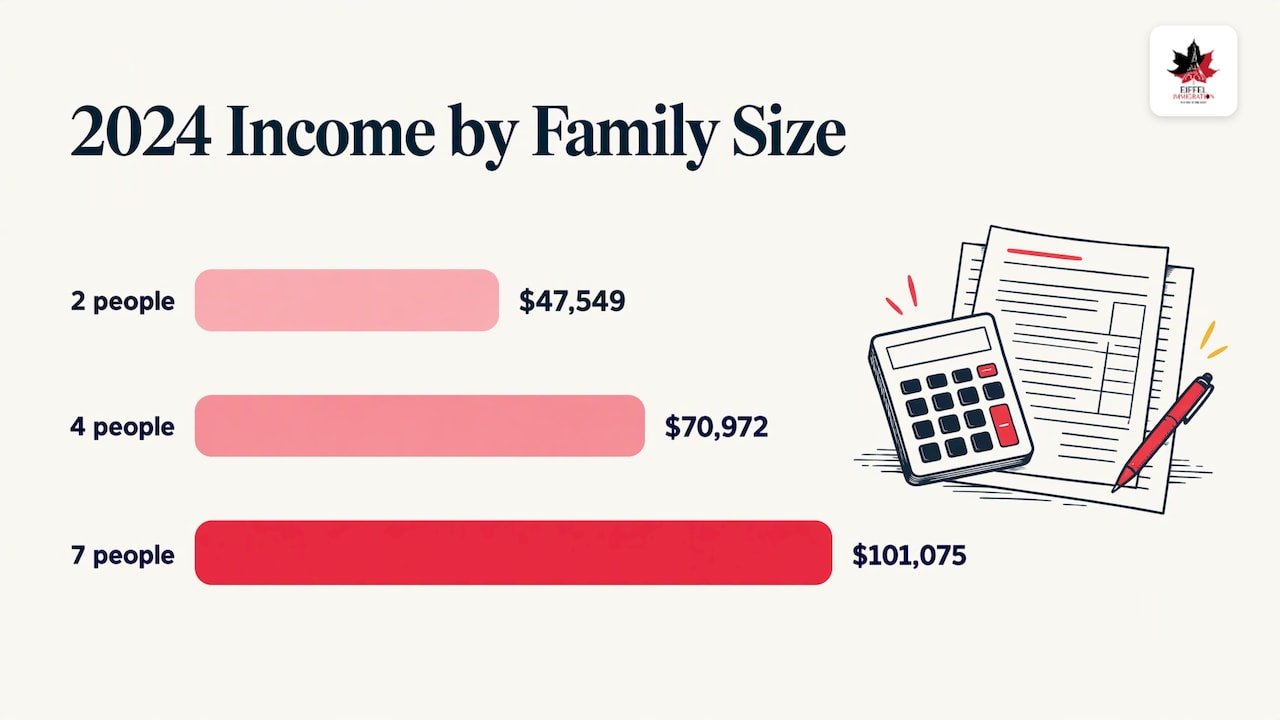
Parents and grandparents are different. The sponsor must show the minimum necessary income, and IRCC publishes the figures by family size. For the 2025 intake, sponsors had to meet the requirement for tax years 2024, 2023 and 2022. The IRCC income requirements page lists these amounts:
| Family size | 2024 | 2023 | 2022 |
|---|---|---|---|
| 2 people | $47,549 | $44,530 | $43,082 |
| 4 people | $70,972 | $66,466 | $64,306 |
| 7 people | $101,075 | $94,658 | $91,582 |
These figures are for the 2025 intake. They are updated for each intake, so use the current table on the IRCC page when the program reopens.
How to apply
Family sponsorship is a two-part process. IRCC explains that you apply to sponsor your relative, and your relative applies for permanent residence. Both applications must be sent at the same time.
For a spouse, partner or child, the person being sponsored submits both applications together online through the Permanent Residence Portal. The sponsor completes forms including IMM 1344, IMM 1283 and IMM 0133, and both the sponsor and the sponsored person must digitally sign IMM 1344.
Declare every family member
This step catches many applicants. IRCC requires you to declare and give details for all your family members, including those who are not applying with you, and those whose location is unknown, who are missing or who are presumed dead. If you leave someone out and they are not examined, you cannot sponsor them after you become a permanent resident.
A practical order of work
- Confirm the category and that both you and your relative are eligible.
- Gather identity, civil status and relationship evidence.
- Complete and sign the forms, and declare all family members.
- Pay the fees and submit both applications together.
- Respond promptly to requests for biometrics and medical exams.
After you apply, IRCC sends an application number and an acknowledgment of receipt, then assesses the sponsor and the sponsored person’s eligibility and admissibility. Biometrics are due within 30 days of the letter requesting them, and IRCC sets a deadline for the medical exam.
Fees
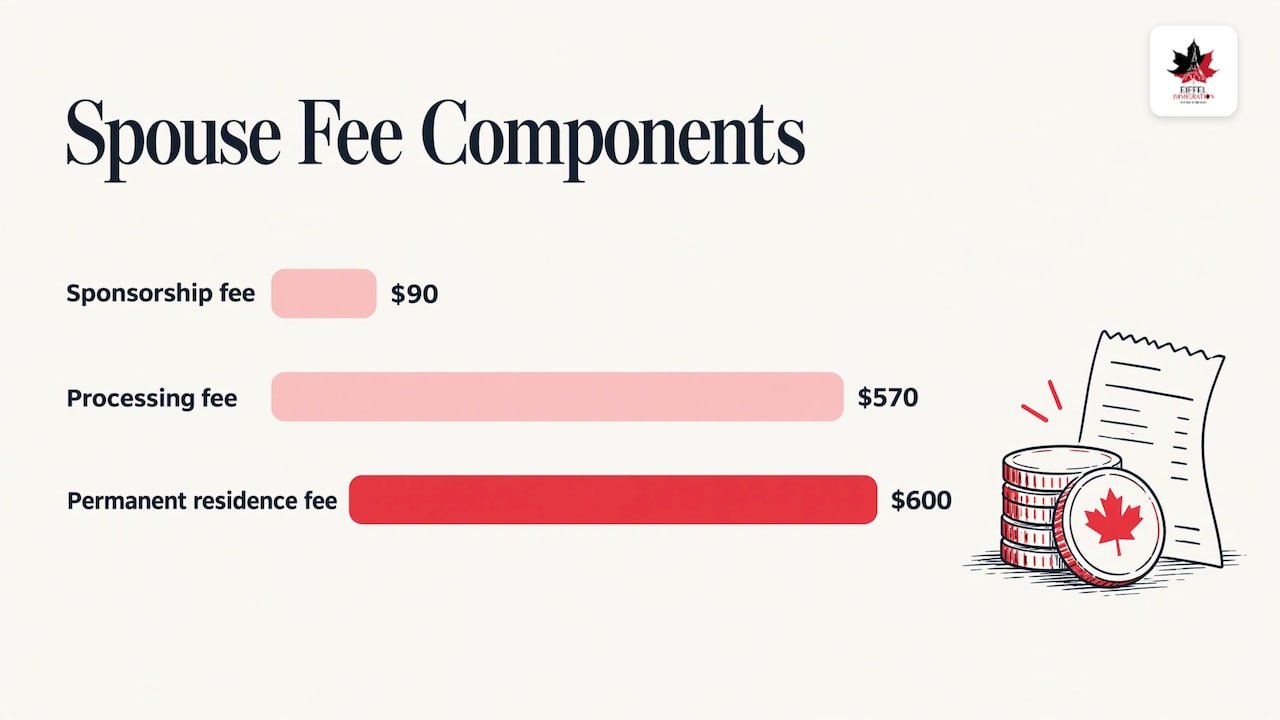
IRCC raised several fees on April 30, 2026. According to the IRCC fee changes page, the sponsorship fee moved from $85 to $90, the sponsored principal applicant fee from $545 to $570, the right of permanent residence fee from $575 to $600, and the fee for an accompanying dependent child from $175 to $180.
On IRCC’s online payment page, the total to sponsor a spouse or partner, including the sponsorship, processing and right of permanent residence fees, is $1,260. A dependent child is $180 per child. Biometrics are $85 per person or $170 for a family of two or more.
These are government fees only. Fees change, so confirm the amounts on IRCC’s pages before you pay. Professional fees are separate; at Eiffel Immigration, a written fee agreement is provided before any payment.
Processing times
Waiting times depend heavily on the category and on whether the file is processed inside or outside Quebec.
- Spouses, partners and children, overseas: IRCC’s service standard is 12 months, met 80% of the time.
- Spouses and partners in Canada: the same briefing states there is no service standard, and wait times have reached about three years in the past.
- As of September 30, 2025, IRCC reported processing times for spouse, partner and child applications outside Quebec of about 12.9 months overseas and 13 months in Canada. For Quebec-bound applications, the figures were about 34 months overseas and 23 months in Canada.
- Parents and grandparents: on the same date, about 47,200 people were in the inventory outside Quebec, with processing at 19 months, and 11,800 in the Quebec inventory, at 44 months.
These are snapshots. IRCC updates its processing tool regularly, so use it for your own category, and see our IRCC processing times update for how the pace has been shifting.
Visiting while you wait
A spouse or partner may qualify for faster visitor visa processing once the sponsor has an acknowledgment of receipt showing the permanent residence application is in progress. IRCC states that eligible applicants receive this automatically, with no request needed. If your spouse is in Canada and wants to work during processing, read our guide to the spousal open work permit.
Parents and grandparents: where the program stands
The Parents and Grandparents Program works differently from other categories. IRCC’s Deputy Minister briefing says it has had annual intake caps since 2014. Intake has two stages: interested sponsors submit an Interest to Sponsor form, then IRCC randomly selects and invites a limited number to apply.
According to IRCC’s application page, the program is paused. IRCC is not accepting new Interest to Sponsor forms or inviting potential sponsors until further notice, though it continues to process existing applications. The 2025 intake closed on October 9, 2025, after IRCC invited 17,860 people who had submitted a form in 2020, aiming to accept 10,000 complete applications.
Levels are set for the coming years too. The 2026 to 2028 plan allocates 15,000 admissions a year to parents and grandparents, and 69,000 for spouses, partners and children in 2026, then 66,000 in 2027 and 2028. The Family Class total is 84,000 in 2026 and 81,000 in each of 2027 and 2028. In 2025 Canada admitted approximately 96,100 people through family sponsorship, and the 2026 plan puts the Family Class at about 22% of overall admissions, per the Deputy Minister briefing.
The Super Visa as a bridge
Parents and grandparents may qualify for a Super Visa. It is a multiple-entry visitor visa valid for up to 10 years that allows stays of up to five years per entry. It requires a medical exam, proof of health insurance and a declaration of support from the host, including proof of sufficient income, according to the same IRCC briefing. We assist with Super Visa applications. For the latest on the pause, see our article on the Parents and Grandparents pause.
What you commit to as a sponsor
Sponsoring is a legal commitment. IRCC states that you must support your relative and their accompanying family members financially from the day they become a permanent resident, for up to 20 years depending on their age and your relationship, and ensure they do not need to ask the government for social assistance.
The commitment continues even if your circumstances change, for example after a separation or a move. Read the undertaking carefully before signing.
Our perspective
Most family sponsorship problems we see are avoidable. They start with the wrong category, an incomplete family declaration, a gap in relationship evidence or a sponsor who did not check the disqualifiers before filing.
Our approach is to assess eligibility and risk before an application is prepared. Every file is handled by a licensed and accredited consultant, and a written fee agreement is provided before payment. Clients receive regular updates from first contact to final decision, and we support clients in multiple languages.
Families are rarely in one category. A sponsor may have a spouse overseas, a child with dependants and parents who need a Super Visa while the program is paused. We plan these together so the order of applications makes sense.
LB
Talk to a licensed consultant
If you want your eligibility, category and documents reviewed before you file, we offer free consultations. Eiffel Immigration handles spousal and child sponsorship, Super Visa applications, spousal open work permits and refusal review and reapplication. See all of our immigration services or read more about our family sponsorship support, then book a free consultation.
FAQ
Is there an income requirement to sponsor my spouse?
In most cases, no. IRCC applies an income requirement only when a dependent child you sponsor, or your spouse’s dependent child, has dependent children of their own. Parent and grandparent sponsors must meet the minimum necessary income.
Is parent sponsorship open?
No. IRCC is not accepting new Interest to Sponsor forms or inviting sponsors until further notice, but it is processing existing applications. Check IRCC’s page for the current status. A Super Visa may allow your parents to stay with you meanwhile.
Can I sponsor someone if I am on social assistance?
It depends on the reason. IRCC lists social assistance received for reasons other than disability as something that may prevent you from sponsoring. If you receive disability support, the rules differ, so have your case reviewed.
How long does a spousal sponsorship take?
IRCC’s overseas service standard is 12 months, met 80% of the time. As of September 30, 2025, outside Quebec, spouse and partner files were taking about 13 months in Canada and 12.9 months overseas. Quebec-bound files take longer.
Can I sponsor a brother or sister?
Only in narrow cases: an orphaned, single sibling under 18, or as your one “other relative” when you have no other eligible relatives and no relatives who are Canadian citizens, permanent residents or registered Indians.
Sources
- IRCC: Sponsor your spouse, partner or children, who you can sponsor
- IRCC: Sponsor your relatives, who you can sponsor
- IRCC: Sponsor your spouse, partner or child, check if you’re eligible
- IRCC: Sponsor your relatives, check if you’re eligible
- Immigration and Refugee Protection Regulations, section 130
- IRCC: Income requirements for the sponsor
- IRCC: Sponsor your relatives, how to apply
- IRCC: Sponsor your spouse, partner or child, how to apply
- IRCC: Sponsor your spouse, partner or child, after you apply
- IRCC: Fee changes
- IRCC: Online payment
- IRCC: Deputy Minister Transition Binder 2026, family reunification
- IRCC: CIMM family reunification briefing, December 4, 2025
- IRCC: Sponsor your parents and grandparents, how to apply
Recommended
Talk it through with an Eiffel case worker
Eiffel Immigration has helped families come to Canada since 2019. Book a free 15-minute call and a case worker will explain what this change means for you. For a full profile review, ask about our $170 flat-rate consultation.
This article is general information, not legal advice. Confirm details with IRCC or a regulated consultant before you act.