


The Canadian Experience Class (CEC) is a permanent residence program for people who have already worked in Canada. To qualify, you need at least one year of skilled, paid Canadian work experience in the last three years, a minimum language score in all four abilities, and an Express Entry profile that IRCC ranks high enough to invite. There is no education requirement. If your file is close to the line, a licensed consultant at Eiffel Immigration Solutions can review your hours, your NOC code and your language results before you submit anything.
Key Takeaways
- The CEC needs 1 year (1,560 hours) of paid work in Canada in a TEER 0, 1, 2 or 3 job, gained within the 3 years before you apply, while authorized to work.
- Language minimums are CLB 7 for TEER 0 or 1 jobs and CLB 5 for TEER 2 or 3 jobs, in speaking, listening, reading and writing.
- Work done while studying full time, self-employment and volunteering do not count toward the year.
- Meeting the minimum does not guarantee an invitation: IRCC ranks every profile with the Comprehensive Ranking System (CRS), and since November 3, 2026 the CRS has a new Labour Market Integration factor.
- If you qualify for several Express Entry programs, you are invited under the CEC first.
Table of Contents
- What the Canadian Experience Class is
- Canadian Experience Class requirements
- How IRCC counts the year of experience
- Language requirements
- From profile to permanent residence
- What changed on November 3, 2026
- CEC or Federal Skilled Worker?
- Common mistakes that cost candidates time
- Our perspective
- Next step: a review of your profile
- FAQ
- Sources
What the Canadian Experience Class is
The CEC is one of three programs managed through Express Entry, Canada’s online system for skilled workers. In law, it is a class of people who may become permanent residents because of their ability to become economically established, their experience in Canada and their intention to live outside Quebec, as set out in section 87.1 of the Immigration and Refugee Protection Regulations.
In practice, the CEC is built for people who are already inside the Canadian labour market:
- international students who finished a program and are working on a Post-Graduation Work Permit;
- workers on employer-specific or open work permits;
- spouses on open work permits who have held a skilled job.
If you are still planning your move and have never worked in Canada, the CEC is not your route yet. The Federal Skilled Worker Program, covered below, is the Express Entry option for people with experience gained abroad.
Canadian Experience Class requirements
IRCC lists the following conditions on its Canadian Experience Class page:
- At least 1 year (1,560 hours) of paid work experience in Canada in an occupation classed as TEER 0, 1, 2 or 3.
- That experience gained within the 3 years before you apply, while you were authorized to work under temporary resident status.
- The minimum language level in all four abilities.
- Admissibility to Canada, which covers matters such as health and criminal and security checks.
- A plan to live outside Quebec, which runs its own selection system.
TEER stands for Training, Education, Experience and Responsibilities. It is the part of the National Occupational Classification (NOC) that sorts jobs by skill level. TEER 0 covers management jobs, TEER 1 usually needs a university degree, TEER 2 a college diploma or apprenticeship, and TEER 3 shorter college training or more than six months of on-the-job training.
There is no education requirement. Education still matters for your ranking, because you can claim CRS points for a Canadian credential or for a foreign one supported by an Educational Credential Assessment report.
How IRCC counts the year of experience
Most refusals and profile errors in the CEC come from this part, so it is worth reading slowly.
The 1,560 hours
IRCC accepts the 1,560 hours in three ways:
| Pattern | What it looks like |
|---|---|
| Full time at one job | Up to 30 hours a week for 12 months |
| Part-time equivalent | For example, 15 hours a week for 24 months |
| Several jobs | Up to 30 hours a week combined across jobs for 12 months |
This is described on the IRCC CEC page. Hours above 30 a week at one job do not speed the clock up.
What counts and what does not
Qualifying work must be paid by wages or commission. You must also show that you performed the actions in the lead statement of the NOC job description and most of its main duties. A job title alone is not enough: the duties on your reference letter have to match the NOC code you claim.
These do not count:
- work done while studying full time, including co-op placements on a study permit, as confirmed in the IRCC help centre;
- self-employment, with a narrow exception for some physicians;
- volunteering;
- any work done without authorization.
The three-year window
The three years are counted back from the moment you apply. That means an old year of work can fall out of the window while you wait to be invited. If you have left Canada, you can still be eligible, provided the experience falls in the window and the other requirements are met, according to IRCC’s help centre.
A worked example
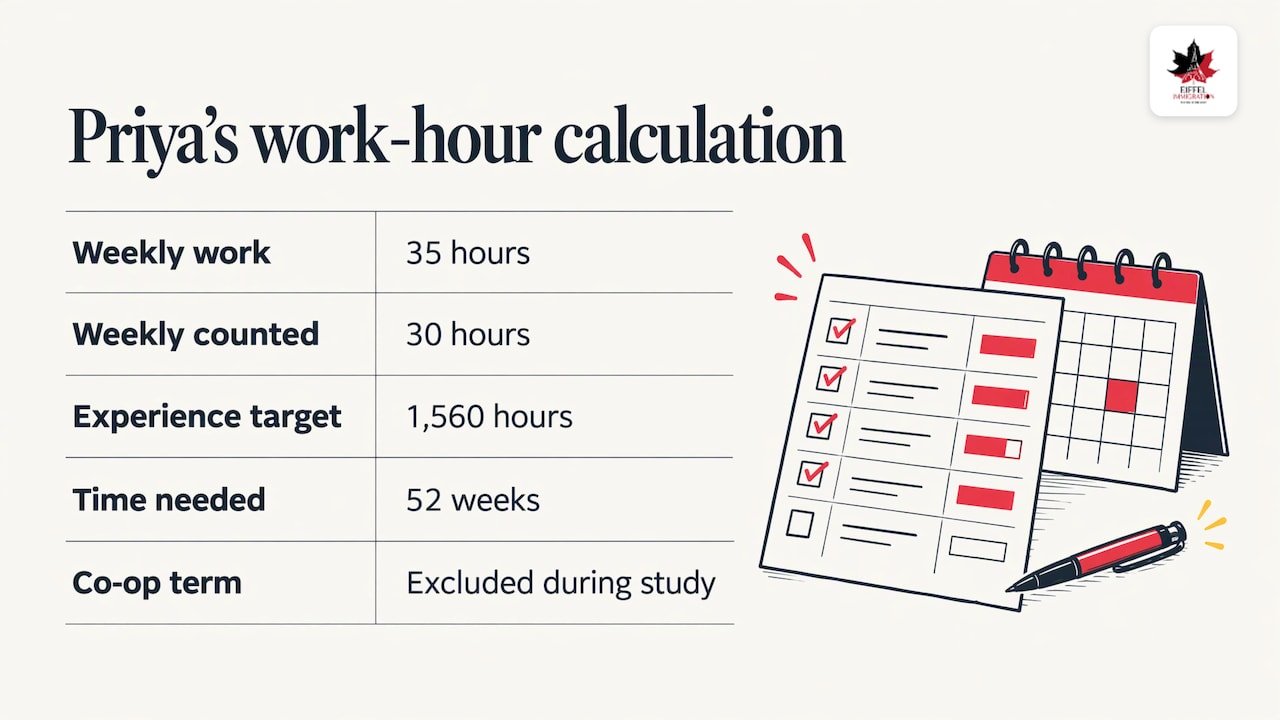
Priya finished a college program and holds a Post-Graduation Work Permit. She works 35 hours a week as an accounting technician, a TEER 3 job, starting in January. Only 30 hours a week count, so she reaches 1,560 hours after 52 weeks, not sooner. She cannot count the co-op term she completed while on her study permit. Her NOC match depends on her duties, so she checks her employer’s letter against the NOC lead statement before entering any dates.
Language requirements
You must take an approved English or French test and reach the minimum in each of the four abilities. IRCC’s language test page sets the levels:
| Job category | Minimum level | IELTS equivalent |
|---|---|---|
| TEER 0 or 1 | CLB 7 (or NCLC 7 for French) | 6.0 in each ability |
| TEER 2 or 3 | CLB 5 (or NCLC 5) | 5.0 speaking, 5.0 listening, 4.0 reading, 5.0 writing |
CLB is the Canadian Language Benchmarks, the scale Canada uses to compare test results. Your results must be less than two years old when you complete your profile and when you submit your permanent residence application. A test taken early can expire before you are invited, so plan the date around your profile.
The minimum only gets you into the pool. Higher scores earn more CRS points, and language is often the fastest area where a candidate can improve a ranking.
From profile to permanent residence
The CEC works through Express Entry in four stages:
- Check eligibility and gather documents. Language results, passport, work permits, and reference letters from each employer showing hours, pay and duties.
- Create an online profile and enter the pool. If you are eligible, IRCC scores you with the CRS.
- Wait for an invitation to apply (ITA). IRCC invites top-ranked candidates in rounds. A profile does not guarantee an invitation.
- Submit your permanent residence application within the deadline stated in the invitation, with all supporting documents.
If you qualify for more than one program, IRCC invites you to the first one in this order: CEC, then Federal Skilled Worker, then Federal Skilled Trades. You cannot choose. That is useful to know if your profile is eligible for all three.
The weakest point is usually not the form, it is the evidence. An ITA gives you a limited time to produce complete documents, so mismatched duties or missing letters can cost you the invitation you waited months for. This is where the work of a licensed consultant helps most: at Eiffel Immigration Solutions, every file is handled by a licensed and accredited consultant, who explains eligibility and risks from the first contact.
What changed on November 3, 2026
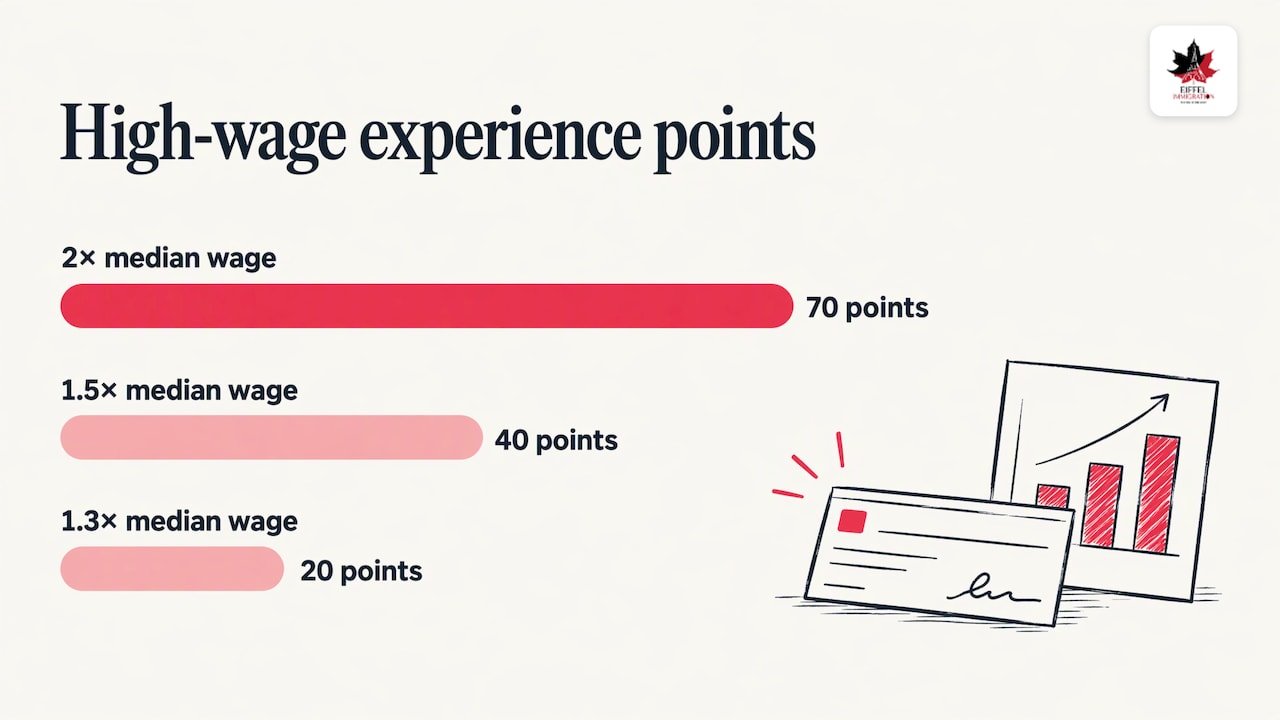
The CRS was updated on November 3, 2026. IRCC’s CRS criteria page now lists a Labour Market Integration factor. It gives points for either Canadian work experience or a high-wage job offer, but not both. For a candidate without a spouse or partner, the maximum is 150 points, made up of up to 80 points for length of Canadian work experience and up to 70 for high-wage experience.
The high-wage points apply to at least 12 months in occupations whose median wages meet set multiples of the median wage:
| High-wage Canadian experience | Points |
|---|---|
| Median wages at least 2 times the median wage | 70 |
| At least 1.5 times | 40 |
| At least 1.3 times | 20 |
Length-of-experience points are unchanged by this factor in their scale: one year of Canadian experience is worth 40 points without a spouse and 35 with one, rising to 80 and 70 at five years or more.
A second change concerns job offers. IRCC states that an LMIA, the employer’s Labour Market Impact Assessment, is not needed for a job offer to count under Express Entry, and having one gives no extra points or priority, according to the Federal Skilled Worker page. An officer assesses whether the offer is genuine at the application stage.
For how these changes play out in draws and cut-offs, see our pages on CRS changes in 2026, CEC draw results and CRS trends. Cut-offs move with every round, so check the latest draw before you judge your score.
CEC or Federal Skilled Worker?
The two programs sit side by side in Express Entry, and many readers search both. The Federal Skilled Worker Program (FSWP) does not require Canadian experience. Here is how they compare:
| Canadian Experience Class | Federal Skilled Worker | |
|---|---|---|
| Where the work was done | Canada only | Canada or abroad |
| Amount | 1 year (1,560 hours) | 1 year continuous or 1,560 hours |
| Time window | Last 3 years | Last 10 years |
| Occupation | TEER 0, 1, 2 or 3 | TEER 0, 1, 2 or 3, same NOC as primary occupation |
| Language | CLB 7 (TEER 0/1) or CLB 5 (TEER 2/3) | CLB 7 in all four abilities |
| Education | None required | Required |
| Points grid | None | At least 67 points |
| Proof of funds | Not required | Required unless exempt |
The FSWP requires you to meet the education and language requirements, score at least 67 points on its selection grid, and show proof of funds unless exempt. The language comparison comes from IRCC’s language test page.
Student work is a key difference. According to IRCC’s help centre, paid, continuous work gained while studying can count for the FSWP, but not for the CEC or Federal Skilled Trades. A graduate who worked part time during a degree may therefore qualify under the FSWP before reaching a full CEC year after graduation.
Our pages on the Federal Skilled Worker grid and funds and on how economic programs compare go further.
Common mistakes that cost candidates time
- Counting study-period work. Co-op and off-campus work during full-time study does not count toward the CEC year.
- Claiming the wrong NOC code. The code must match your actual duties, not just your job title.
- Letting language results expire. Results older than two years cannot be used.
- Assuming a job offer needs an LMIA. For Express Entry, it does not.
- Counting hours over 30 a week. Extra hours do not shorten the required year.
- Waiting too long. Experience older than three years leaves the window.
Our perspective
We read CEC files every week, and the pattern is consistent: eligibility is rarely the problem. Documentation is. A candidate can hold a full year of skilled work and still have a weak file because the reference letters do not show hours, pay and duties in the way an officer expects.
That is why we start with a full profile review before any profile is entered into the pool. A licensed consultant checks the NOC code against your real duties, the 1,560-hour count, your language results and your expiry dates, and explains the eligibility and risks in writing from the first contact.
The new Labour Market Integration factor makes this more valuable. Whether your Canadian experience falls into a high-wage occupation can change your score, so how your work is described, accurately, matters. We also look at whether a provincial nomination or a different program suits you better, and we offer support in multiple languages so that every client understands each step.
LB
Next step: a review of your profile
Eiffel Immigration Solutions is a licensed immigration consultancy in the Greater Toronto Area. We offer free consultations, and a written fee agreement is provided before any payment. Our services cover the Canadian Experience Class and 19 other programs, and our full profile review is the place to start if you want your hours, NOC code and language results checked. Our Canadian Experience Class page sets out the rules and the November 3 points.
FAQ
Who can apply for the Canadian Experience Class?
Skilled workers with at least one year of paid Canadian experience in a TEER 0, 1, 2 or 3 job, gained in the last three years under valid temporary resident status. They must meet the language minimum, be admissible and plan to live outside Quebec. Graduates on a Post-Graduation Work Permit are the most common applicants.
Do I need a job offer for the CEC?
No. The CEC requires past Canadian work experience, not a job offer. Since November 3, 2026, a high-wage job offer can earn CRS points without an LMIA, but it is counted in the same factor as work experience and not in addition to it.
Is there an education requirement for the CEC?
There is none. You can still claim CRS points for a Canadian credential, or for a foreign one with an Educational Credential Assessment report, and these points can raise your ranking.
Can I apply if I have left Canada?
Yes, if you meet the requirements, including 12 months of qualifying experience in the three years before you are invited to apply. Check the window carefully, because the time since you left counts against it.
Does meeting the requirements guarantee an invitation?
No. IRCC invites the highest-ranked candidates in each round, and a profile does not guarantee an invitation. Your CRS score and the cut-off of the round decide the outcome.
Sources
- Express Entry: Canadian Experience Class, Canada.ca
- Immigration and Refugee Protection Regulations, section 87.1
- IRCC help centre: work experience gained while studying (answer 667)
- IRCC help centre: eligibility after returning home (answer 389)
- Express Entry: Language test results, Canada.ca
- Express Entry: Create your profile and enter the pool, Canada.ca
- Express Entry: Federal Skilled Worker Program, Canada.ca
- IRCC help centre: student work experience (answer 394)
- Express Entry: Comprehensive Ranking System criteria, Canada.ca
Recommended
Talk it through with an Eiffel case worker
Eiffel Immigration has helped families come to Canada since 2019. Book a free 15-minute call and a case worker will explain what this change means for you. For a full profile review, ask about our $170 flat-rate consultation.
This article is general information, not legal advice. Confirm details with IRCC or a regulated consultant before you act.