

Imagine earning $35 per hour in Canada while your friend earns $25 per hour. You might think you have a better chance of getting additional Express Entry points because your salary is higher. But under Canada’s new Express Entry rules, that is not necessarily true!
Starting November 3, 2026, Immigration, Refugees and Citizenship Canada (IRCC) is introducing major changes to the Comprehensive Ranking System (CRS).
One of the biggest changes is the introduction of Express Entry high-wage points, which could help eligible candidates improve their CRS scores.
But here is something many applicants may misunderstand: your actual salary is not what determines whether your occupation qualifies for these new points.
Let’s understand how the new system works and what it means for your Canadian permanent residence journey.
What Are Express Entry High-Wage Points in 2026?
Under the new rules, IRCC will introduce a Labour Market Integration factor that rewards eligible Canadian work experience and qualifying job offers.
Candidates may receive additional CRS points when their occupation appears on IRCC’s official high-wage occupation list.
The government has divided eligible occupations into three wage levels based on their National Occupational Classification (NOC) codes.
These categories are determined by comparing the typical wages of occupations across Canada with the overall Canadian workforce.
This means Express Entry high-wage points depend on the occupation’s wage classification rather than simply how much an individual worker earns.
Does Your Actual Salary Matter for Express Entry High-Wage Points?
No. Your individual salary does not determine whether your occupation belongs to a high-wage category.
This is probably the most important part of the new rules.
IRCC uses national occupational wage data to classify jobs into different high-wage levels.
For example:
Example 1:
Raj works in an occupation that IRCC classifies at twice the national average median wage. His actual salary is $55,000 per year.
If Raj has at least 12 months of eligible Canadian work experience in that occupation, he may qualify for 70 additional CRS points.
Example 2:
Simran earns $90,000 per year, but her occupation is not included on IRCC’s high-wage occupation list.
Even though Simran earns more than Raj, she would not receive additional high-wage occupation points based on that job.
These are hypothetical examples, but they explain an important distinction.
A higher personal salary does not automatically mean more Express Entry high-wage points.
Your correct NOC classification, qualifying experience and the occupation’s position on IRCC’s official list are what matter.
How Many Express Entry High-Wage Points Can You Receive?
Starting November 3, 2026, candidates with at least one year of qualifying Canadian work experience in an eligible high-wage occupation may receive the following additional points:
| Occupation wage level | Additional CRS points |
|---|---|
| At least 2 times the overall average median wage | 70 |
| At least 1.5 times the overall average median wage | 40 |
| At least 1.3 times the overall average median wage | 20 |
These additional points are awarded on top of the CRS points available for the duration of eligible Canadian work experience.
For example, a candidate without an accompanying spouse who has five or more years of eligible Canadian work experience may receive 80 points for work experience duration.
If that candidate also qualifies for 70 high-wage occupation points, the combined total could reach 150 CRS points under the Labour Market Integration factor.
For candidates with an accompanying spouse or common-law partner, the corresponding maximum is 140 points.
However, applicants must meet all applicable eligibility requirements.
Which Jobs Qualify for Express Entry High-Wage Points?
Not every skilled occupation qualifies for the additional points.
IRCC has published an official list of eligible high-wage occupations using NOC codes.
Some occupations appearing on the list include:
- Financial managers
- Engineering managers
- Computer and information systems managers
- General practitioners and family physicians
- Nurse practitioners
- Lawyers and Quebec notaries
- University professors and lecturers
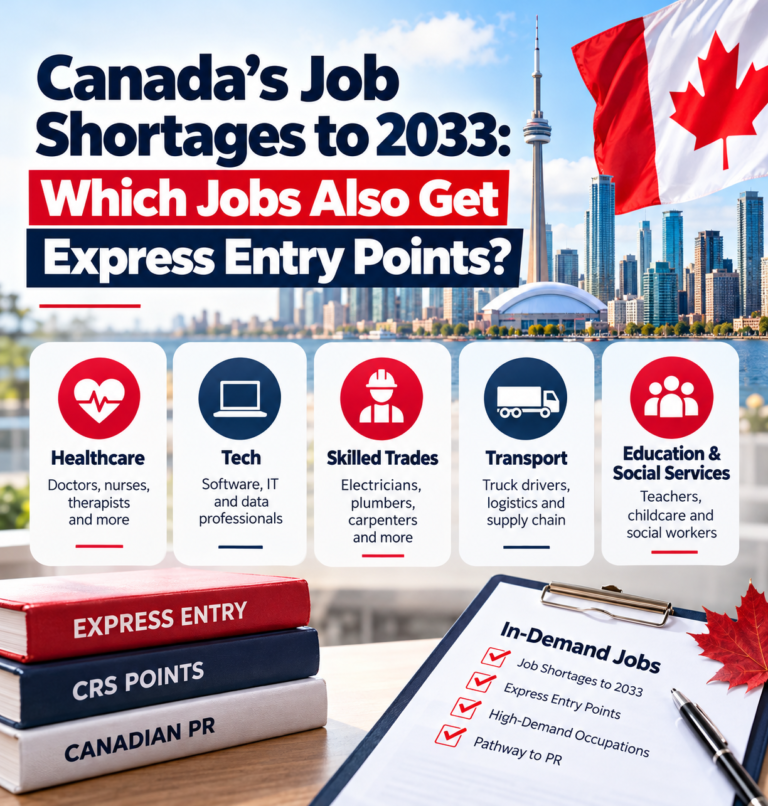
Other occupations in healthcare, technology, engineering, skilled trades and related sectors may also qualify under the applicable wage levels.
However, having a job title that sounds similar to an eligible occupation does not guarantee eligibility.
Your actual job duties must support the correct NOC classification.
Applicants should verify their NOC code against IRCC’s official list before assuming they qualify.
Can You Get Express Entry High-Wage Points Through a Job Offer?
Yes!
Another major change is that qualifying job offers in eligible high-wage occupations can receive CRS points.
Under the new system:
| High-wage occupation level | Job offer CRS points |
|---|---|
| At least 2 times the overall average median wage | 100 |
| At least 1.5 times the overall average median wage | 70 |
| At least 1.3 times the overall average median wage | 50 |
A qualifying job offer generally must involve full-time, continuous employment in Canada for at least one year after the applicant becomes a permanent resident.
The employer must also be able to demonstrate that the offer is genuine and meets IRCC’s requirements.
Important: Candidates cannot combine the points available for a qualifying job offer with those available for Canadian work experience under the Labour Market Integration factor.
IRCC will use whichever option provides the higher score.
Will an LMIA Still Be Required for Express Entry Job Offer Points?
Starting November 3, 2026, an LMIA will no longer be required for qualifying job offers to receive the new CRS points.
This is a significant change for foreign workers and Canadian employers.
Previously, many applicants believed that obtaining an LMIA was essential to improving their Express Entry opportunities.
Under the new rules, IRCC will assess qualifying job offers without requiring an LMIA.
However, this does not mean that every employment letter or job offer automatically qualifies.
IRCC officers will still examine whether the employer is operating a genuine business, whether the employment offer meets reasonable business needs, and whether the applicant is qualified for the position.
The removal of the LMIA requirement for Express Entry job offer assessment also does not automatically remove LMIA requirements for obtaining an employer-specific work permit.
What If Your Occupation Is Not on the High-Wage List?
There is no need to assume that your permanent residence options have ended.
Candidates working in occupations that are not classified as high-wage may still receive CRS points for their eligible Canadian work experience.
They may also qualify under programs such as the Canadian Experience Class, Federal Skilled Worker Program or Federal Skilled Trades Program, provided they meet the applicable requirements.
Other factors, including language proficiency, education, Canadian work experience and provincial nominations, can continue to influence Express Entry eligibility and ranking.
Therefore, even without additional Express Entry high-wage points, a candidate may still have opportunities to improve their CRS score.
What Should Express Entry Candidates Do Before November 3, 2026?
With the new changes approaching, applicants should review their Express Entry profiles carefully.
First, confirm that their NOC code accurately reflects their actual employment duties.
Second, check whether their occupation appears on IRCC’s official high-wage occupation list.
Third, review their eligible Canadian work experience, including the duration and whether it meets Express Entry requirements.
Candidates with qualifying job offers should ensure that their employment information is complete and accurate.
IRCC has indicated that existing Express Entry profiles will be recalculated after the new rules take effect. This process may take up to two weeks, during which invitation rounds will be paused.
Keeping profile information accurate before the changes take effect is therefore particularly important.
Final Thoughts: Does Salary Really Matter for Express Entry in 2026?
Canada’s new Express Entry high-wage points represent a significant change in how the country recognizes Canadian work experience and qualifying job offers.
But the biggest takeaway is simple:
You do not necessarily need a personally high salary to qualify for high-wage occupation points. You need qualifying employment in an occupation that IRCC officially classifies as high-wage.
Two people earning different salaries may qualify for the same high-wage points if they work in the same eligible NOC category and meet the relevant requirements.
At the same time, a worker earning a higher salary in a non-eligible occupation may receive no additional high-wage points.
Understanding this difference can help applicants avoid incorrect assumptions about their CRS scores.
At Eiffel Immigration Solutions, we believe that understanding immigration changes in simple language helps applicants make better decisions about their future in Canada.
Disclaimer: This article provides general information based on IRCC’s announced changes effective November 3, 2026. Immigration eligibility depends on individual circumstances and applicable rules. Additional CRS points do not guarantee an invitation to apply for permanent residence.