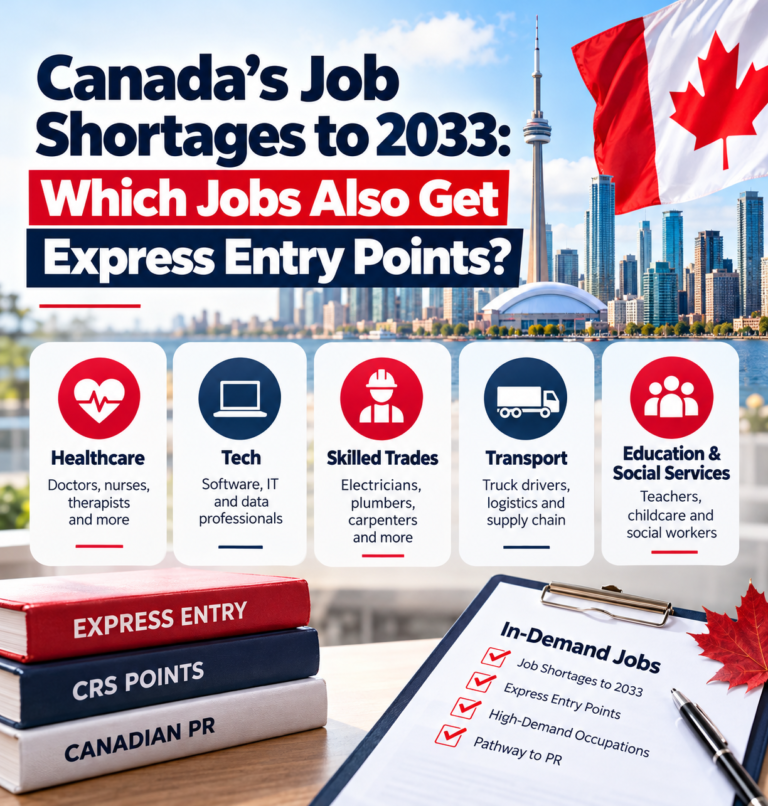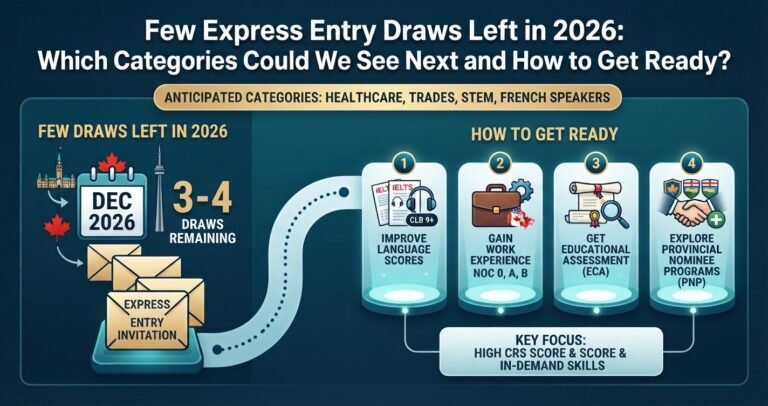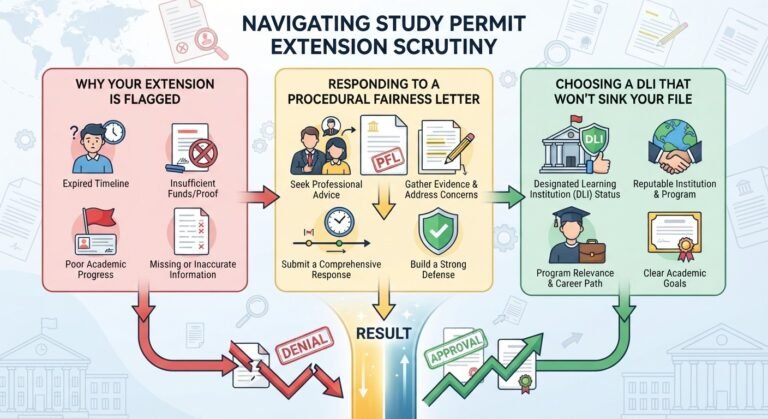

Did you know that Canada could face worker shortages in more than 100 occupations by 2033? But here’s the interesting part: some of these jobs may also help foreign workers qualify for Express Entry invitations or additional CRS points!
If you are planning to work, study or apply for permanent residence in Canada, understanding Canada job shortages and Express Entry points could help you make better career and immigration decisions.
Canada is looking for skilled workers in healthcare, construction, engineering, education and several other sectors.
However, not every job facing a shortage automatically qualifies for additional Express Entry points.
Let’s understand which occupations are expected to remain in demand and how they connect to Canada’s immigration system.
Canada Job Shortages and Express Entry Points: What Does the 2033 Report Say?
Employment and Social Development Canada (ESDC) has released labour market projections covering 2024 to 2033.
According to the Canadian Occupational Projection System (COPS), 103 occupations are expected to face a moderate or strong risk of worker shortages by 2033.
The report also estimates approximately 8.1 million job openings across Canada during this period.
A large portion of these openings will come from workers retiring rather than entirely new jobs being created.
Here is how the 103 shortage occupations are distributed:
| Occupational sector | Occupations facing shortages |
|---|---|
| Healthcare | 34 |
| Construction trades and transportation | 28 |
| Natural and applied sciences | 12 |
| Education and social services | 11 |
| Manufacturing | 8 |
| Agriculture | 4 |
| Sales and services | 4 |
| Natural resources | 2 |
| Total | 103 |
These numbers show where Canada may need workers over the next several years.
But what makes Canada job shortages and Express Entry points particularly interesting is that some occupations also appear in IRCC’s immigration priority categories.
1. Healthcare Jobs: Strong Demand and Express Entry Opportunities
Healthcare remains one of Canada’s most important sectors.
An aging population, growing demand for medical services and worker retirements are expected to create continued demand for healthcare professionals.
Some healthcare occupations facing projected shortages also qualify under Express Entry’s healthcare and social services category.
Examples include:
| Occupation | NOC code |
|---|---|
| Registered nurses | 31301 |
| Licensed practical nurses | 32101 |
| General practitioners and family physicians | 31102 |
| Pharmacists | 31120 |
| Physiotherapists | 31202 |
| Medical laboratory technologists | 32120 |
| Nurse aides and patient service associates | 33102 |
Why does this matter for immigration?
Under category-based selection, eligible healthcare workers may receive invitations in rounds specifically targeting healthcare and social services occupations.
For example, someone with qualifying experience as a registered nurse may have opportunities through healthcare-focused Express Entry draws.
However, meeting the category requirements does not guarantee an invitation.
Canada job shortages and Express Entry points are closely connected in healthcare, but applicants must still meet Express Entry program eligibility and ranking requirements.
2. Skilled Trades: Electricians, Plumbers and Construction Workers
Canada needs workers to build homes, maintain infrastructure and support construction projects.
The COPS projections identify construction-related trades among the occupations at risk of long-term shortages.
Some examples include:
- Electricians — NOC 72200
- Plumbers — NOC 72300
- Carpenters — NOC 72310
- Welders — NOC 72106
- Construction millwrights — NOC 72400
- Heating, refrigeration and air conditioning mechanics — NOC 72402
These occupations also appear in IRCC’s 2026 Express Entry trades category.
Can trades workers receive additional CRS points?
Potentially, yes.
Starting November 3, 2026, eligible candidates may receive additional CRS points for qualifying Canadian work experience in a high-wage occupation or a qualifying high-wage job offer.
However, being in the trades category does not automatically mean an occupation qualifies for high-wage points.
The occupation must separately appear on IRCC’s official high-wage list.
This is an important distinction when comparing Canada job shortages and Express Entry points.
3. Engineering and Technology: Which Jobs Have Immigration Opportunities?
Canada’s demand for engineering and technical expertise is expected to continue through 2033.
Some occupations appearing in the projected shortage list include:
| Occupation | NOC code |
|---|---|
| Civil engineers | 21300 |
| Mechanical engineers | 21301 |
| Electrical and electronics engineers | 21310 |
| Industrial and manufacturing engineers | 21321 |
| Cybersecurity specialists | 21220 |
| Civil engineering technologists | 22300 |
These occupations are also included in IRCC’s 2026 STEM category.
What about software developers?
Not every technology occupation is included in the current STEM category.
For example, software developers and programmers should not assume that their occupation qualifies simply because it belongs to the technology sector.
Applicants must check the exact NOC code against IRCC’s published occupation list.
When reviewing Canada job shortages and Express Entry points, the correct NOC code matters more than a general job title.
4. Education Jobs: Teachers and Early Childhood Educators
Canada is also expected to face shortages in several education-related occupations.
These include:
- Secondary school teachers — NOC 41220
- Elementary school and kindergarten teachers — NOC 41221
- Early childhood educators and assistants — NOC 42202
- Instructors of persons with disabilities — NOC 42203
- Elementary and secondary school teacher assistants — NOC 43100
These occupations appear in IRCC’s education category for Express Entry.
For example, an early childhood educator with qualifying work experience may be eligible for an education-focused invitation round.
This makes education another important sector when discussing Canada job shortages and Express Entry points.
However, applicants should remember that certain teaching and childcare occupations are regulated in Canada and may require provincial certification.
5. Transport Jobs: Which Workers May Qualify?
Transportation is another area where Canada expects continued labour demand.
Some transport-related occupations also appear in Express Entry’s 2026 transport category.
Examples include:
- Aircraft mechanics and aircraft inspectors — NOC 72404
- Air pilots, flight engineers and flying instructors — NOC 72600
- Aircraft avionics technicians and inspectors — NOC 22313
- Automotive service technicians, truck and bus mechanics — NOC 72410
Do truck drivers qualify for transport category draws?
This is an important question.
Although transport and logistics are major parts of Canada’s economy, transport truck drivers (NOC 73300) are not included in the current 2026 Express Entry transport category list.
A worker should never assume that an occupation qualifies for category-based selection simply because it belongs to the transportation industry.
Understanding this difference is essential when researching Canada job shortages and Express Entry points.
6. Do Jobs Facing Shortages Automatically Get Extra CRS Points?
No.
This is one of the biggest misunderstandings about Express Entry.
There are two different concepts:
Category-based selection: IRCC may invite eligible candidates working in certain priority occupations through dedicated invitation rounds.
Additional CRS points: Starting November 3, 2026, eligible high-wage occupations may qualify for additional points under the new Labour Market Integration factor.
The two systems are related to labour market needs, but they are not identical.
For example, an occupation may qualify for a healthcare category draw without necessarily qualifying for high-wage occupation points.
Therefore, Canada job shortages and Express Entry points should be evaluated separately for each applicant.
7. How Many Additional Express Entry Points Can Workers Receive?
Under the changes scheduled for November 3, 2026, eligible candidates may receive additional points for Canadian work experience in high-wage occupations.
| High-wage occupation classification | Additional experience points |
|---|---|
| At least twice the overall average median wage | 70 |
| At least 1.5 times the overall average median wage | 40 |
| At least 1.3 times the overall average median wage | 20 |
Qualifying job offers in eligible high-wage occupations may receive 100, 70 or 50 CRS points, depending on the occupation’s wage classification.
Applicants cannot combine Canadian work experience points and job offer points under the new Labour Market Integration factor. The higher applicable option is used.
Importantly, the high-wage classification is based on national occupational wage information, not simply the salary an individual receives.
When comparing Canada job shortages and Express Entry points, candidates should check both the official occupation list and their eligibility.
8. How Much Work Experience Is Required for Category-Based Draws?
For the main occupation-based Express Entry categories in 2026, applicants generally need:
- At least 12 months of eligible full-time work experience, or an equivalent amount of part-time experience.
- Experience gained within the previous three years.
- Experience in one occupation listed under the relevant category.
- Eligibility under at least one Express Entry immigration program.
For the healthcare, STEM, trades, education and transport categories, qualifying experience may generally be gained in Canada or abroad.
Some specialized categories, including physicians, researchers and senior managers with Canadian work experience, have their own specific requirements.
Applicants must also meet the applicable Express Entry program requirements.
Canada job shortages and Express Entry points can create opportunities, but simply completing one year of work does not automatically guarantee permanent residence.
9. What About Jobs That Are in Demand but Not on Express Entry’s Priority List?
Canada may face shortages in occupations that do not qualify for category-based selection.
For example, certain agricultural, manufacturing, caregiving and service occupations may face labour shortages without appearing on the current Express Entry occupation lists.
Workers in these occupations may still have immigration options through:
- Provincial Nominee Programs (PNPs)
- Canadian Experience Class, if eligible
- Federal Skilled Worker Program, if eligible
- Federal Skilled Trades Program, if eligible
- Other applicable regional or employer-supported immigration pathways
The correct option depends on the applicant’s occupation, experience, education, language scores and immigration status.
This is why Canada job shortages and Express Entry points should be considered alongside provincial immigration programs.
10. How Can International Students and Foreign Workers Prepare?
If you are already studying or working in Canada, understanding future labour market needs may help you plan your career.
Start by checking whether your current or intended occupation appears in Canada’s 2024–2033 shortage projections.
Next, compare the occupation’s NOC code with IRCC’s current category-based selection lists.
You should also review whether the occupation qualifies for additional high-wage CRS points.
Remember that immigration eligibility is not based on your job title alone. Your actual employment duties, experience and other requirements matter.
International students should also consider whether their program is eligible for a post-graduation work permit and whether the occupation requires professional licensing.
Rather than choosing a career only because it appears on an immigration list, consider your qualifications, employment opportunities and long-term goals.
11. Will Canada Continue Prioritizing These Occupations Until 2033?
Not necessarily.
The 2033 projections identify occupations that may experience long-term labour shortages.
However, Express Entry categories are selected and reviewed by IRCC and may change over time.
An occupation that qualifies for category-based selection in 2026 may not necessarily remain eligible in future years.
Likewise, new occupations could be added as Canada’s labour market needs evolve.
Therefore, Canada job shortages and Express Entry points provide useful information for planning, but they should not be treated as guaranteed future immigration pathways.
Final Thoughts: Canada Job Shortages and Express Entry Points Through 2033
Canada is expected to need workers across many important sectors over the coming years.
Healthcare professionals, skilled trades workers, engineers, teachers and certain transportation professionals are among those who may benefit from the country’s labour market priorities.
But one thing is clear: a job shortage does not automatically mean extra Express Entry points or guaranteed permanent residence.
Candidates should understand the difference between labour market projections, category-based invitations and additional CRS points.
For international students, temporary foreign workers and skilled professionals, keeping track of Canada job shortages and Express Entry points can help identify realistic opportunities and make informed immigration decisions.
At Eiffel Immigration Solutions, our goal is to make Canadian immigration information easier to understand so applicants can plan their future with confidence.
Disclaimer: This article is based on ESDC’s 2024–2033 occupational projections and IRCC’s announced 2026 Express Entry rules. Immigration policies, eligible occupations and selection categories may change. Individual eligibility must be assessed under the rules applicable at the time of application.