
If you have been following Canada’s Express Entry draws, you may have noticed something frustrating: a CRS score that once looked competitive may no longer feel competitive enough.
For many candidates sitting around the 450–500 range, the big question is:
“Should I just wait for the Express Entry CRS Score cut-off to come down?”
Waiting may be an option, but it is not always the best strategy.
Your Express Entry CRS score is what determines your ranking in the Express Entry pool. IRCC considers factors such as age, education, language skills and work experience when calculating your score.
The good news? There are several ways candidates can actively improve their profile instead of simply waiting for a lower draw.
Let’s look at some practical strategies.
First, Understand Why Your Express Entry CRS Score Matters
Express Entry is not a first-come, first-served immigration program.
Candidates who are eligible for one of the three Express Entry programs enter the pool and receive a CRS score. IRCC then ranks candidates and conducts different types of invitation rounds.
This means that even if you are eligible for Express Entry, eligibility does not automatically mean that you will receive an Invitation to Apply (ITA).
For example, a candidate with a CRS score of 480 may be eligible but could still be waiting for an invitation depending on the type of draw and the candidates in the pool.
So instead of asking:
“When will the Express Entry CRS Score drop?”
it may be better to ask:
“What can I do to increase my Express Entry CRS score?”
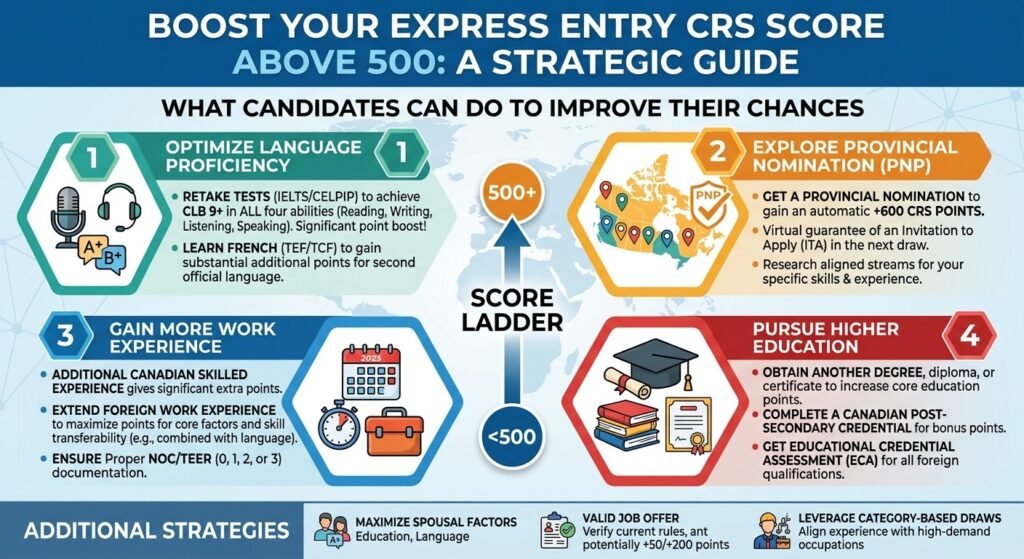
1. Retake Your English Language Test
For many candidates, language ability is one of the easiest areas to improve.
If you have already taken IELTS General Training, CELPIP-General or another accepted test, check your individual scores carefully.
You may have a situation where your overall English is good, but one ability—such as writing or speaking—is keeping you from reaching a higher CLB level.
A small improvement in your language results can sometimes produce a meaningful CRS increase because language scores can also interact with education and work experience under the skill-transferability factors.
Ask yourself:
- Can I improve my listening score?
- Can I move from CLB 8 to CLB 9?
- Can I improve writing or speaking?
- Is my language test still valid?
- Would another approved language test work better for me?
Don’t assume your current language score is the best score you can achieve.
2. Consider Learning French if you have to increase the Express Entry CRS Score
If you are serious about improving your Express Entry profile, French may be worth considering.
IRCC currently has a French-language category under Express Entry. Candidates generally need to meet the required French-language threshold in all four abilities to qualify for a French-language category-based round.
French can also provide additional CRS points.
Depending on your English results, achieving the required French level can provide up to 50 additional CRS points under the additional-points section.
For someone sitting at 470–480 CRS, that difference can be significant.
Of course, learning French takes time. It should therefore be treated as a medium- to long-term strategy rather than a quick fix.
3. Look at Your Education Options
Education is another major component of the Express Entry CRS Score calculation.
If you have only one post-secondary credential, you may want to determine whether additional education could improve your profile.
For candidates with multiple credentials, the CRS system has specific rules regarding how education is assessed. For example, IRCC states that to receive the maximum points associated with having two or more credentials, at least one credential must come from a program of three years or longer.
If your education was completed outside Canada, an Educational Credential Assessment (ECA) may also be required to claim points for that education.
Before enrolling in another program, however, calculate the potential CRS benefit first.
Don’t spend thousands of dollars on education simply because someone told you it will increase your CRS score.
4. Gain More Skilled Work Experience
Canadian and foreign skilled work experience can contribute to your Express Entry CRS Score .
As your experience increases, your CRS score may change depending on your circumstances and the applicable CRS factors.
Canadian work experience can also interact with education and foreign work experience under the skill-transferability section.
For candidates already working in Canada, this is particularly important.
Instead of focusing only on today’s CRS score, look at your projected CRS score six or twelve months from now.
Sometimes patience combined with additional qualifying work experience can make a meaningful difference.
5. Check Whether You Qualify for a Category-Based Draw
This is an area candidates should not ignore.
IRCC uses category-based selection to invite candidates who meet specific economic priorities. Current categories include areas such as:
- French-language proficiency
- Healthcare and social services
- STEM occupations
- Trade occupations
- Education
- Transport
- Physicians with Canadian work experience
- Senior managers with Canadian work experience
- Researchers with Canadian work experience
- Skilled military recruits
Candidates must still meet the requirements of an Express Entry program and the specific requirements for the category.
This is important because not every candidate needs to compete only in a general draw.
Your occupation and work experience could potentially put you into a category-based pool.
6. Explore Provincial Nominee Programs (PNPs)
If your CRS score is not high enough, don’t limit your immigration strategy to Express Entry alone.
A Provincial Nominee Program (PNP) may provide another pathway to permanent residence.
The CRS system currently awards 600 additional points for a provincial or territorial nomination.
That can dramatically change a candidate’s ranking.
However, every province has its own eligibility requirements, streams and selection priorities.
So don’t simply apply everywhere.
Instead, determine which provinces or streams may actually match your:
- Occupation
- Work experience
- Education
- Language ability
- Job offer
- Canadian connection
- Immigration goals
7. Don’t Count on Job Offer CRS Points
This is an important change that many candidates still misunderstand.
IRCC removed CRS points for job offers effective March 25, 2025.
That means receiving a qualifying job offer does not automatically give you the old CRS bonus points.
However, job offers can still matter for certain immigration programs and requirements, including some provincial pathways and eligibility situations.
So if someone tells you:
“Get an LMIA and you will automatically receive 50 CRS points.”
Be careful.
That is outdated information for the CRS calculation.
8. Check Your Spouse’s Profile
If you are applying with a spouse or common-law partner, don’t look only at the principal applicant’s profile.
Your spouse’s:
- Education
- Canadian work experience
- Language ability
may affect your overall CRS calculation.
Sometimes candidates focus entirely on improving their own profile without checking whether their spouse could contribute additional points.
A complete CRS calculation should consider the whole family profile.
9. Keep Your Express Entry Profile Updated
Your Express Entry profile should reflect your current circumstances.
For example, if you:
- Receive additional eligible work experience
- Complete another credential
- Retake your language test
- Obtain new language results
- Become eligible for a category
- Have another qualifying change
you should review whether your profile needs to be updated.
IRCC’s Express Entry system allows candidates to view their CRS score and profile information through their account.
10. Don’t Build Your Immigration Plan Around One CRS Number
This may be the most important advice.
Candidates often say:
“My CRS is 490. Should I wait?”
But a CRS score by itself does not tell the whole story.
You need to consider:
490 CRS + occupation + Canadian experience + language + age + education + province + category eligibility
That combination can produce very different immigration strategies.
IRCC also continues to use category-based selection to respond to Canada’s labour-market and economic priorities.
So your strategy should be based on your profile, not just the latest draw cut-off.
What Should You Do If Your CRS Is Below 500?
If your CRS score is currently below 500, don’t panic.
Instead, make a CRS improvement plan.
Start with these five questions:
1. Can I improve my English score?
2. Could French give me additional points or category eligibility?
3. Will additional Canadian work experience increase my score?
4. Do I qualify for an Express Entry category-based draw?
5. Could I qualify for a PNP stream?
The answers to these questions can help you identify where your biggest opportunity lies.
Final Thoughts: Don’t Just Wait for the CRS Cut-Off
A high CRS environment can be frustrating, especially when you have been waiting in the Express Entry pool for months.
But waiting is not the only strategy.
You can work on your language score, gain eligible experience, explore French, review your education, investigate category-based selection and look at provincial nomination opportunities.
The goal isn’t simply to wait for CRS scores to fall. The goal is to make your profile stronger.
And remember: there is no guaranteed CRS cut-off for future Express Entry draws. IRCC determines the number and type of invitations for each round, and category-based rounds have their own eligibility requirements.
If your CRS score is sitting below 500, this may be the right time to stop asking “Will the score come down?” and start asking: