
Getting a refusal from IRCC can be stressful and confusing. Many applicants think their journey ends there — but that’s not always true.
In some cases, you may have the option to request reconsideration, which means asking the immigration officer to review your application again due to a mistake or oversight.
This guide explains everything you need to know about reconsideration, when it works, and what your next steps should be.
What is Reconsideration?
Reconsideration is a request made to Immigration, Refugees and Citizenship Canada (IRCC) asking them to reopen and review a decision they already made.
It is important to understand:
-
It is not a formal appeal
-
It is free of cost
-
It is completely discretionary (the officer is not required to accept it)
👉 In simple terms: You are asking IRCC to fix a mistake — not to give you a second chance.
When Can You Request Reconsideration?
According to IRCC’s internal guidelines (CPC-E Standard Operating Procedures updated to January 24, 2025), reconsideration is typically considered when there is a clear error in the original decision.
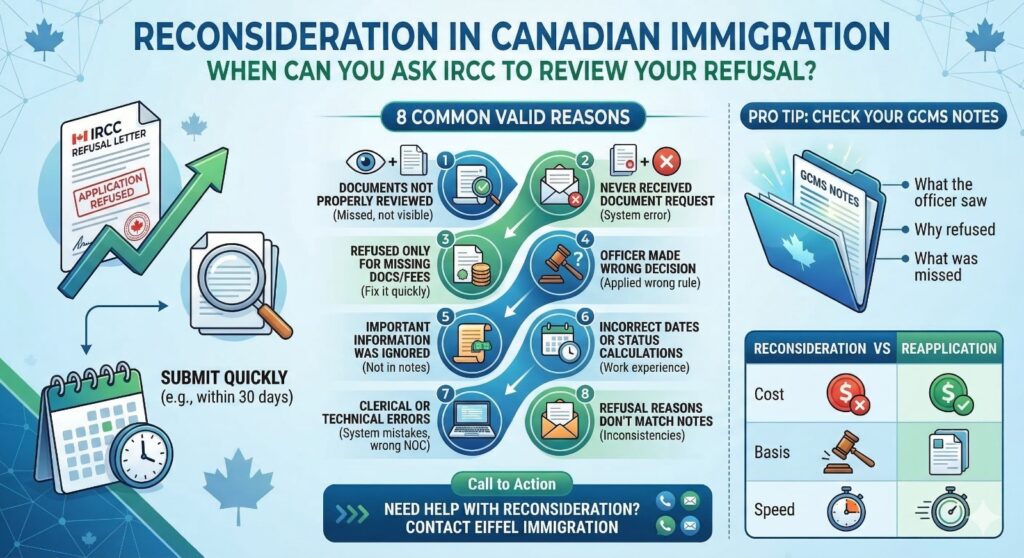
Here are the most common valid reasons:
1. Documents Were Not Properly Reviewed
Sometimes documents:
-
Were uploaded incorrectly
-
Were not visible in the system
-
Were submitted before the decision but reviewed after
If important documents were missed, reconsideration may succeed.
2. You Never Received a Document Request
If IRCC refused your application for missing documents, but:
-
You never received the request
-
Or the request was never properly sent
This is a strong ground for reconsideration.
3. Refusal Based Only on Missing Documents or Fees
If your application was refused solely because:
-
A document was missing
-
A fee was not paid
And you correct the issue quickly (usually within 30 days), reconsideration may be granted.
4. Officer Made an Incorrect Decision
If the officer:
-
Misinterpreted your documents
-
Applied the wrong rule
-
Made an unreasonable conclusion
You may request reconsideration based on error in judgment.
5. Important Information Was Ignored
If relevant information was in your application but:
-
Not mentioned in the officer’s notes
-
Not considered in the decision
It may indicate an oversight.
6. Incorrect Dates or Status Calculations
Errors in:
-
Work experience
-
Immigration status validity
-
Eligibility timelines
These mistakes can directly affect your application outcome.
7. Clerical or Administrative Errors
Simple errors such as:
-
Typing mistakes
-
Wrong category or code applied
-
System glitches
Can justify reconsideration.
8. Refusal Reasons Don’t Match Officer Notes
If your refusal letter says one thing, but internal notes say another, it creates inconsistency — which can support your request.
What Reconsideration Is NOT
Many applicants misunderstand this process.
❌ It is NOT for:
-
Submitting new documents (in most cases)
-
Re-explaining your application
-
Disagreeing without proof
👉 The key question is:
“Was there a clear mistake in the original decision?”
⏳ The Time Factor: When Should You Apply?
There is no official legal deadline for reconsideration.
However, based on real practice, there is a strong guideline:
👉 Submit your reconsideration request within 15–30 days of receiving your refusal
Why this matters:
-
Shows urgency and seriousness
-
Keeps your file active and relevant
-
Improves your chances significantly
❌ Waiting too long (for example, 6 months):
-
Greatly reduces success chances
-
Officers are unlikely to reopen old files
-
It may appear you accepted the refusal
👉 Best practice: Act immediately.
📄 Why GCMS Notes Are Critical
Before submitting a reconsideration request, you should review your GCMS notes.
These notes reveal:
-
The officer’s reasoning
-
What was reviewed
-
What may have been missed
👉 This helps you identify real errors, not just assumptions.
How to Request Reconsideration
You can submit your request through the IRCC Webform.
Your submission should include:
-
A clear explanation of the error
-
Supporting evidence
-
Application details (UCI, file number)
👉 Keep it professional, factual, and focused on the mistake.
Reconsideration vs Reapplication
Many applicants wonder which option is better.
Reconsideration
-
Free
-
Faster (in some cases)
-
Works only if there is an error
Reapplication
-
Requires new fees
-
Allows you to strengthen your case
-
More reliable if refusal was justified
👉 In many situations, a combined strategy is the most effective.
⚖️ What If your request Is Ignored or Refused?
Reconsideration is not guaranteed. IRCC may:
-
Not respond
-
Or refuse to reopen your file
In such cases, there is a legal option:
👉 Judicial Review at the Federal Court of Canada
This is a formal legal process where the Court reviews whether:
-
The decision was fair
-
The officer followed the law
-
The decision was reasonable
Important to know:
-
It is not a new application
-
The Court does not reassess your entire case
-
It focuses only on errors in the decision-making process
⏰ Strict Deadlines for Judicial Review:
-
15 days (if you are inside Canada)
-
60 days (if you are outside Canada)
🧠 Expert Strategy: What Works Best?
In many cases, the strongest approach includes:
-
Filing a quick reconsideration request, and
-
Evaluating whether Judicial Review should also be pursued
👉 This requires careful legal and strategic planning.
Final Thoughts
A refusal is not always the end of your immigration journey.
If a mistake was made, second review can be a powerful tool to correct it without starting over.
But success depends on:
-
Identifying a real error
-
Acting quickly
-
Presenting a clear and strong argument
Need Help With Reconsideration?
At Eiffel Immigration, we:
-
Analyze refusal letters and GCMS notes
-
Identify officer errors
-
Prepare strong reconsideration requests
-
Guide you on Judicial Review when necessary
👉 Don’t leave your future to chance — get expert advice today.