Your work permit is expiring. Your permanent residency application has been submitted and is in process. What happens to your job — and your legal status in Canada — while you wait?
The answer is the Bridging Open Work Permit (BOWP) — a special open work permit designed specifically for this situation. And in 2026, it has never been more critical to understand.
According to IRCC data, more than 314,000 work permits expired in Q1 2026 alone, with the total reaching approximately 1.4 million expiring work permits by year end. If you are one of these temporary residents with a permanent residence application in process, the Bridging Open Work Permit Canada 2026 may be your most important application of the year.
A Bridging Open Work Permit is a special category of open work permit issued by Immigration, Refugees and Citizenship Canada (IRCC) to foreign nationals in Canada who have submitted a permanent residence application and whose current work permit is about to expire.
Unlike an employer-specific work permit, the BOWP is an open work permit — meaning you can work for any employer in Canada, in any occupation, anywhere in the country. You are not tied to one company, one job, or one province.
It is not a new immigration pathway — it does not change or speed up your PR application. It is purely a bridge: a legal authorization to continue working while IRCC finishes processing your permanent residence file.
- Application fee: $255 CAD (2026)
- Processing time: approximately 2–6 months (IRCC estimates up to 181 days in 2026 due to high volumes)
- Maintained status: granted immediately upon submission — you can legally continue working
- Validity: typically 12 months or until a PR decision is made, whichever comes first
- Study rights: not included — work authorization only
- Quebec: separate provincial restrictions apply
To qualify for a Bridging Open Work Permit in Canada, you must meet all of the following conditions at the time of application. Missing any one of them means your application will be refused.
The Bridging Open Work Permit is an inside-Canada application only. If you have left Canada and your work permit has expired abroad, you cannot apply for a BOWP — you must obtain a new work permit through the regular international stream.
You must currently hold a valid work permit — employer-specific, PGWP, or another open work permit. If your permit expired but you applied to renew it before it expired, you are on maintained status (formerly “implied status”) and are still eligible to apply.
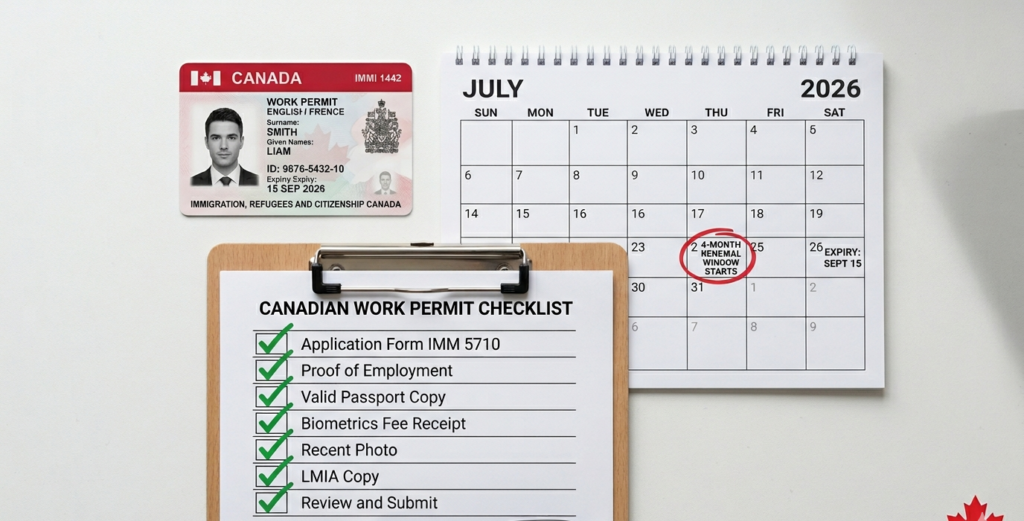
This is the most commonly misunderstood rule. You cannot apply for a BOWP too early. Your current work permit must be expiring within 4 months at the time you submit your BOWP application.
The optimal application window is 90 to 120 days before your current work permit expires. This gives IRCC enough processing time while keeping you inside the eligibility rule. Apply outside this window — either too early or too late — and your application will be refused.
Your permanent residence application must have been submitted and accepted into processing under an eligible program. Eligible programs include:
- Express Entry — Canadian Experience Class (CEC), Federal Skilled Worker (FSW), Federal Skilled Trades (FST)
- Provincial Nominee Program (PNP) — federal processing stage only
- Agri-Food Pilot
- Atlantic Immigration Program (AIP)
- Rural and Northern Immigration Pilot (RNIP)
- TR to PR Pathway 2026 — where applicable under the new open work permit public policy
You cannot apply for a Bridging Open Work Permit without first receiving an official Acknowledgment of Receipt (AOR) from IRCC. The AOR confirms that your PR application has passed the completeness check (R10 check) and has been accepted into processing. Keep this document — you will need your PR application number from it when completing your BOWP forms.
Post-Graduation Work Permit (PGWP) holders represent the largest single group applying for BOWPs in 2026. With over 300,000 PGWPs expiring by Q1 2026 alone, here is what every PGWP holder must understand about the Bridging Open Work Permit Canada 2026:
- ✓ PGWPs cannot be renewed or extended. The BOWP is the only option to maintain work authorization while your PR is processed.
- ✓ A BOWP for a PGWP holder is typically valid for 12 months — it does not match the remaining PGWP duration. Plan accordingly.
- ✓ All standard BOWP requirements apply: valid status, AOR received, permit expiring within 4 months.
- ✓ Study permit holders transitioning to PGWP should be aware that time spent studying under the now-expired work permit / study exemption does not count toward PGWP eligibility.
Verify that your current work permit expires within 4 months and that you have received your AOR from IRCC for your PR application. Calculate your ideal submission date: 90–120 days before permit expiry.
- Current valid work permit (or proof of maintained status)
- AOR / PR application number from IRCC
- Copy of valid passport (must be valid beyond intended BOWP period)
- Recent pay stubs or employer letter confirming current employment
- Biometrics — if submitted within the last 10 years to IRCC, you typically do not need to resubmit
Complete the Application to Change Conditions, Extend My Stay or Remain in Canada as a Worker (IMM 5710) via your IRCC Secure Account (My IRCC Account). Key selections:
- Under “Type of work permit” → select Open work permit
- Under “Reason for open work permit” → indicate you are a PR applicant with an application in progress
- Enter your PR application number from your AOR
The BOWP costs $255 CAD in 2026. Both the work permit processing fee and the open work permit holder fee are required. The open work permit holder fee is refundable if the application is refused.
Once submitted, you will receive an IRCC confirmation of receipt. From that moment, maintained status is active — you can legally continue working even after your current work permit expiry date, while IRCC processes your BOWP application.
A BOWP refusal is a serious situation. Here are your three main options:
If your work permit expired fewer than 90 days ago, you can apply to restore your status. The restoration fee is $229 CAD in 2026, in addition to the work permit application fee. Critical warning: Restoration does not grant maintained status. You must stop working immediately once your permit expires and cannot resume until IRCC approves the restoration application.
If restoration is not possible, you may need to leave Canada, obtain a new work permit from outside the country, and re-enter. This disrupts your employment, may affect your Canadian work experience accumulation, and in some cases may affect your PR processing. This is a last resort.
A BOWP refusal should be reviewed by a professional to determine whether grounds exist to challenge the decision, identify which of the above options applies to your situation, and avoid compounding the problem with an additional error.
Yes. A Bridging Open Work Permit is an open work permit — you can work for any employer in Canada, in any occupation, in any province. This is a significant advantage over an employer-specific closed work permit. Quebec applicants should verify provincial rules separately.
Yes — this is a common pitfall. IRCC will not issue a BOWP valid beyond your passport expiry date. A short passport validity means a short BOWP — possibly shorter than your PR processing period. Renew your passport before applying for a BOWP if it is expiring within the next 12–18 months.
Possibly. Eligibility for a Spousal Open Work Permit (SOWP) depends on your specific occupation, TEER level, and whether your spouse meets the updated 2025–2026 SOWP eligibility rules. Visit our spousal immigration services page or book a consultation to assess your spouse’s eligibility.
No — not under the BOWP category. Inland spousal sponsorship applicants who receive Approval in Principle (AIP) are eligible for a different type of open work permit (the spousal AIP work permit). This is a separate category and has different application instructions. Contact our office to confirm which open work permit applies to your situation.
No. Submitting a BOWP application is entirely separate from your PR application and has no impact on its processing. IRCC processes them through completely different queues.
Yes, but with care. If you leave Canada while on maintained status (application submitted, BOWP not yet approved), you may be considered to have abandoned your application. Always confirm your travel plans with a licensed RCIC before leaving the country while in the BOWP application process. Once you have the physical BOWP document, travel is generally permitted per the conditions of your eTA or entry visa.
The Bridging Open Work Permit Canada 2026 is one of the most valuable tools available to temporary foreign workers on the path to permanent residence. But it is also one of the most timing-sensitive immigration applications in the entire system.
Apply too early — refused. Apply too late — out of status. Miss the window entirely — you may be forced to stop working, or worse, leave Canada while your PR is still in process.
With 1.4 million work permits expiring in Canada in 2026, the competition for IRCC processing capacity has never been higher. Apply early within your window. Apply correctly. Apply with professional help.
Our licensed RCICs will handle your BOWP from eligibility check to submission — completely. 🍁
📞 Call Now — Free BOWP Consultation