
If you are waiting for a Canadian immigration decision right now, you are not alone.
Every month, thousands of applicants check Immigration, Refugees and Citizenship Canada (IRCC) processing times hoping for faster approvals on work permits, study permits, visitor visas, permanent residence, or citizenship applications.
The latest IRCC processing times for May 2026 show a mixed picture across Canada’s immigration system. Some categories are moving faster, while others are experiencing major delays and growing backlogs.
For international students, workers, permanent residence applicants, and families, these changing timelines can directly impact immigration plans, employment, travel, and legal status in Canada.
In this article, we break down:
- the latest IRCC processing times,
- what categories improved,
- what became slower,
- and what applicants should expect moving forward.
Latest IRCC Processing Times in May 2026
According to the latest IRCC data updated in May 2026, processing times currently look like this:
| Immigration Category | Estimated Processing Time |
|---|---|
| Express Entry | About 6–7 months |
| Study Permit | 4–18 weeks |
| Visitor Visa | 14–90 days |
| Open Work Permit | 5–13 weeks |
| LMIA Work Permit | 7–19 weeks |
| PGWP | 5–19 weeks |
| Spousal Sponsorship | 9–14 months (varies) |
| Citizenship | 12–18 months |
| PR Card Renewal | 10–16 weeks |
| PNP (Non-Express Entry) | About 14 months |
IRCC states that these timelines represent the amount of time needed to process approximately 80% of applications.
What Got Faster in May 2026?
Several immigration categories showed noticeable improvements this month.
1. Inland Work Permits Improved
One of the biggest improvements in May 2026 was inland work permit processing.
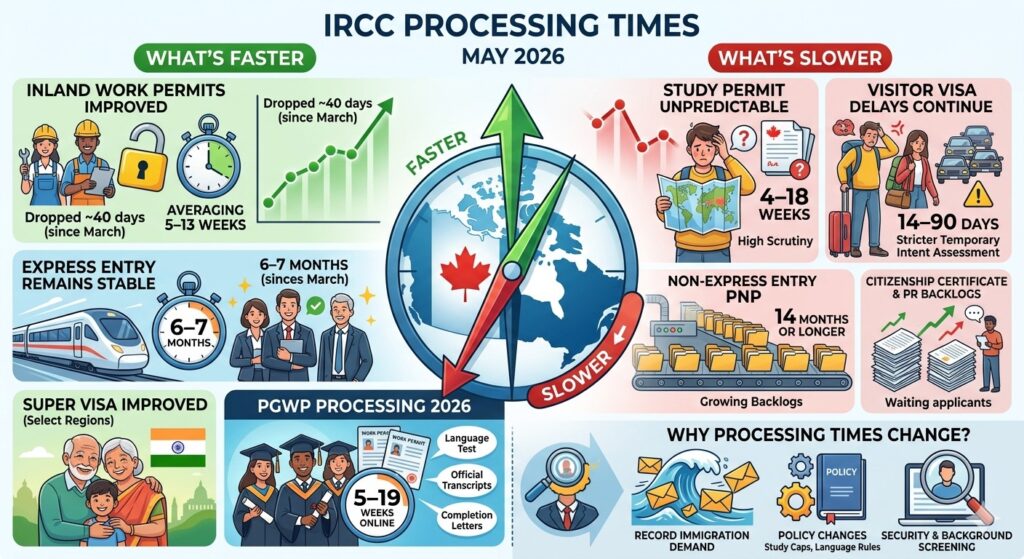
Recent reports show inland work permit timelines dropped significantly compared to earlier months in 2026. Some categories reportedly improved by more than 40 days since March.
Open work permits are currently averaging:
- approximately 5–13 weeks.
This is positive news for:
- spouses of workers and students,
- bridging open work permit applicants,
- and temporary residents extending work authorization inside Canada.
2. Express Entry Remains Stable
Express Entry continues to be one of Canada’s fastest permanent residence pathways.
Current processing times remain around:
- 6 to 7 months for most complete applications.
Programs such as:
- Canadian Experience Class (CEC),
- Federal Skilled Worker (FSW),
- and Express Entry-linked PNP streams
have remained relatively stable throughout 2026.
This stability is important because many applicants feared longer delays after recent immigration reforms.
3. Super Visa Processing Improved in Some Countries
Some countries experienced major improvements in Super Visa processing times.
Recent reporting suggests certain visa offices saw dramatic reductions in wait times, especially for applicants from India.
This could help families reunite faster under Canada’s parents and grandparents temporary stay program.
What Became Slower?
Unfortunately, several immigration categories are now taking longer than before.
1. Study Permit Processing Remains Unpredictable
Study permit processing continues to vary heavily depending on the applicant’s country.
Current timelines range from:
- 4 to 18 weeks.
While some applicants receive approvals quickly, others are facing:
- additional financial reviews,
- security checks,
- and document verification delays.
Canada’s stricter international student policies introduced since 2024 continue affecting processing consistency.
Students applying for Fall 2026 should apply as early as possible.
2. Visitor Visa Delays Continue
Temporary Resident Visa (TRV) processing remains highly inconsistent.
Current processing estimates range from:
- 14 to 90 days depending on country and application volume.
IRCC officers are also applying stricter temporary intent assessments compared to previous years.
This means applicants with:
- weak travel history,
- unclear financial support,
- or immigration concerns
may experience longer delays or refusals.
3. Non-Express Entry PNP Applications Are Slower
Provincial Nominee Program applications outside Express Entry remain among the slower permanent residence pathways.
Current processing times are approximately:
- 14 months or longer.
Growing backlogs and increased provincial nomination demand continue affecting timelines.
This is especially important for applicants relying on employer-driven provincial pathways.
4. Citizenship Certificate and PR Backlogs Are Growing
Reports indicate that some citizenship-related queues increased significantly in May 2026.
While citizenship grants remain relatively stable overall, certain supporting document processes are experiencing growing backlogs.
Applicants should continue preparing for fluctuating timelines.
PGWP Processing Times in 2026
Post-Graduation Work Permit (PGWP) processing remains one of the most closely watched categories for international students.
Current PGWP processing times are approximately:
- 5–19 weeks online,
- and longer for paper applications or applications submitted outside Canada.
Since Canada introduced new PGWP language requirements, many applications now face additional review.
Incomplete applications continue causing:
- refusals,
- delays,
- and document requests.
Applicants should ensure they upload:
- language test results,
- official transcripts,
- and completion letters correctly.
Why Are Processing Times Changing?
Several major factors continue affecting IRCC processing times in 2026.
Record Immigration Demand
Canada continues receiving extremely high application volumes across almost all immigration categories.
Policy Changes
Recent reforms introduced:
- PGWP language rules,
- study permit caps,
- category-based Express Entry draws,
- and stricter temporary resident assessments.
These policy changes can temporarily slow processing while officers adapt to updated requirements.
Security and Background Screening
Applications requiring enhanced verification often take longer.
This may depend on:
- travel history,
- country of residence,
- previous refusals,
- or employment verification.
What Applicants Should Do Right Now
Changing processing times mean applicants need to prepare carefully.
Submit Complete Applications
Missing documents remain one of the biggest causes of delays.
Always double-check:
- forms,
- signatures,
- translations,
- and supporting documents.
Apply Early
Do not wait until your permit is close to expiring.
Early applications reduce stress and provide better flexibility if delays occur.
Monitor IRCC Updates Regularly
IRCC processing times change frequently.
Applicants should regularly monitor official updates and avoid relying only on social media rumors.
Final Thoughts
IRCC processing times in May 2026 show that Canada’s immigration system is still adjusting to record demand and major policy changes.
While some categories like inland work permits and Express Entry remain relatively stable, others — including study permits, visitor visas, and non-Express Entry PNP applications — continue facing delays and unpredictable timelines.
For applicants, preparation is more important than ever.
Submitting a strong and complete application, applying early, and staying informed about current processing trends can make a major difference during the immigration process.