

One mistake on your Canadian immigration application — even an accidental one — can result in a five-year ban from Canada, cancellation of your visa or permanent residency, and in serious cases, removal from the country.
This is not a hypothetical warning. IRCC recorded a 64% increase in 5-year bars for fraud in January 2025 compared to a year earlier, with approximately 9,000 misrepresentation investigations launched per month in 2024.
At Eiffel Immigration, we meet clients who arrive at our office after receiving misrepresentation notices for errors they made years ago on their own applications — errors they didn’t even know were wrong. This guide explains exactly what misrepresentation in Canadian immigration means, what triggers it, and the critical steps you must take to protect yourself.
Misrepresentation in Canadian immigration is governed by Section 40 of the Immigration and Refugee Protection Act (IRPA). Under this section, a foreign national or permanent resident is inadmissible if they — directly or indirectly — provide false or misleading information, or withhold material facts that could affect a decision made under the Act.
The critical legal word is material. A fact is material if it could have influenced the officer’s decision — even if the outcome would ultimately have been the same.
- Direct misrepresentation — you personally provide false information on a form
- Indirect misrepresentation — someone else (a consultant, family member) provides false information on your behalf
- Innocent misrepresentation — an honest mistake that still affects an officer’s decision
All three carry the same consequences. IRCC does not distinguish between deliberate fraud and an innocent clerical error — the result can be identical.
Understanding misrepresentation in Canadian immigration starts with knowing exactly what triggers a finding. These are the seven most common mistakes we see — many of which applicants never realize are problems until it’s too late.
Many IRCC application forms ask whether you have ever been refused an immigration application. Most applicants mistakenly believe this only applies to Canadian applications. It does not.
Applicants who fail to disclose visa refusals from the USA, UK, Australia, Schengen countries, or anywhere else have faced A40 misrepresentation findings and 5-year bans. According to Immigration, Refugees and Citizenship Canada (IRCC), disclosure applies to all refusals, regardless of country, year, or whether the decision was overturned.
During IRCC’s Fraud Prevention Month in March 2026, enforcement actions included applicants using fake employment reference letters, altered pay stubs, and fabricated educational credentials. The 5-year ban was applied even when a third-party consultant submitted the documents without the applicant’s full knowledge. You are responsible for everything in your file — no exceptions.
Failing to declare a spouse, dependent child, or other family member — even if you consider the relationship effectively over — is a common and costly mistake. A divorce that is legally incomplete means the spouse must be declared. A child born outside of marriage must still be listed as a dependent.
Claiming a senior title you did not hold, or exaggerating hours worked to meet Express Entry thresholds, is among the fastest routes to a misrepresentation finding. IRCC cross-references your job duties against NOC occupation descriptions and verifies with employers directly.
Even a small mistake by your immigration consultant, lawyer, or a helpful family member can trigger a misrepresentation finding. The law places the burden on you — not your representative. This is why hiring an unregulated “ghost consultant” or relying on friends is so dangerous. A licensed RCIC regulated by the CICC carries professional accountability and liability. An unlicensed agent does not.
Any criminal charge or conviction must be disclosed — including those for which you received a pardon or record suspension. Applicants sometimes assume that a spent conviction doesn’t count. IRCC considers non-disclosure of criminal history one of the most serious forms of misrepresentation.
Failing to disclose prior unauthorized overstays in Canada, previous refused Canadian applications, or removal orders is a critical misrepresentation mistake. IRCC has full access to your immigration history — they already know the answer before they ask the question. Non-disclosure is treated as active concealment.
📞 Speak to a Licensed RCIC Now
When IRCC or the Canada Border Services Agency (CBSA) determines that misrepresentation in Canadian immigration has occurred, the consequences are severe and in many cases permanent:
- ✗ Immediate refusal of your current application
- ✗ A 5-year ban on entering or applying to Canada — for any visa, permit, or PR
- ✗ A permanent mark on your IRCC immigration record
- ✗ Removal from Canada if you are already inside the country
- ✗ Loss of permanent resident status or Canadian citizenship — even if already granted
- ✗ In extreme fraud cases, potential criminal charges
There is one powerful protection available to applicants who made an honest mistake: self-correction before IRCC discovers the error.
In the landmark Federal Court case Ganeshalingam v. Canada (Citizenship and Immigration), 2024 FC 1437, Justice Battista ruled that it is unreasonable to conclude that someone committed misrepresentation if they corrected the error before IRCC discovered it.
This means: if you realize you made a mistake on a submitted application — even after submission — reaching out proactively and correctly through the proper IRCC channel can protect you from a formal finding.
⚠️ Important: Do not contact IRCC through a casual webform message — a rushed or poorly worded message can contain admissions that make your situation worse. Work with a licensed RCIC or immigration lawyer to correct the record properly.
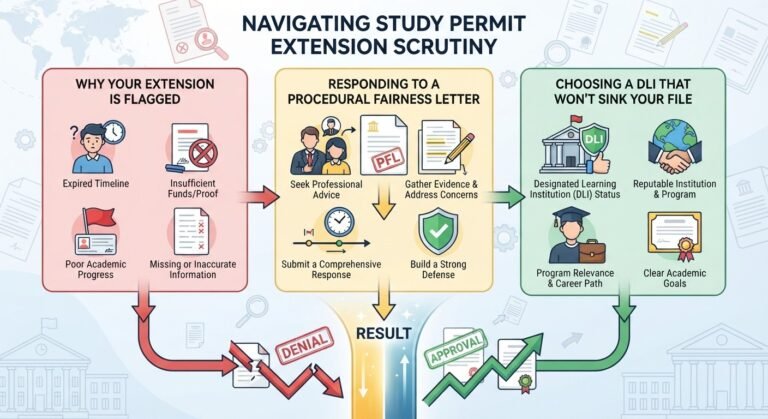
Before making a formal misrepresentation finding, IRCC typically issues a Procedural Fairness Letter (PFL). This letter:
- Informs you of the specific concern IRCC has identified
- Gives you an opportunity to respond — usually within 30 days, sometimes less
- Is your only formal opportunity to prevent a misrepresentation finding before it becomes final
This letter is not a refusal. It is your chance to provide an explanation, clarify facts, and submit supporting documentation. A well-prepared response to a PFL — backed by evidence and legal argument — can prevent the 5-year ban entirely.
If you receive a Procedural Fairness Letter, do not respond without professional guidance. Contact a licensed RCIC or immigration lawyer immediately.
Your options after a misrepresentation finding depend on your status:
Permanent Residents facing a removal order based on misrepresentation may appeal to the IAD on humanitarian and compassionate grounds in limited circumstances. The IAD can consider the best interests of children, length of time in Canada, and the degree of hardship a removal would cause.
Visa applicants and temporary residents typically must apply for Judicial Review at the Federal Court of Canada. The Court reviews only whether the officer made a legal error — it cannot substitute its own judgment for the officer’s. New evidence is generally not permitted. These cases require experienced immigration legal counsel and must be filed within strict timelines (typically 15 days for inland decisions, 60 days for overseas).
To protect yourself from a misrepresentation finding, always disclose the following — regardless of how old, minor, or unlikely to be discovered you believe the information is:
- ✓ All visa or immigration refusals — any country, any year, including withdrawn applications
- ✓ All criminal charges or convictions — including pardons, record suspensions, and youth offences
- ✓ All family members — spouses (even separated), all biological children, dependents
- ✓ Previous stays in Canada — including any unauthorized overstays, even brief ones
- ✓ Accurate employment history — correct job titles, real duties, accurate dates and hours
- ✓ Educational credentials exactly as earned — do not inflate degree names or graduation dates
- ✓ All immigration applications ever submitted — including those withdrawn before a decision
- ✓ Medical conditions — if you have been asked for a medical exam and have undisclosed conditions relevant to public health
Not necessarily. Courts have recognized innocent misrepresentation where an honest error did not affect the outcome. In Kasimova v. Canada, 2025 FC 1500, a misrepresentation finding was overturned where the applicant had submitted a fake document in a previously withdrawn application — and the Court found that the context mattered. However, these outcomes require professional legal representation and are not guaranteed.
Under Canadian immigration law, yes — you are responsible for the accuracy of your own application regardless of who prepared it. This is one core reason to always work with a licensed RCIC regulated by the College of Immigration and Citizenship Consultants (CICC). You have formal recourse against a licensed RCIC if they acted improperly. You have no recourse against an unlicensed ghost consultant.
Yes — but the misrepresentation history remains permanently on your IRCC file and must be disclosed in all future applications. As confirmed by Federal Court in 2026, it can continue to be a negative factor even after the ban period ends. A strong, professionally prepared reapplication with full transparency is the only path forward.
Contact a licensed immigration professional immediately. Based on Federal Court jurisprudence, proactively correcting an error before IRCC discovers it may protect you from a formal misrepresentation finding. Do not contact IRCC directly without professional guidance — an improperly worded response can harm your case.
No. Misrepresentation applies to all Canadian immigration applications — visitor visas, study permits, work permits, spousal sponsorships, Express Entry, PNP, and citizenship applications. The same 5-year ban and consequences apply regardless of the application type.
The misrepresentation rules in Canadian immigration exist to protect the integrity of Canada’s immigration system — and they are enforced seriously. In 2026, with IRCC processing volumes higher than ever and enforcement tighter, there has never been a riskier time to cut corners or rely on outdated advice.
The applicants who suffer the worst consequences are not always those who deliberately lied. Many are honest people who didn’t know what they didn’t know — and submitted applications without professional review.
The best protection against misrepresentation in Canadian immigration is a thorough, professionally prepared application reviewed by a licensed RCIC before submission. At Eiffel Immigration, that is exactly what we do — for every client, every time.
The Sky Is The Limit — and we’ll make sure nothing holds you back. 🍁
📞 Book Free Consultation — Call Now
>