
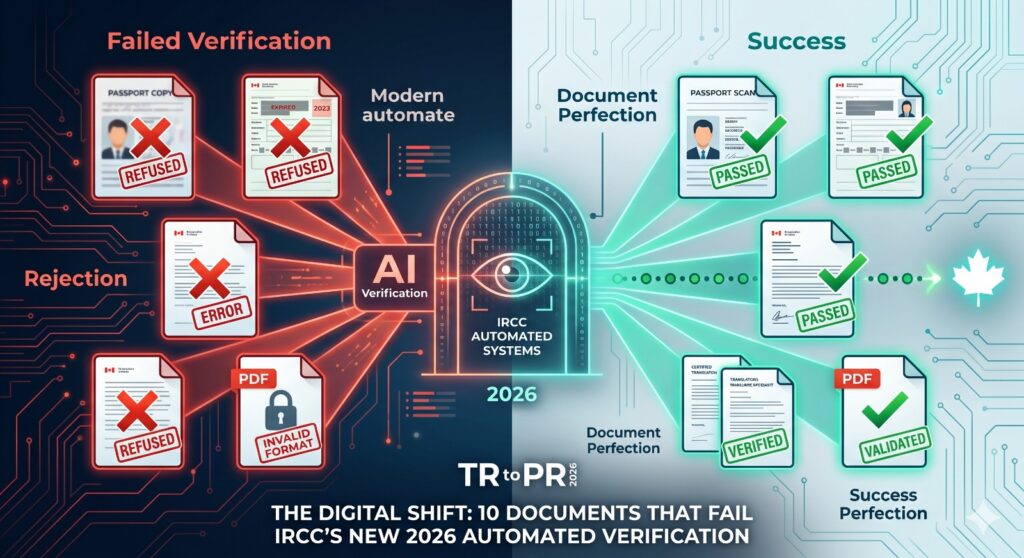
Canada’s immigration system is evolving — and fast. With the upcoming TR to PR pathways in 2026, Immigration, Refugees and Citizenship Canada (IRCC) is moving toward automated document verification systems.
This means your application is no longer just reviewed by an officer — it’s first screened by digital tools that detect errors, inconsistencies, and non-compliant uploads within seconds.
And here’s the harsh reality:
Even small mistakes can get your application returned, delayed, or refused.
If you’re preparing for TR to PR, this blog breaks down the 10 most commonly rejected documents under IRCC’s new automated checks — and how to fix them.
Why Automated Verification Matters in TR to PR
Under the TR to PR pathway, applicants must submit a complete and accurate digital file upfront — there’s little room for corrections later.
Automated systems now verify:
- File format and clarity
- Data consistency across documents
- Expiry and validity dates
- Matching personal details
If anything doesn’t align → your application may never reach an officer.
1. Blurry or Low-Resolution Passport Copies
Your passport is your primary identity document, and IRCC systems scan it for:
- Name consistency
- Date of birth
- Passport validity
If the image is blurred, cropped, or shadowed — it fails instantly.
👉 Pro Tip: Upload high-resolution, full-page scans (including stamps).
2. Expired Language Test Results
For TR to PR, language tests like IELTS or CELPIP must be:
- Valid within 2 years
- Clearly readable
- Matching your profile
Expired scores are automatically flagged.
👉 Many applicants miss this because they prepared documents early.
3. Incorrect or Incomplete Employment Letters
IRCC doesn’t just check if you worked — it verifies:
- Job duties
- Salary
- Dates of employment
- Employer contact details
Missing any of these? Rejected.
👉 Employment proof is critical for TR to PR eligibility.
4. Non-Compliant Translations
If your documents are not in English or French:
- You need certified translations
- Must include translator details and declaration
Automated checks flag:
- Missing certification
- Partial translations
- Self-translations
👉 This is one of the top silent rejection reasons.
5. Mismatched Personal Information
Even small inconsistencies can trigger refusal:
- Different name spellings
- DOB mismatches
- Passport vs. education records
Digital systems cross-check everything.
👉 Consistency is more important than perfection.
6. Invalid or Missing Police Certificates
Police certificates must:
- Cover all countries lived in (6+ months)
- Be recent and valid
If missing or outdated → automatic issue flag.
👉 This is a mandatory document in most PR pathways.
7. Incorrect File Format or Size
IRCC portals have strict requirements:
- PDF/JPEG formats
- File size limits
- Clear naming conventions
If your file:
- Won’t open
- Is password-protected
- Exceeds size limits
👉 It may not even upload properly — leading to incomplete applications.
8. Missing Proof of Status in Canada
For TR to PR, you must prove:
- Valid temporary resident status
- Work permit or study permit
Without this, your application is incomplete.
9. Weak Proof of Current Employment
IRCC now verifies:
- Whether you’re currently working in Canada
- Employer authenticity
Submitting only:
- Pay stubs
- Job offers
…without a proper employer letter can fail verification.
10. Incomplete Document Sets
This is the biggest mistake.
IRCC systems check if:
- All required documents are uploaded
- Each document meets criteria
If even one required document is missing, your application can be:
- Returned
- Delayed
- Refused
The Reality of TR to PR in 2026
The upcoming TR to PR pathway is expected to be highly competitive, with limited spots and fast intake windows.
That means:
👉 You don’t get time to fix mistakes after submission
👉 Your application must be perfect on Day 1
How to Beat IRCC’s Automated System
Here’s a simple strategy used by professionals:
✅ 1. Create a Document Checklist Early
Don’t wait for the program launch.
✅ 2. Standardize All Information
Make sure:
- Name format is identical everywhere
- Dates match exactly
✅ 3. Use Certified Translators Only
Avoid shortcuts — they cost refusals.
✅ 4. Double-Check Before Upload
Review:
- File clarity
- Completeness
- Validity
✅ 5. Think Like a System, Not an Officer
Ask yourself:
👉 “Would a computer flag this?”
Final Thoughts
The shift toward automation is not a bad thing — it’s a filter.
It rewards applicants who are:
✔ Prepared
✔ Organized
✔ Detail-focused
And penalizes those who:
❌ Rush
❌ Ignore formatting
❌ Submit incomplete files
If you’re serious about TR to PR in 2026, your biggest advantage isn’t luck —
it’s document perfection.