
For international students in Canada, a study permit extension may look like a routine application. But an extension is not simply a formality.
IRCC can look at your current studies, enrolment history, academic progress, financial situation, school information and compliance with your study permit extension conditions. With mandatory DLI compliance reporting and enhanced verification of letters of acceptance and enrolment, students should be particularly careful about the information they submit.
This raises an important question:
Why is my study permit extension being scrutinized, and what should I do if IRCC sends me a procedural fairness letter?
In this article, Eiffel Immigration explains some of the issues that can attract questions, how to respond to an IRCC fairness letter, and what students should consider before choosing or changing their DLI.
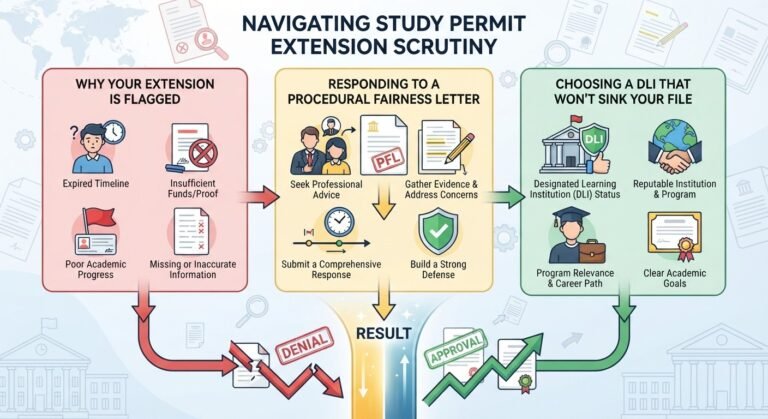
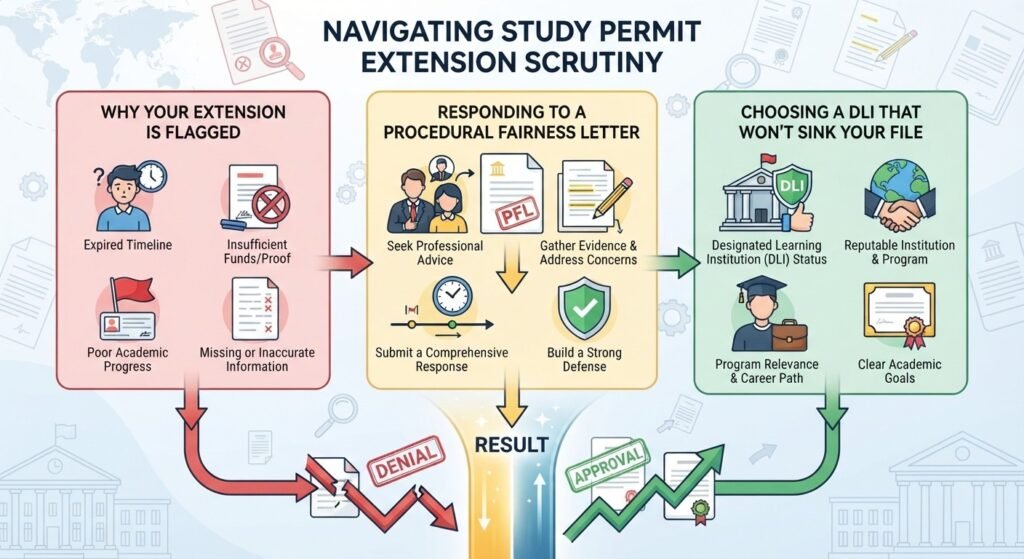
Why Is Your Study Permit Extension Being Flagged?
A request for additional information does not automatically mean that your application will be refused. However, it can indicate that the officer needs clarification or evidence before making a decision.
IRCC confirms that study permit holders must remain enrolled at a DLI and make reasonable and timely progress toward completing their program. Post-secondary DLIs also report enrolment information to IRCC.
Here are some situations that can lead to increased scrutiny.
1. Your studies are taking much longer than expected
A longer-than-expected program is not automatically a problem.
Students can sometimes need additional time because of:
- Failed courses
- Course withdrawals
- Medical or family circumstances
- Program changes
- Academic difficulties
- Course scheduling
- Co-op or placement requirements
- Other documented circumstances
The concern arises when the application does not clearly explain why study permit extension is required.
If you are requesting an extension, your explanation should connect your academic history with your current plan.
For example:
Weak explanation:
“I need another year to finish my studies.”
Stronger approach:
Explain which courses remain, why they remain outstanding, when they will be completed, and why the requested extension is reasonable based on your school’s records.
2. Gaps in enrolment or academic activity
IRCC’s student compliance system is designed to assess whether international students continue to meet their study permit conditions, including actively pursuing their studies.
Therefore, unexplained periods of:
- Non-enrolment
- Leave from studies
- Repeated withdrawals
- Very limited academic progress
- Extended gaps between semesters
can create questions.
This does not mean every gap results in refusal.
The important issue is whether you can document and explain the circumstances accurately.
If there was a medical issue, provide appropriate evidence.
If the school approved a leave, provide the school’s documentation.
If courses were unavailable, obtain evidence from the institution where possible.
Your explanation should be consistent with your academic records.
3. You changed schools or programs
Changing schools is permitted, but students need to follow the applicable IRCC requirements.
If you change your post-secondary DLI, you generally need a new study permit by applying to extend your current permit before starting studies at the new institution. In many situations, you cannot simply start studying at the new school while waiting for approval.
IRCC also requires specific documentation when changing schools, including a letter explaining the change and, unless an exception applies, a new PAL/TAL.
So if your immigration history shows multiple school or program changes, your application should clearly explain:
- Why you changed programs
- Why you changed institutions
- How the new program fits your academic background
- What happened with the previous program
- Whether you remained compliant with your previous study permit
- Your realistic completion timeline
4. Your DLI’s records don’t match your documents
This is becoming increasingly important.
Post-secondary DLIs are required to verify letters of acceptance or enrolment for study permit applications, including study permit extensions submitted from inside Canada.
IRCC has also reported that some LOA verification cases produce a “no-match” result requiring further review.
In March 2026, IRCC reported that in 2025 more than 368,000 LOAs were verified and approximately 4,900 were flagged as “no-match.” IRCC said some of those cases were resolved through the procedural fairness process when applicants were able to provide a verifiable LOA.
This means you should never assume that an acceptance or enrolment document will automatically be accepted simply because the school issued it.
Check that:
- Your name is correct
- Your student number is correct
- Program information is accurate
- Dates are accurate
- The document reflects your actual enrolment
- Your school can verify the document
If something is wrong, contact the school before submitting your application.
5. Your financial situation is unclear
Financial capacity remains an important part of a study permit application.
IRCC states that students applying for an extension must demonstrate that they have enough money to continue supporting themselves while studying in Canada.
A financial explanation becomes particularly important where there are questions about:
- Who is paying your tuition?
- Who is supporting your living expenses?
- Whether your funds are genuinely available
- Large unexplained deposits
- Significant changes in financial circumstances
- Tuition arrears
- Long periods of study without a clear funding plan
Don’t simply upload a bank statement and assume the officer will understand the source of the money.
Where necessary, explain the source of funds and provide supporting documentation.
6. Your work history does not appear consistent with being a student
International students must comply with the conditions attached to their study permits.
IRCC states that failure to comply with study permit conditions, including working or studying in a way that was not authorized, can affect future applications.
Therefore, if your application shows a significant amount of employment while your academic records show limited progress, an officer may have questions.
This is especially important where:
- Your work hours appear inconsistent with the applicable authorization;
- Your employment history conflicts with your school attendance;
- Your studies were interrupted while you continued working;
- You changed schools without following the applicable immigration requirements.
The solution is not to hide the issue.
Address it directly and provide evidence.
What Is a Procedural Fairness Letter?
A procedural fairness letter, often called a PFL, gives an applicant an opportunity to respond to concerns before a decision is made.
For a study permit extension, the letter may identify a concern involving your:
- Academic progress
- Enrolment
- DLI
- Financial situation
- Compliance with study permit conditions
- Documents
- Credibility or purpose of studies
- Other information relevant to the application
A PFL should be taken seriously.
It is not the time to send a generic explanation.
The response should address the specific concern raised by the officer.
How to Respond to a Study Permit PFL
Step 1: Read the letter carefully
Do not focus only on the first paragraph.
Identify exactly what the officer is concerned about.
Create a list:
Officer’s concern → Your explanation → Supporting evidence
This makes the response much easier to organize.
Step 2: Answer the concern directly
Suppose IRCC says:
Your academic progress does not demonstrate reasonable progress toward completion.
Don’t respond with several pages about why you want to live in Canada.
Instead, explain:
- What happened academically
- Why it happened
- What evidence supports your explanation
- What you have done since
- What courses remain
- When you expect to graduate
The response should be evidence-driven.
Step 3: Provide documents that prove your explanation
Depending on the issue, evidence could include:
- Official transcript
- Letter of enrolment
- Letter from the registrar
- Academic progress letter
- Updated program completion timeline
- Course registration
- Medical documentation where relevant
- School-approved leave documentation
- Tuition receipts
- Bank statements
- Employment records
- Pay statements
- Updated LOA
- PAL/TAL, where required
- Correspondence with the institution
The documents should support the explanation rather than simply increase the size of the application.
Step 4: Correct mistakes immediately
If your application contains an error, don’t ignore it.
For example, if your application says you completed a course but the transcript shows that you withdrew from it, explain the discrepancy.
If your school issued an incorrect document, obtain a corrected document.
If there is a mismatch in your LOA or enrolment information, ask the DLI to verify and correct its records.
Step 5: Don’t turn the PFL response into a generic personal statement
A PFL response is different from a standard study plan.
The officer has already identified a concern.
Your response should therefore be structured around that concern.
A useful structure is:
1. Introduction
Identify the application and acknowledge the officer’s concern.
2. Response to Concern #1
Explain the facts.
3. Evidence
Identify the documents supporting your explanation.
4. Response to Concern #2
Repeat the same structure.
5. Current Study Plan
Explain your current enrolment and expected completion.
6. Conclusion
Summarize why the evidence addresses the concerns.
Choosing a DLI That Won’t Create Problems Later
One of the most important decisions can happen before you even submit your study permit application.
A DLI is not simply a school name that you need for an acceptance letter.
IRCC has strengthened DLI compliance requirements, including enrolment reporting and LOA verification.
Before selecting a school, students should research the institution carefully.
Check whether the school is currently a DLI
A school must have DLI status for the applicable program and study situation.
Don’t rely solely on an old website, an agent’s advertisement or a social media post.
Check the current information through IRCC.
Check the program—not just the school
Two programs at the same institution can have very different characteristics.
Look at:
- Program length
- Credential
- Tuition
- Admission requirements
- Course structure
- Delivery method
- Campus/location
- Start dates
- Academic requirements
- Whether the program fits your previous education and career background
Check the school’s ability to support international students
A student should also consider whether the institution has reliable systems for:
- Enrolment documentation
- LOA verification
- Academic records
- Letters of enrolment
- Program completion letters
- Transcripts
- Immigration-related documentation
A problem with school documentation can create unnecessary complications for an immigration application.
What If Your DLI Loses Its Status?
This is another reason students should monitor their institution.
IRCC states that if the DLI where you are studying loses its designated status while you are studying there, you can generally continue studying there until your current study permit expires or apply to a different DLI. However, you cannot apply for a study permit extension to continue studying at that institution after it loses DLI status.
IRCC also maintains information about DLIs that are suspended.
If your school is affected, don’t make an immigration decision based solely on advice from classmates or social media. Review the current IRCC rules for your specific situation.
Don’t Choose a School Only Because It Is “Easy for PR“
This is an important point for international students.
There is no school that can guarantee permanent residence.
Your immigration options can depend on factors including:
- Your program
- Your occupation after graduation
- Your work experience
- Language ability
- Canadian immigration programs
- Provincial programs
- Eligibility requirements in force at the time you apply
A program should make sense for your education, career plans and immigration circumstances.
Choosing a program solely because someone promises that it will lead to PR can create problems later if the program, employment outcome or immigration rules do not work as expected.
Study Permit Extension Checklist
Before submitting your extension, review:
☐ Current study permit
☐ Passport validity
☐ Valid LOA or letter of enrolment
☐ Current DLI status
☐ Transcript
☐ Academic progress
☐ Explanation for any delays or gaps
☐ Tuition payment information
☐ Proof of funds
☐ PAL/TAL or applicable exemption
☐ Explanation for any school/program change
☐ Employment information, where relevant
☐ Previous immigration history
☐ Compliance with study permit conditions
☐ Updated letter of explanation
IRCC recommends applying at least 30 days before your current permit expires. If you apply before expiry, you can generally continue studying under the same conditions while the application is processed, provided you remain in Canada and continue meeting the applicable requirements.
Final Thoughts from Eiffel Immigration
A study permit extension should not be treated as a simple “renewal.”
Your current application tells IRCC what happened during your previous period of study and what you plan to do next.
If there are gaps in your studies, repeated program changes, weak academic progress, unexplained financial transactions, work-related concerns or discrepancies in your school documents, prepare an explanation before submitting the application.
And if IRCC sends a procedural fairness letter, don’t respond with a generic letter.
Read the concern, answer it directly, and support your explanation with evidence.
At Eiffel Immigration, we can review your study history, DLI information, academic records and immigration documents and help you prepare a clear response where additional scrutiny arises.
This article is for general information only and does not replace legal or immigration advice. Immigration requirements and IRCC procedures can change, so applicants should verify the current requirements before submitting an application.