
Introduction: What’s Really Happening in 2026
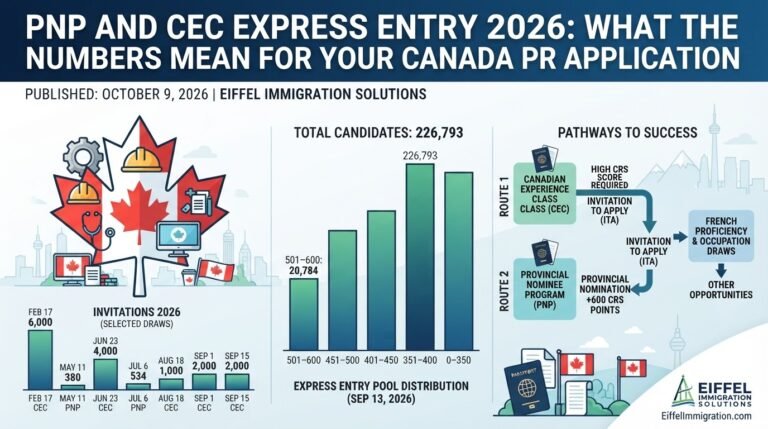
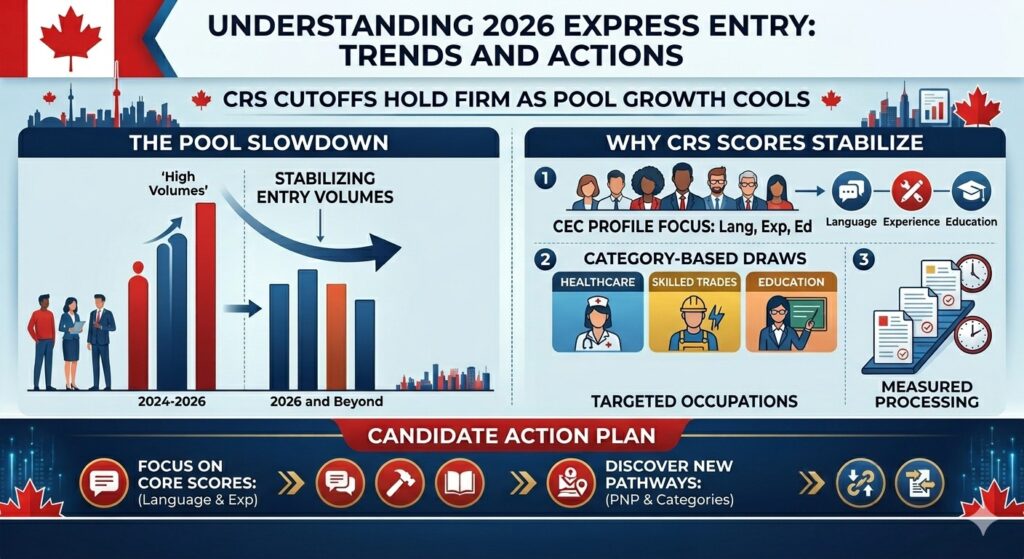
CRS scores in 2026 are holding in the 510–520 range for general and CEC draws, despite a noticeable slowdown in Express Entry Pool growth.
This may seem counterintuitive. Fewer new candidates entering the pool should reduce competition — but the data shows otherwise.
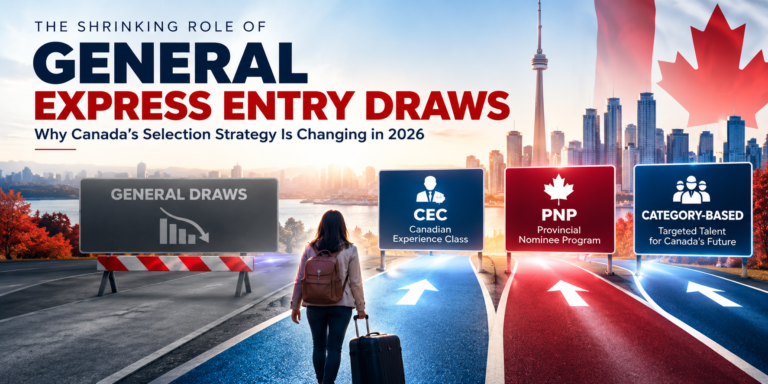
The reason is simple: Canada is no longer selecting broadly from the Express Entry Pool. It is selecting strategically.
Express Entry Pool: Slower Growth, Same Pressure
Over the past two years, the Express Entry Pool expanded rapidly due to:
- High volumes of international graduates
- Post-pandemic work permit extensions
- Increased global demand for Canadian PR
However, in 2026:
- Fewer new high-scoring profiles are entering
- The pool is stabilizing in size
- IRCC is issuing controlled numbers of Invitations to Apply (ITAs)
Despite this slowdown, the quality of candidates remains high, which keeps CRS cutoffs elevated.
Why CRS Scores Are Not Dropping
1. High-Scoring Profiles Still Dominate
Even with slower growth, the top segment of the Express Entry Pool remains saturated with candidates who have:
- Canadian work experience (CEC profiles)
- CLB 9–10 language scores
- Post-secondary education in Canada
This concentration at the top prevents CRS scores from falling.
2. Targeted Draws Are Reshaping Selection
IRCC’s shift to category-based draws has fundamentally changed how candidates are selected from the Express Entry Pool.
Key Categories (2026 Focus)
- Healthcare occupations (TEER 1–3)
Examples: Registered nurses (NOC 31301), physicians (NOC 31100), pharmacists (NOC 31120) - Skilled trades (TEER 2–3)
Examples: Electricians (NOC 72200), plumbers (NOC 72300), welders (NOC 72106) - Education occupations (TEER 1–2)
Examples: Secondary school teachers (NOC 41220), early childhood educators (NOC 42202)
Typical CRS Ranges (Recent Trends)
- Healthcare draws: 470–500
- Trades draws: 430–470
- Education draws: 480–505
These draws often select candidates with lower CRS scores than general draws, but only if their occupation aligns with the category.
How to Check Eligibility
To determine if you qualify under a category-based draw:
- Identify your NOC 2021 code based on your job duties (not just title)
- Confirm your TEER level
- Ensure your work experience matches the lead statement and main duties
- Maintain an active profile in the Express Entry Pool
Without this alignment, candidates remain dependent on higher CRS general draws.
3. Limited ITAs Per Draw
Recent draws have been issuing approximately 1,500–2,000 ITAs, which is relatively controlled compared to demand.
Fewer invitations mean:
- Slower movement down the CRS ranking
- Continued pressure on cutoff scores
4. IRCC’s Processing Strategy
Immigration targets remain high, but IRCC is balancing:
- Application backlogs
- Processing timelines
- Economic priorities
This results in a measured, selective approach rather than large, score-dropping draws.
What This Means for Candidates in the Express Entry Pool
1. Waiting for CRS to Drop Is No Longer a Strategy
The assumption that CRS scores will fall as the Express Entry Pool stabilizes is not supported by current trends.
Candidates who delay profile improvements risk:
- Missing category-based opportunities
- Falling behind newer, stronger profiles
2. Profile Optimization Is Critical
In a stable but competitive Express Entry Pool, incremental improvements can determine outcomes.
Key areas to focus on:
- Increasing language scores to CLB 9 or higher
- Adding Canadian work experience
- Leveraging spouse credentials
- Completing additional education (if applicable)
3. Category-Based Draws Offer a Strategic Advantage
Candidates in targeted occupations can receive invitations at significantly lower CRS scores.
However, success depends on:
- Accurate NOC classification
- Relevant, verifiable work experience
- Timely profile updates
4. Provincial Nominee Programs (PNPs) Remain a Game-Changer
A provincial nomination adds 600 CRS points, effectively guaranteeing an ITA.
Many provinces are aligned with the same sectors as category-based draws, including:
- Healthcare
- Skilled trades
- Education
Expert Insight: A Shift from Ranking to Selection
Based on over 8 years of experience, the current system reflects a clear transition:
The Express Entry Pool is no longer just a ranking system — it is a targeted selection mechanism.
Success is no longer determined solely by CRS score, but by:
- Occupational relevance
- Economic demand alignment
- Strategic profile positioning
Action Plan for 2026 Applicants
Step 1: Assess Your Current CRS Score
Understand where you rank within the Express Entry Pool.
Step 2: Identify Eligibility for Category-Based Draws
Review your NOC code and determine if it aligns with targeted sectors.
Step 3: Improve Core Factors
Focus on:
- Language test retakes
- Work experience accumulation
- Education upgrades
Step 4: Explore Provincial Pathways
Research PNP streams aligned with your occupation and province of interest.
Step 5: Stay Updated and Act Quickly
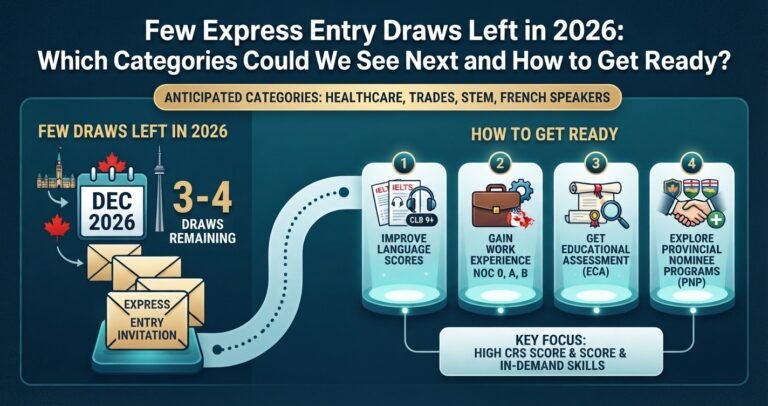
Draw patterns are evolving. Timing is increasingly critical.
Future Outlook
Looking ahead, the Express Entry Pool is expected to:
- Grow more selectively rather than rapidly
- Continue prioritizing category-based draws
- Maintain relatively stable CRS cutoffs in general draws
Candidates with Canadian experience and in-demand occupations will remain at an advantage.
Conclusion
The slowdown in Express Entry Pool growth does not mean easier PR pathways — it signals a more refined and selective system.
CRS scores remain firm because Canada is choosing candidates based on specific economic needs, not just ranking position.
For applicants, the takeaway is clear:
Strategic positioning now matters more than passive waiting.
Need Professional Guidance?
Eiffel Immigration provides:
- CRS score assessment
- NOC and category eligibility analysis
- Express Entry profile optimization
- PNP strategy planning