
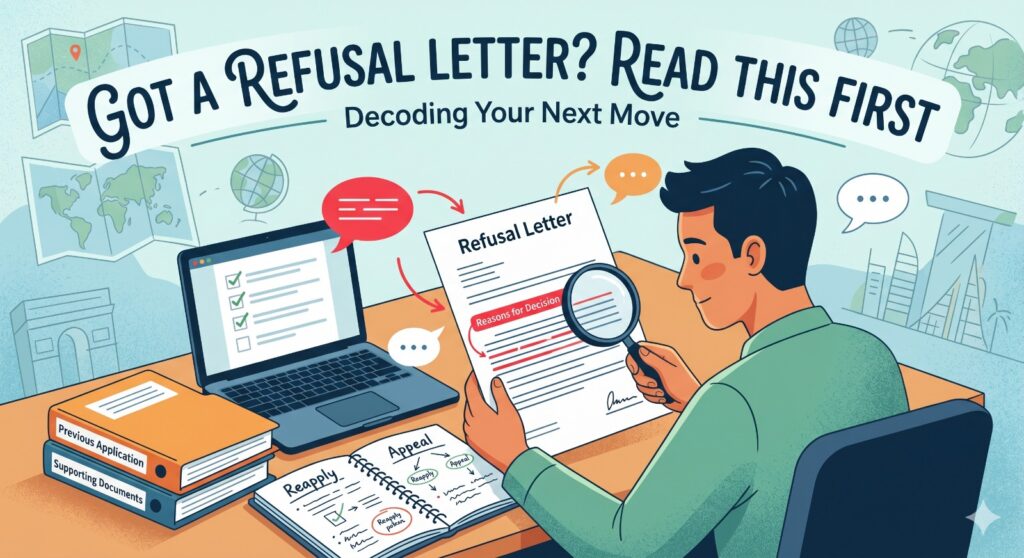
Receiving a refusal letter can feel discouraging. You spent time, effort, and money on your application—only to see it rejected. But here’s something important: a refusal letter is not the end of your immigration journey.
In fact, it can be the most valuable document you receive.
Why? Because it tells you exactly what went wrong—and what you need to fix.
The real question is not “Why did I get refused?”
The real question is: “What should I do next—resubmit or appeal?”
What Is a Refusal Letter?
A refusal letter is an official document issued by an immigration officer explaining why your application was not approved.
It typically includes:
- Specific reasons for refusal
- References to immigration rules or regulations
- Concerns about your documents or eligibility
However, not all refusal letters are easy to understand. Some are very detailed, while others are short and vague.
👉 That’s why learning how to decode your refusal letter is crucial.
Why Your Refusal Letter Matters More Than You Think
Most applicants make one big mistake—they read the refusal letter once and move on.
That’s risky.
A refusal letter is not just a rejection. It’s a strategy guide for your next application.
It tells you:
- What the officer was not convinced about
- Where your application was weak
- What needs improvement
If you ignore these clues and reapply with the same documents, chances are high you’ll get refused again.
Resubmit or Appeal: Understanding Your Options
After receiving a refusal letter, you generally have two choices:
Option 1: Resubmit (Reapply)
Resubmitting means you prepare a stronger application and apply again.
This is the most common and practical option.
You should resubmit if:
- You submitted incomplete or weak documents
- Your proof (funds, job, ties) was not strong enough
- Your explanation letter lacked clarity
- Your situation has improved since applying
👉 Example:
If your refusal letter mentions “insufficient financial proof,” you can provide stronger bank statements, additional funds, or a clearer explanation and reapply.
Advantages of resubmitting:
- Faster than appeals
- More control over your application
- Higher success rate if done correctly
Option 2: Appeal (Challenge the Decision)
An appeal means you are legally challenging the refusal decision.
This option is not always available for every application type, and it can be complex.
You should consider an appeal if:
- The officer made a clear mistake
- Important documents were ignored
- The decision is unfair or unreasonable
- There is a legal or procedural error
👉 Example:
If your refusal letter states you didn’t submit a required document—but you actually did—this could be grounds for an appeal.
Things to keep in mind:
- Appeals can take months or even years
- They often require legal expertise
- They are not always guaranteed to succeed
How to Analyze Your Refusal Letter Like an Immigration Expert
Understanding your refusal letter properly is the key to success.
Here’s how professionals break it down:
1. Identify the Real Reason Behind the Refusal
Sometimes the reason mentioned in the refusal letter is not the full story.
For example:
“Not satisfied you will leave Canada at the end of your stay”
This doesn’t just mean travel intent—it may point to:
- Weak employment ties
- Lack of family connections
- Unclear purpose of visit
👉 Always look deeper than the surface.
2. Check Your Documents Carefully
Ask yourself:
- Did I provide enough supporting evidence?
- Were my documents clear and well-organized?
- Did anything seem incomplete or confusing?
Even small gaps can lead to refusal.
3. Look for Red Flags
Most refusal letters highlight common concerns such as:
- Insufficient financial proof
- Unstable employment history
- Inconsistent information
- Weak travel history
- Lack of strong ties to home country
👉 These are the areas you must fix before reapplying.
4. Compare With Your Original Application
Go back and review everything you submitted.
Match your documents with the points raised in the refusal letter.
This step often reveals exactly what went wrong.
When Resubmitting Is the Better Choice
In most cases, resubmitting is the smarter option.
Why?
Because many refusals happen due to:
- Poor documentation
- Weak explanation
- Missing details
These issues can be corrected.
👉 The key is not to simply reapply—but to rebuild your application stronger than before.
Tips for a successful reapplication:
- Address every refusal reason clearly
- Add stronger supporting documents
- Write a clear and detailed explanation letter
- Remove any inconsistencies
When an Appeal Makes Sense
Appeals should be considered carefully.
They are best used when the issue is not with your application—but with the decision itself.
Choose this route if:
- The refusal letter contains factual errors
- The officer ignored critical evidence
- There was a violation of fairness or procedure
👉 In such situations, professional guidance is highly recommended.
Common Mistakes to Avoid After a Refusal Letter
Many applicants repeat the same errors after receiving a refusal letter.
Avoid these:
❌ Reapplying without changes
❌ Ignoring refusal reasons
❌ Submitting the same documents again
❌ Rushing the process
❌ Not seeking proper guidance when needed
These mistakes can lead to repeated refusals.
Pro Tip: Turn Your Refusal Letter Into a Winning Strategy
Instead of seeing your refusal letter as a setback, use it as a tool.
Ask yourself:
- What exactly was missing?
- What can I improve?
- How can I present my case more clearly?
Every strong application is built on learning from past mistakes.
Conclusion: Your Next Step Matters Most
A refusal letter can feel disappointing—but it also gives you direction.
Whether you choose to resubmit or appeal, your success depends on how well you understand and respond to that letter.
👉 In most situations, a well-prepared reapplication is the fastest and most effective path.
👉 Appeals should be reserved for cases involving clear errors or unfair decisions.
At the end of the day, your refusal letter is not a dead end—it’s a second chance to get it right.