
When most people think about working in Canada, they immediately assume that obtaining a Work Permit is the first step. In many cases, that’s true. Whether you’re coming to Canada as a skilled worker, temporary foreign worker, or international graduate, a Work Permit is often required before you can legally work.
However, what surprises many people is that not everyone needs a Work Permit to work in Canada.
Over the past decade, we’ve spoken with countless individuals who were unaware that Canadian immigration laws provide several exemptions allowing certain foreign nationals to work without first obtaining a WP While these exemptions don’t apply to everyone, understanding them can help you determine whether you may qualify for a simpler route to working in Canada.
Let’s explore who may be able to work in Canada without a Work Permit and what you need to know before relying on an exemption.
What Is a Work Permit?
A Work Permit is an authorization issued by Immigration, Refugees and Citizenship Canada (IRCC) that allows a foreign national to work legally in Canada.
Generally, foreign workers need either:
- An employer-specific Work Permit
- An open Work Permit
A Work Permit outlines the conditions under which an individual can work, including the employer, location, and duration of employment.
Because Canada regulates its labour market carefully, most foreign nationals must obtain authorization before accepting employment. However, Canadian immigration regulations recognize that certain activities and professions do not require a Work Permit.
Why Does Canada Allow Work Permit Exemptions?
The purpose of WP exemptions is to facilitate activities that provide economic, cultural, educational, or diplomatic benefits to Canada.
In some situations, requiring a Work Permit would create unnecessary administrative barriers for individuals whose work is temporary, specialized, or internationally recognized.
As a result, immigration regulations provide exemptions for specific categories of workers.
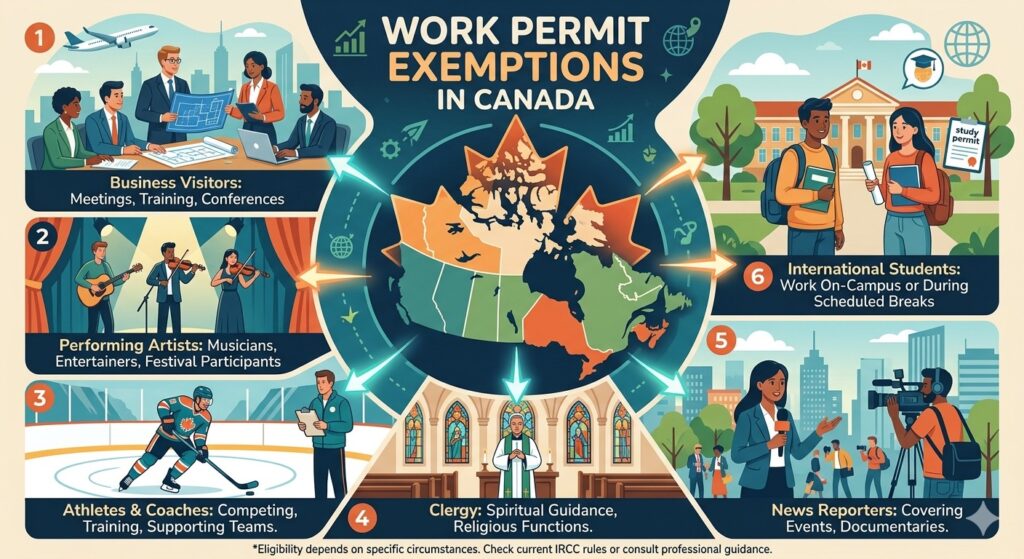
Business Visitors
One of the most common WP exemptions applies to business visitors.
Business visitors may enter Canada to engage in international business activities without directly entering the Canadian labour market.
Examples include:
- Attending meetings
- Participating in conferences
- Negotiating contracts
- Conducting site visits
- Receiving or providing training
The key factor is that the individual’s primary source of income and place of business remain outside Canada.
Many entrepreneurs and corporate representatives mistakenly assume they need a Work Permit for short-term business activities when they may actually qualify as business visitors.
Foreign Representatives and Diplomats
Diplomatic personnel and foreign government representatives may also work in Canada without obtaining a WP.
This category typically includes:
- Diplomats
- Embassy staff
- Consular officials
- Representatives of foreign governments
These individuals are generally covered under international agreements and diplomatic arrangements.
Public Speakers
Some public speakers can work in Canada without a Work Permit, particularly when their engagement is short-term.
Examples include:
- Guest lecturers
- Commercial speakers
- Seminar presenters
- Industry experts attending conferences
In many cases, speaking engagements lasting only a few days may qualify for an exemption.
However, the specific circumstances matter, and individuals should verify their eligibility before travelling.
Performing Artists
Canada recognizes the cultural value that international artists bring to events and performances.
Certain performing artists may work without a Work Permit, including:
- Musicians
- Theatre performers
- Guest entertainers
- Festival participants
The exemption often applies when artists are performing for a limited duration and are not entering into long-term employment arrangements with Canadian organizations.
This exemption has helped facilitate numerous cultural events across the country.
Athletes and Coaches
Professional athletes and coaches may also qualify for a Work Permit exemption under specific circumstances.
Examples include:
- Professional athletes competing in Canada
- Foreign-based team members
- Coaches and trainers supporting athletes
- Participants in international sporting events
Canada regularly hosts international competitions, making this exemption particularly important.
News Reporters and Media Crews
Foreign journalists covering Canadian events often do not require a WP.
This category may include:
- News reporters
- Documentary crews
- Film journalists
- Foreign correspondents
The exemption allows international media organizations to report on Canadian events efficiently while maintaining freedom of the press.
Clergy and Religious Workers
Certain religious workers may perform duties in Canada without obtaining a Work Permit.
Examples include:
- Ministers
- Priests
- Rabbis
- Imams
- Missionaries
These individuals must generally be performing genuine religious functions or providing spiritual guidance within a religious community.
Expert Witnesses and Investigators
Individuals entering Canada to participate in legal proceedings may also be exempt from Work Permit requirements.
This category can include:
- Expert witnesses
- Investigators
- Consultants assisting legal matters
Their work is generally limited to the specific proceeding or investigation for which they were invited.
International Students Working During Studies
Many international students are surprised to learn that their study permit may already authorize them to work under certain conditions.
Depending on their eligibility, students may be permitted to:
- Work on campus
- Work off campus during studies
- Work during scheduled breaks
In these situations, a separate WP may not be required.
Students should carefully review the conditions listed on their study permit before accepting employment.
Temporary Public Policies and Special Programs
From time to time, the Canadian government introduces temporary public policies that provide additional work authorization opportunities.
These programs may allow certain foreign nationals to work without applying for a traditional Work Permit or may simplify the process significantly.
Because immigration policies evolve frequently, individuals should stay informed about current rules and announcements from IRCC.
Common Misconceptions About Work Permit Exemptions
Over the years, we’ve noticed several misunderstandings regarding Work Permit exemptions.
“I Don’t Need a Work Permit Because I’m Only Staying a Few Days”
Length of stay alone does not determine whether a Work Permit is required. The nature of the activity is what matters most.
“I’m Getting Paid Outside Canada, So I Don’t Need a Work Permit”
Receiving payment from outside Canada does not automatically create an exemption.
“My Friend Entered Without a Work Permit, So I Can Too”
Every immigration situation is unique. Eligibility depends on your specific role, duties, and circumstances.
Why Professional Guidance Matters
One of the biggest mistakes people make is assuming they qualify for a WP exemption without obtaining proper advice.
A misunderstanding can result in:
- Refused entry at the border
- Delays in immigration applications
- Compliance issues
- Future immigration complications
Before travelling to Canada for work-related activities, it’s important to understand exactly which rules apply to your situation.
Final Thoughts
While most foreign nationals require a Work Permit to work legally in Canada, there are several important exemptions that many people don’t know about.
Business visitors, public speakers, performing artists, athletes, journalists, clergy members, and certain students may all be able to work in Canada without obtaining a traditional WP.
However, eligibility depends on the specific facts of each case.
Canadian immigration laws are complex and frequently updated. What applies to one individual may not apply to another. That’s why understanding the requirements before travelling or accepting work is essential.
If you’re unsure whether you need a Work Permit, seeking professional immigration guidance can help you avoid costly mistakes and ensure you remain compliant with Canadian immigration regulations.
Understanding your options today could make your journey to Canada much smoother tomorrow.