
If you have been following Express Entry draws in 2026, you have probably noticed one thing: CRS cut-off scores remain stubbornly high.
Many candidates expected scores to gradually fall as Immigration, Refugees and Citizenship Canada (IRCC) continued issuing Invitations to Apply (ITAs). Instead, the opposite has happened. Despite regular draws, the pool is becoming increasingly competitive, particularly among candidates with CRS scores above 500.
As someone who has worked in Canadian immigration for over 10 years, I have rarely seen such a significant concentration of candidates in the upper CRS ranges. The latest Express Entry pool data provides a clear explanation for why many applicants are still waiting for an invitation despite having strong profiles.
The Latest CRS Pool Data Reveals a Major Shift
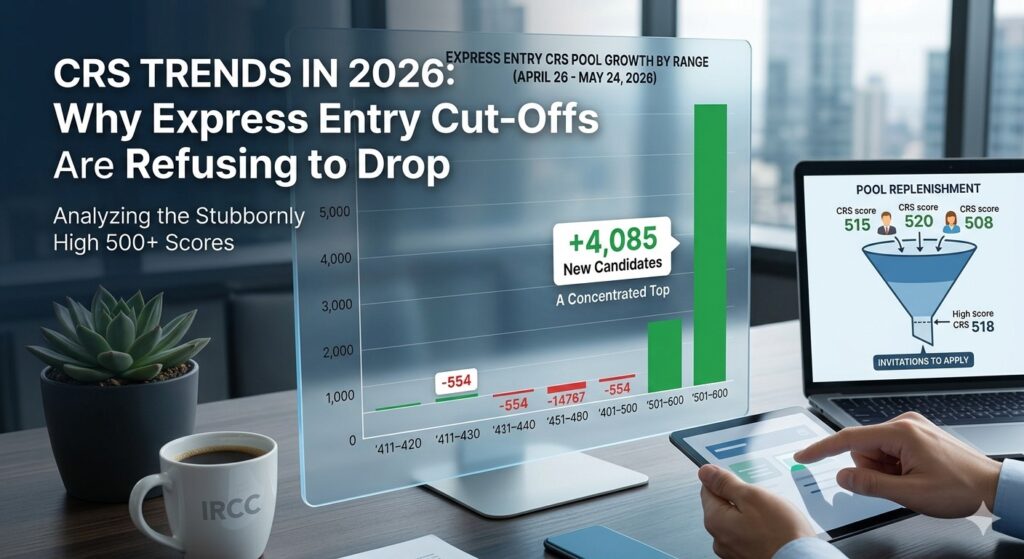
Between April 26 and May 24, 2026, the Express Entry pool grew by 4,395 candidates, increasing from 234,452 to 238,847 profiles. What is most remarkable is where that growth occurred.
The 501–600 CRS range alone added 4,085 new candidates, accounting for approximately 93% of the entire pool’s growth during that period.
Here is what happened in key CRS ranges:
| CRS Range | Change |
|---|---|
| 501–600 | +4,085 |
| 491–500 | +240 |
| 481–490 | +508 |
| 471–480 | +553 |
| 461–470 | +289 |
| 421–430 | +302 |
| 411–420 | -554 |
| 401–410 | -403 |
| 351–400 | -293 |
The data tells a simple story: the Express Entry pool is not growing evenly. It is growing at the top.
Why Are Comprehensive Ranking System Scores Above 500 Growing So Quickly?
Several factors are contributing to the rapid increase in high-scoring candidates.
1. More Canadian Experience Candidates Are Becoming Eligible
Thousands of temporary foreign workers continue to complete their first year of skilled Canadian work experience each month. Once they qualify under the Canadian Experience Class (CEC), their Comprehensive Ranking System scores often jump significantly.
Many candidates also receive additional points through:
- Improved language test results
- Spousal language scores
- Educational Credential Assessments
- French-language proficiency
- Provincial nominations
These improvements push many profiles into the coveted 500+ range.
2. CEC Draw Pauses Create Backlogs
The recent 29-day gap between CEC draws allowed high-scoring candidates to accumulate in the pool while very few were removed through invitations. During that period, the number of candidates in the 501–600 range surged from 13,860 to 17,945.
When CEC draws resumed, the impact was immediate.
IRCC issued 3,000 invitations with a CRS cut-off of 518, making it one of the highest CEC thresholds seen in 2026.
3. French-Language Candidates Continue to Benefit
French-language proficiency remains one of the strongest tools available for increasing CRS scores.
Many candidates who achieve strong French test results receive substantial additional points and may qualify under category-based selection streams. Recent French-language draws have had Comprehensive Ranking System requirements significantly lower than standard CEC draws.
For candidates currently sitting in the mid-400s, French remains one of the fastest ways to become competitive.
What This Means for Candidates in the 450–500 Comprehensive Ranking System Range
This is the group facing the greatest challenge in 2026.
According to pool data, more than 74,000 candidates are currently sitting between CRS 451 and 500.
Even when IRCC conducts larger draws, new high-scoring profiles are entering the pool almost as quickly as invitations are being issued.
This explains why many candidates are asking:
“Why are CRS cut-offs not dropping even after large draws?”
The answer is straightforward:
The pool replenishes itself faster than it can be cleared.
Every time IRCC invites thousands of candidates, new profiles with Comprehensive Ranking System scores above 500 enter the system.
Will Comprehensive Ranking System Scores Drop Below 500 in 2026?
It is possible, but several conditions would need to occur simultaneously:
Scenario 1: Larger and More Frequent CEC Draws
If IRCC consistently issues 4,000–5,000 ITAs through CEC draws every two weeks, the upper CRS ranges could gradually thin out.
Scenario 2: Increased Immigration Targets
Higher admissions targets generally require more invitations, which can put downward pressure on Comprehensive Ranking System cut-offs.
Scenario 3: Slower Growth in High-Scoring Profiles
If fewer candidates enter the 500+ range, IRCC would eventually begin inviting candidates from lower Comprehensive Ranking System bands.
At present, however, available data suggests that candidates with CRS scores above 500 continue to grow at a pace that keeps cut-offs elevated.
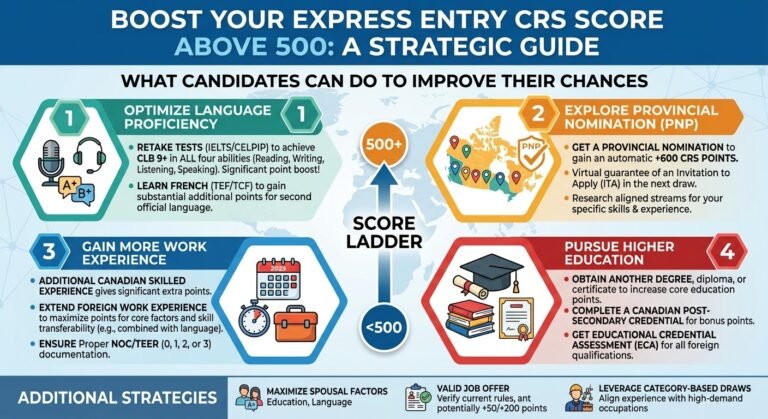
What Candidates Should Do Right Now
Instead of waiting for CRS scores to fall, candidates should focus on increasing their competitiveness.
Some of the most effective strategies include:
Improve Language Scores
A small increase in IELTS or CELPIP results can add valuable CRS points.
Learn French
French proficiency remains one of the strongest CRS boosters available.
Gain Additional Canadian Work Experience
An extra year of skilled work can significantly improve your ranking.
Explore Provincial Nominee Programs
A provincial nomination adds 600 CRS points and virtually guarantees an invitation.
Update Your Express Entry Profile
Many candidates overlook opportunities to claim additional points for education, work experience, or spouse factors.
Final Thoughts
The biggest immigration story of 2026 is not the number of Express Entry draws being conducted—it is the rapid growth of candidates with exceptionally high CRS scores.
The latest pool data shows that nearly all recent growth has occurred in the 501–600 CRS range, making competition fiercer than many candidates expected.
For applicants with CRS scores in the mid-400s, waiting for scores to drop may not be the best strategy. The candidates receiving invitations today are often those actively improving their profiles, gaining additional qualifications, or pursuing alternative pathways such as French-language programs and provincial nominations.
In 2026, the reality of Express Entry is clear: