
If you are planning to immigrate to Canada through Express Entry, you have probably heard about the CRS score many times. Many applicants ask immigration consultants one common question: “Will taking a short course increase my CRS score?”
It’s a very important question because improving your CRS score can increase your chances of receiving an Invitation to Apply (ITA) for permanent residence.
However, there is a lot of confusion about short courses and CRS points. Some people believe that completing any short course will increase their CRS score, but that is not always true.
In this blog, we will explain in simple language how short courses affect your CRS score and what Immigration, Refugees and Citizenship Canada (IRCC) actually counts.
Understanding CRS Score in Express Entry
The Comprehensive Ranking System (CRS) is the points system used in Express Entry to rank candidates in the immigration pool.
Your CRS score is calculated based on several factors such as:
-
Age
-
Education
-
Language proficiency (IELTS/CELPIP)
-
Work experience
-
Canadian work experience
-
Spouse factors (if applicable)
-
Additional factors such as provincial nomination or job offer
Among these, education plays an important role in determining your CRS score.
This is why many applicants look for short courses to try to increase their education points.
But the key question is: Does IRCC actually count short courses?
Do Short Courses Increase CRS Score?
The simple answer is: Not always.
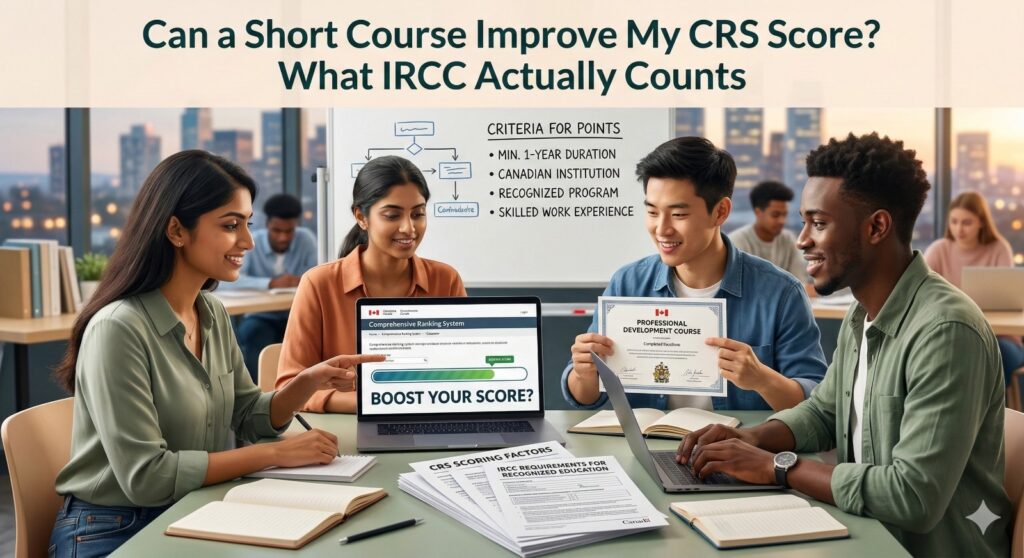
For a course to increase your CRS score, it must meet specific requirements set by IRCC.
If a short course does not meet these conditions, it will not add any CRS points.
Many short courses are designed for skill development, but they may not qualify as a recognized educational credential for Express Entry.
So before enrolling in any short course, it is important to understand what IRCC considers valid education.
What IRCC Counts as Education
For Express Entry, IRCC only counts education credentials that are:
-
Completed from a recognized institution
-
Assessed by an Educational Credential Assessment (ECA) organization (if completed outside Canada)
-
Equivalent to a Canadian educational credential
Common ECA organizations include:
-
WES (World Education Services)
-
IQAS
-
ICES
-
CES
If your short course cannot be assessed by an ECA organization, it usually will not contribute to your CRS score.
Types of Education That Can Increase CRS Score
The following types of education typically count toward CRS points:
1. Diplomas or Certificates from Recognized Institutions
Programs such as:
-
One-year diploma
-
Two-year diploma
-
Postgraduate certificate
-
Bachelor’s degree
-
Master’s degree
These programs can increase your CRS score if they are recognized and assessed properly.
2. Canadian Educational Credentials
Education completed in Canada from a Designated Learning Institution (DLI) can provide additional CRS points.
For example:
-
One-year Canadian program
-
Two-year Canadian diploma
-
Canadian degree programs
These may also provide extra CRS points under the Canadian education category.
When a Short Course Does NOT Increase CRS Score
Many short courses are:
-
3-month training programs
-
Online certification courses
-
Professional workshops
-
Skill development courses
Even though these programs may improve your knowledge and career prospects, they often do not qualify for CRS points because they are not considered formal academic credentials.
For example:
-
Online digital marketing courses
-
Short IT training programs
-
Weekend certifications
These are useful for professional development but IRCC usually does not count them for CRS scoring.
Situations Where a Short Course May Help
While many short courses do not increase CRS points directly, they can still help your immigration journey in other ways.
Improving Job Opportunities
A short course can help you gain specialized skills, which may improve your chances of getting a job offer in Canada.
A valid job offer may provide additional CRS points.
Supporting Provincial Nominee Programs (PNPs)
Some provinces consider specific skills or training programs when selecting candidates under Provincial Nominee Programs.
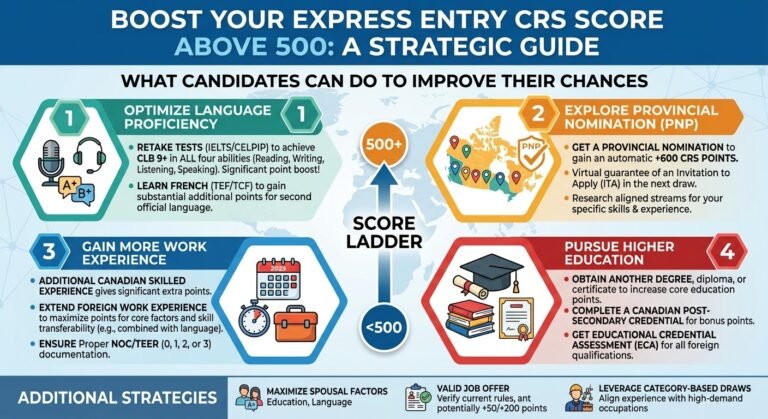
Even if the course does not increase CRS directly, it may help you qualify for a provincial nomination, which can add 600 CRS points.
Enhancing Language Preparation
Some short courses focus on IELTS preparation or language improvement.
Improving your IELTS score can significantly increase your CRS points.
For example, moving from CLB 7 to CLB 9 can dramatically boost your CRS score.
Better Ways to Increase Your CRS Score
Instead of relying only on short courses, consider the following strategies to increase your CRS score.
Improve Your Language Score
Language tests such as IELTS or CELPIP can have a huge impact on your CRS score.
Even a small improvement in your band score can add many points.
Gain More Work Experience
Additional years of skilled work experience can increase your CRS score.
Both foreign and Canadian work experience contribute to CRS points.
Higher Education
Completing a higher degree such as a master’s program can significantly increase CRS points.
Provincial Nomination
Receiving a Provincial Nominee Program (PNP) nomination adds 600 CRS points, almost guaranteeing an invitation to apply.
Spouse Factors
If you are applying with your spouse, their education and language scores can also contribute to your CRS score.
The Biggest Mistake Applicants Make
One common mistake applicants make is taking random short courses without checking IRCC requirements.
This can lead to:
-
Wasting time
-
Spending unnecessary money
-
No improvement in CRS score
Before enrolling in any program, it is important to confirm whether the credential will be recognized for immigration purposes.
Consulting an immigration professional can help you make the right educational decisions for Express Entry.
Final Thoughts
So, can a short course improve your CRS score?
The answer is only if the course leads to a recognized educational credential that can be assessed by an ECA organization or completed at a recognized Canadian institution.
Most short courses designed for skill development do not directly increase CRS points, although they may still help with employment opportunities or provincial programs.
If your goal is to improve your CRS score, focus on strategies that IRCC actually counts, such as:
-
Higher education
-
Better language scores
-
Skilled work experience
-
Provincial nominations
Understanding how CRS scoring works can help you make smarter decisions and improve your chances of immigrating to Canada.
Need guidance on improving your CRS score or choosing the right educational pathway for Express Entry?
The team at Eiffel Immigration can help you evaluate your profile and identify the best strategies to strengthen your immigration application.