
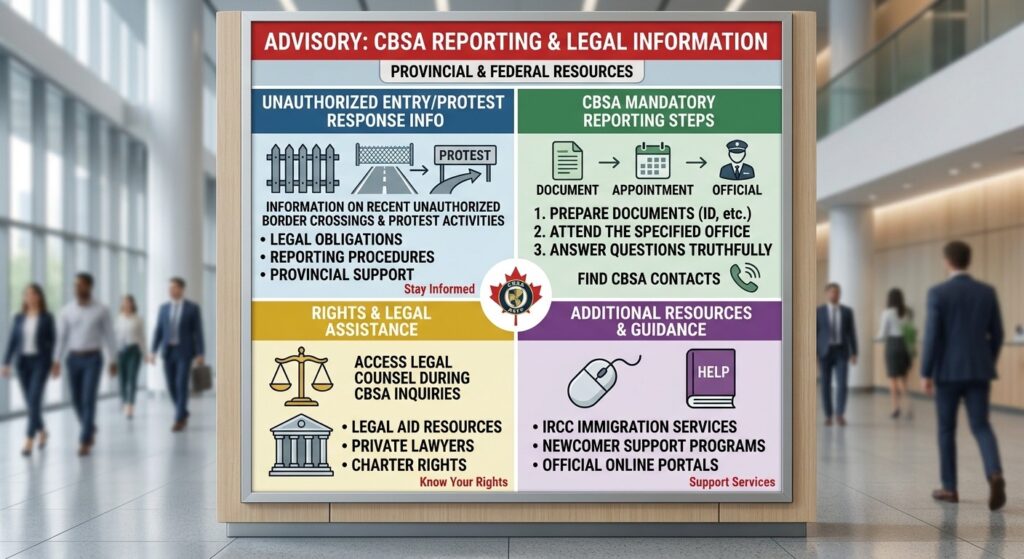
The latest Alberta Protest involving international students has raised an important immigration question: What should you do if the Canada Border Services Agency (CBSA) asks you to report to an immigration office?
In August 2026, CBSA officers visited an ongoing international student protest in Calgary and checked the immigration status of people at the site. Reports indicate that some participants were instructed to report to a CBSA office after their status was reviewed. The protest involved international graduates who had been challenging refusals of their Post-Graduation Work Permit (PGWP) applications.
The situation has attracted significant attention because it highlights an important reality for temporary residents in Canada:
Your immigration status continues to matter even when you are challenging an immigration decision, participating in a protest, or waiting for another application to be processed.
If you receive a CBSA reporting notice, it is important to understand what it means and what steps you should take.
Important: Being asked to report to CBSA does not necessarily mean that you are being removed from Canada immediately. The exact implications depend on your individual immigration history, current status, previous applications and the document you received.
What Happened During the Latest Alberta Protest?
The latest Alberta Protest was connected to international students and graduates who had been demonstrating in Calgary over PGWP refusals.
According to reporting, the affected graduates had studied in programs associated with Portage College and argued that they had expected to qualify for PGWPs after completing their studies. IRCC began issuing refusals to applicants whose programs were considered non-credit and therefore did not meet the applicable PGWP requirements.
The protest continued for several weeks, including a hunger strike.
On August 12, 2026, CBSA officers attended the protest location and conducted immigration-status checks. Reports indicate that some individuals were given instructions to appear at a CBSA office.
The protest was subsequently suspended following the CBSA visit.
Why Is This Important?
The Alberta Protest has created concern among international students and temporary residents about what happens when CBSA becomes involved.
However, it is important to understand that CBSA and IRCC have different roles.
IRCC generally handles immigration applications and status-related decisions, while CBSA is responsible for enforcement of immigration legislation, including investigations, removals and certain immigration-related compliance activities.
Therefore, receiving a CBSA notice should be taken seriously.
What Does It Mean If CBSA Asks You to Report?
A request to report to a CBSA office can occur for different reasons.
For example, CBSA may want to:
- Verify your identity
- Confirm your immigration status
- Review your immigration documents
- Discuss an outstanding immigration matter
- Obtain additional information
- Review compliance with the conditions of your temporary status
- Discuss a removal process
- Complete an immigration enforcement procedure
The reason for the appointment should be determined from the notice you received and your individual circumstances.
Do not assume that every CBSA reporting appointment means the same thing.
Step 1: Do Not Ignore the CBSA Notice
This is perhaps the most important step.
If CBSA gives you a written notice requiring you to report, do not simply ignore it because you are worried about what may happen.
Failing to comply with an immigration reporting requirement can create additional problems.
Read the document carefully and identify:
- The date of the appointment
- Time of the appointment
- Location
- Officer or office information
- Any reference or file number
- Documents you are required to bring
- Any instructions concerning your immigration status
Keep the original document and make copies or electronic scans for your records.
Step 2: Determine Your Current Immigration Status
Before attending the appointment, establish exactly what your current status is.
For example, you may be:
- A valid study permit holder
- A valid work permit holder
- A visitor
- Waiting for restoration
- Waiting for a work permit decision
- Waiting for a visitor record
- An applicant with an outstanding immigration application
- Out of status
- Subject to a removal process
Do not rely only on what you believe your status is.
Review your actual documents and application history.
Pay Particular Attention to Expiry Dates
Temporary residents should know:
When did my study permit expire?
When did my work permit expire?
Did I apply before it expired?
Did I apply for restoration?
Was my application refused?
Did I receive a maintained-status letter?
Have I received any CBSA or IRCC correspondence?
These details can significantly affect how your situation should be handled.
Step 3: Get Professional Advice Before the Appointment
If CBSA has specifically asked you to report to an office, it is generally wise to obtain immigration advice before the appointment, particularly if you have:
- A refused immigration application
- An expired permit
- A PGWP refusal
- A restoration issue
- A removal order
- A previous immigration violation
- An inadmissibility concern
- An outstanding refugee or humanitarian application
- Conflicting immigration documents
A professional review can help identify potential issues before you attend.
The objective is not to avoid CBSA.
The objective is to understand your legal position and prepare appropriately.
Step 4: Gather Your Immigration Documents
Before attending your CBSA appointment, organize your documents.
Depending on your circumstances, this may include:
Identification
- Passport
- Government-issued identification
- Provincial identification
Immigration Documents
- Study permit
- Work permit
- Visitor record
- Temporary resident visa
- Electronic travel authorization, if applicable
- Permanent residence documents, if applicable
Application Documents
- IRCC application confirmation
- Application submission confirmation
- Refusal letters
- Approval letters
- Restoration application
- Work permit application
- PGWP application
- PR application
- Supporting correspondence from IRCC
Other Supporting Evidence
Depending on your case:
- School records
- Transcripts
- Graduation documents
- Employment letters
- Pay statements
- Proof of residence
- Correspondence with your school
- Correspondence with IRCC
- Previous legal or immigration documents
Organize everything chronologically.
Step 5: Do Not Destroy or Alter Immigration Documents
If you have received a refusal letter, reporting notice, removal-related document or other official correspondence, keep it.
Do not delete important emails.
Do not alter documents.
Do not submit false information to CBSA or IRCC.
If you believe there is an error in an immigration decision, the appropriate response is to pursue the available legal or administrative remedy—not to conceal the issue.
Step 6: Understand the Difference Between a PGWP Refusal and CBSA Enforcement
This distinction is extremely important in situations similar to the Alberta Protest.
A PGWP refusal is an immigration application decision.
It does not automatically mean that a person is immediately removed from Canada.
However, if a person’s temporary status has expired and they do not have another legal basis to remain in Canada, the situation can become an immigration-status and enforcement issue.
This is why an individual whose PGWP was refused should immediately determine:
What is my current legal status in Canada?
The answer may depend on the expiry date of the previous permit, the timing and type of applications submitted, whether restoration was requested, and the outcome of those applications.
What If Your PGWP Was Refused?
If you are among the international graduates affected by the Alberta Protest, do not assume that participating in the protest itself changes your immigration status.
Instead, review the underlying immigration issue.
Ask:
Why was my PGWP refused?
Read the refusal letter carefully.
Was the refusal based on my program?
Determine what IRCC identified as the reason for refusal.
Was my application submitted under the rules that applied to me?
Immigration rules can change, and eligibility may depend on when you began your program, when you applied and the specific characteristics of the program.
Do I currently have valid status?
This is a separate question from whether your PGWP application was refused.
Is there a reconsideration or judicial review option?
Depending on the circumstances, there may be legal or administrative options worth discussing with a qualified immigration professional.
Can You Continue Working After a PGWP Refusal?
Do not assume that you can continue working simply because you previously had a study permit or because you have challenged the refusal.
Whether you are authorized to work depends on your specific circumstances and the legal basis for your work authorization.
For example, there can be significant differences between:
- Having a valid work permit
- Working under maintained status
- Having submitted a new work permit application
- Having applied for restoration
- Having received a refusal
- Having no valid authorization to work
If you are uncertain, obtain professional advice before continuing employment.
What If You Are Out of Status?
If your status has expired, the situation requires immediate attention.
Depending on the circumstances, a person may have options such as restoration of status or another immigration pathway.
However, restoration is not available indefinitely, and not every situation qualifies.
If CBSA has already contacted you, the situation may be more serious than a simple expired permit.
That is why the timing of professional advice matters.
What If CBSA Mentions Removal?
If your CBSA correspondence refers to:
- Removal
- A removal order
- Enforcement
- Inadmissibility
- Departure
- A pre-removal process
- A reporting requirement connected to enforcement
you should obtain professional legal advice as soon as possible.
Do not assume that you can simply resolve the issue by submitting another temporary resident application.
The appropriate legal strategy depends on the exact document and your immigration history.
Does Participating in the Alberta Protest Automatically Affect Your Immigration Status?
No.
Participating in a lawful protest does not, by itself, automatically mean that someone loses their immigration status.
The important issue is the individual’s actual immigration circumstances.
The recent Alberta Protest situation demonstrates why temporary residents should keep their immigration documents and status up to date while pursuing their rights or challenging immigration decisions.
Reports indicate that CBSA’s visit involved checking the immigration status of people at the protest and issuing instructions to some individuals to report to an office.
This should not be interpreted as meaning that every person who attended the protest is subject to removal.
Each person’s situation must be assessed individually.
What Should You Take to a CBSA Appointment?
A practical document package may include:
- Passport
- Current and expired immigration permits
- CBSA notice
- IRCC letters
- Application submission confirmations
- Refusal letters
- Restoration documents
- Work permit documents
- Study permit documents
- School documents
- Employment documents
- Proof of any pending application
- Copies of previous immigration correspondence
Keep everything organized and bring originals where appropriate, along with copies for your records.
What Should You Avoid Doing?
If CBSA has asked you to report, avoid:
- Ignoring the appointment
- Assuming the notice is harmless
- Providing false information
- Destroying immigration documents
- Continuing unauthorized work without confirming your authorization
- Assuming that another application automatically gives you legal status
- Waiting until the day of the appointment to seek advice if there are serious immigration concerns
- Relying solely on social-media advice
Every immigration case is different.
The Alberta Protest Is a Reminder for International Students
The recent Alberta Protest has brought attention to a much larger issue affecting international students and graduates: the importance of understanding the conditions and limits of temporary immigration status in Canada.
Students may invest significant amounts of money in Canadian education with the expectation that they can work after graduation or eventually pursue permanent residence.
However, studying in Canada does not automatically guarantee a PGWP or permanent residence.
Eligibility depends on the applicable immigration rules and the individual’s circumstances.
The current situation involving Portage College graduates also demonstrates how important it is to understand PGWP eligibility before choosing a program and before relying on a future immigration pathway.
Frequently Asked Questions
Does a CBSA reporting notice mean I am being deported?
Not necessarily. A reporting appointment can have different purposes. You should review the notice carefully and obtain advice based on your individual circumstances.
Should I attend the CBSA appointment?
If CBSA has formally required you to report, do not ignore the requirement. Obtain professional advice beforehand if you have concerns about your status or immigration history.
What happens if my PGWP was refused?
A PGWP refusal does not automatically answer the question of your current status. You should determine whether you have another valid status or whether another immigration remedy may be available.
Can I work after my PGWP refusal?
Do not assume that you can. Your authorization to work depends on your specific immigration circumstances.
Can I apply for another immigration program?
Possibly. However, eligibility depends on your circumstances, including your status, work experience, education, language ability and immigration history.
Does attending the Alberta Protest mean I will be deported?
No automatic rule makes protest attendance equivalent to removal. The recent reports concern CBSA status checks and notices to certain individuals. Each person’s immigration situation is different.
Final Takeaway
The latest Alberta Protest has highlighted an important lesson for international students and temporary residents in Canada:
Know your immigration status before a problem becomes an enforcement issue.
If CBSA asks you to report to an office, do not panic—but do not ignore the notice either.
Review your documents, understand why CBSA has contacted you, gather your complete immigration history and seek professional advice if there is any uncertainty about your status.
For international graduates facing a PGWP refusal, the first question should not simply be “How can I get a work permit?”
The first question should be:
“What is my current legal status in Canada, and what options are available to me now?”
At Eiffel Immigration Solutions, we can assess your immigration history, review your refusal or CBSA documents and help you understand the potential options available based on your circumstances.
Disclaimer: This article is for general information purposes only and does not constitute legal advice. Immigration outcomes depend on individual circumstances. Always review your specific documents and applicable IRCC/CBSA requirements with a qualified immigration professional.