
Immigrate to Canada is one of the most talked-about topics today. Every year, thousands of people apply for study permits, work permits, permanent residence, or citizenship. But along with genuine information, there are also many misconceptions about Immigration laws that spread through social media, word of mouth, and sometimes even through professionals who misunderstand the rules.
Believing these myths can cause applicants to make costly mistakes, delay their applications, or lose opportunities. Immigration law in Canada is detailed and constantly evolving, which makes it easy for misinformation to spread.
In this blog, we will discuss some of the most common myths that people still believe and explain the real facts in simple language.
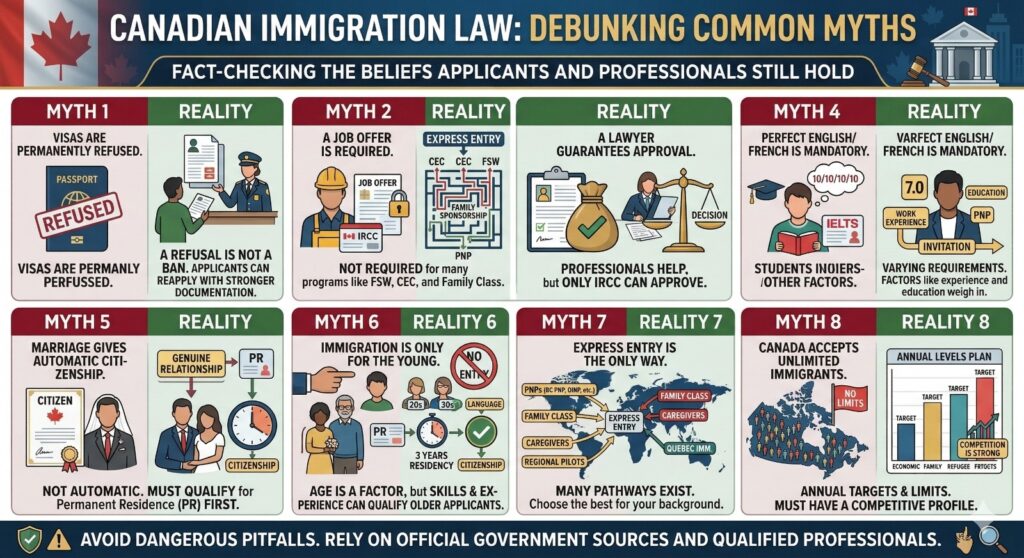
Myth 1: If Your Visa Is Refused, You Can Never Apply Again
Many people believe that once their visa or application is refused, their chances of entering Canada are over forever.
Reality:
A refusal does not mean a permanent ban.
In many cases, visa applications are refused because of missing documents, incorrect information, or insufficient proof of funds or ties to the home country. Applicants can often reapply with stronger documentation or a better explanation.
For example, if a study permit is refused due to weak financial proof, the applicant may submit additional documents and apply again. The key is understanding why the refusal happened and fixing those issues before submitting a new application.
Myth 2: You Must Have a Job Offer to Immigrate to Canada
A very common misunderstanding about Immigration is that you must have a job offer from a Canadian employer before applying.
Reality:
While a job offer can strengthen an immigration profile, it is not required in many programs.
For example, programs under Express Entry, including the Federal Skilled Worker Program or Canadian Experience Class, allow many applicants to qualify without a job offer. Other pathways such as family sponsorship or certain provincial nominee programs also exist.
In short, a job offer can help increase your points or improve your chances, but it is not mandatory for many Immigration pathways.
Myth 3: Hiring an Immigration Lawyer Guarantees Approval
Some applicants believe that hiring a lawyer or consultant guarantees that their application will be approved.
Reality:
No immigration lawyer, consultant, or agency can guarantee approval.
All decisions are made by Immigration, Refugees and Citizenship Canada (IRCC). Professionals can help prepare a strong application, avoid mistakes, and guide you through the process, but they cannot influence the final decision.
If anyone promises “guaranteed approval,” it should be considered a red flag.
Myth 4: You Need Perfect English or French to Immigrate
Many applicants worry that unless they score extremely high in language tests like IELTS or TEF, they cannot immigrate.
Reality:
While language ability is important, perfect language scores are not required.
Different programs have different language requirements. Many programs accept moderate language scores combined with strong work experience or education.
In addition, applicants can improve their scores later and update their profiles, which may increase their chances of receiving an invitation.
Myth 5: Marrying a Canadian Gives You Automatic Citizenship
Another common myth is that marrying a Canadian citizen automatically makes someone a Canadian citizen.
Reality:
Marriage alone does not give citizenship.
If you marry a Canadian citizen or permanent resident, your spouse may sponsor you for permanent residence. However, the couple must prove the relationship is genuine and meet several requirements. Only after becoming a permanent resident and living in Canada for the required period can someone apply for citizenship.
Immigration authorities also carefully investigate marriage fraud, so honesty and proper documentation are essential.
Myth 6: Immigration Is Only for Young Applicants
Age plays a role in Canada’s Immigration system, especially in points-based programs, but many people believe older applicants have no chance.
Reality:
Canada accepts immigrants from many age groups.
While younger applicants may receive more points in certain programs, individuals with strong work experience, language skills, education, or provincial nominations can still qualify.
Canada’s Immigration system is designed to fill labour shortages and support economic growth, so skills and experience often matter more than age alone.
Myth 7: Express Entry Is the Only Way to Immigrate
Because Express Entry is widely discussed online, many people believe it is the only Immigration option.
Reality:
Canada has many immigration pathways.
Besides Express Entry, applicants may qualify through:
-
Provincial Nominee Programs (PNPs)
-
Family sponsorship
-
Caregiver programs
-
Rural and regional pilots
-
Start-up visa programs
-
Quebec immigration programs
Each pathway has different eligibility requirements, so the best option depends on the applicant’s background, education, and work experience.
Myth 8: Canada Accepts Unlimited Immigrants
Canada is known as an immigrant-friendly country, which leads some people to believe there are unlimited spots available.
Reality:
Canada sets annual immigration targets and limits.
The government publishes immigration levels plans every year, which specify how many immigrants will be admitted under different categories such as economic immigration, family sponsorship, and refugee programs.
This means competition can be strong, and applicants must ensure their profiles are competitive.
Why Immigration Myths Are Dangerous
The myths may seem harmless, but they can lead to serious problems, including:
-
Submitting incomplete applications
-
Choosing the wrong immigration program
-
Falling victim to fraud or scams
-
Missing deadlines or requirements
Canada’s Immigration system is complex, and relying on rumors or outdated information can damage an application.
The best approach is to rely on official government information or qualified professionals who understand the current rules.
Final Thoughts
Immigration to Canada offers incredible opportunities for students, skilled workers, and families. However, the process requires accurate information and careful planning.
Unfortunately, myths about Immigration laws continue to circulate, sometimes even among professionals. Understanding the truth behind these misconceptions can help applicants make smarter decisions and avoid unnecessary delays.
If you are planning your journey, take the time to research the correct rules, verify information, and seek proper guidance when needed. With the right strategy and preparation, your dream of living in Canada can become a reality.