
Introduction
Canada’s reputation as a safe and welcoming country for refugees is well established. At the same time, recent data from Immigration, Refugees and Citizenship Canada (IRCC) and policy research has highlighted a growing trend: an increase in aslyum claims made by individuals who initially entered Canada as international students.
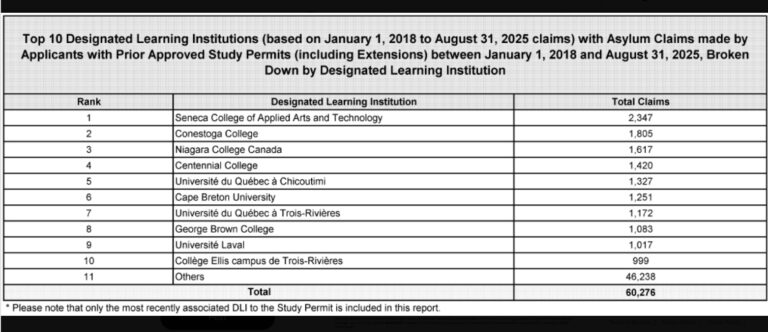
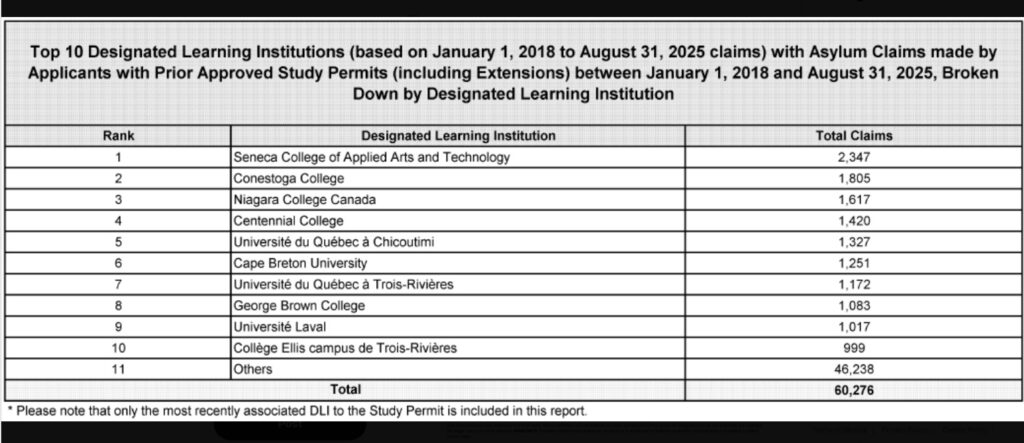
This blog explores the top 10 designated learning institutions (DLIs) linked to such claims between January 1, 2018 and August 31, 2025, while providing verified context from IRCC data and public policy sources.
Important Data Clarification
The dataset referenced in this article covers January 2018 to August 31, 2025, not the full calendar year of 2025.
-
The institutional breakdown is consistent with ATIP-style data reporting, where the most recent DLI tied to a study permit is counted
-
The figures align with broader federal trends showing a rise in asylum activity in Canada
According to IRCC, asylum claims in Canada have increased significantly in recent years, rising from 64,020 claims in 2019 to over 173,000 in 2024
Top 10 Institutions Linked to Refugee Claims
Below are the institutions with the highest number of refugee claims by former study permit holders:
-
Conestoga College – 1,805
-
Niagara College Canada – 1,617
-
Centennial College – 1,420
-
Université du Québec à Chicoutimi – 1,327
-
Cape Breton University – 1,251
-
Université du Québec à Trois-Rivières – 1,172
-
George Brown College – 1,083
-
Université Laval – 1,017
-
Collège Ellis campus de Trois-Rivières – 999
Total Breakdown
-
Top 10 total: 14,038 claims
-
Other institutions: 46,238 claims
-
Overall total: 60,276 claims
The numbers are internally consistent and demonstrate that aslyum claims are not limited to a few institutions, but occur across Canada’s education system.
National Trend: Rise in Refugee Claims by Students
Data confirms that this is not an isolated issue.
-
Refugee claims by international students increased sharply—from 1,810 in 2018 to nearly 12,000 in 2023
-
Over 20,000 claims were filed in 2024 alone
-
IRCC has acknowledged a growing number of students claiming asylum shortly after arrival
In fact, internal IRCC committee data shows that around 55% of claims in early 2025 were made within one year of permit approval
This highlights how closely linked the student and aslyum systems have become in recent years.
Why Are Some Students Filing Refugee Claims?
The reasons behind refugee claims are complex and should not be generalized. Evidence and research suggest a combination of factors:
1. Global Instability and Safety Concerns
Refugee claims are often driven by real risks such as political instability, violence, or persecution. Canada’s asylum system exists to protect individuals in such situations.
2. Rapid Growth in International Student Programs
Canada has seen a significant increase in international students over the past decade, which naturally increases the number of individuals who may later apply for refugee protection
3. Immigration System Pressures
As pathways to permanent residence become more competitive, some individuals explore all available legal avenues, including refugee protection.
4. System Integrity Concerns
Policy discussions have also pointed to concerns around certain institutions or actors within the system. Some research suggests that specific colleges may be disproportionately associated with asylum claims
At the same time, experts emphasize that each refugee claim is assessed individually, and no assumption should be made about intent.
Understanding the Legal Reality of a Refugee Claim
A refugee claim in Canada is a formal legal process, not an automatic pathway to stay.
-
Claims are assessed by the Immigration and Refugee Board (IRB)
-
Applicants must demonstrate a well-founded fear of persecution
-
Outcomes vary: some applicants receive protection, while others do not
IRCC data also confirms that asylum claims can be made either at ports of entry or from within Canada
Broader Impact on Canada’s Immigration System
The increase in refugee claims has led to important policy discussions:
Processing Capacity
Canada has experienced high claim volumes, with tens of thousands of applications annually, impacting processing timelines.
Policy Adjustments
The government has introduced measures to manage temporary resident numbers, including international students
Public Debate
The issue has sparked national conversations around system integrity, fairness, and access to protection.
What This Means for Future Students
For prospective international students, this trend highlights the importance of planning and awareness.
-
A study permit is intended for education purposes
-
Canada offers multiple structured pathways to permanent residence
-
Refugee protection exists for those who genuinely need it
Understanding these distinctions helps applicants make informed and responsible decisions.
Conclusion
The data on refugee claims linked to international students between 2018 and August 2025 reflects a broader shift in Canada’s immigration landscape.
While institutions like Seneca College of Applied Arts and Technology and Conestoga College appear prominently in the data, the issue itself is system-wide and multifaceted.
Ultimately, refugee claims are not just statistics—they represent individual circumstances shaped by global events, immigration systems, and personal realities.
A balanced, fact-based understanding is essential for anyone navigating Canada’s immigration pathways today.