

Understanding In-Demand Occupations in 2026
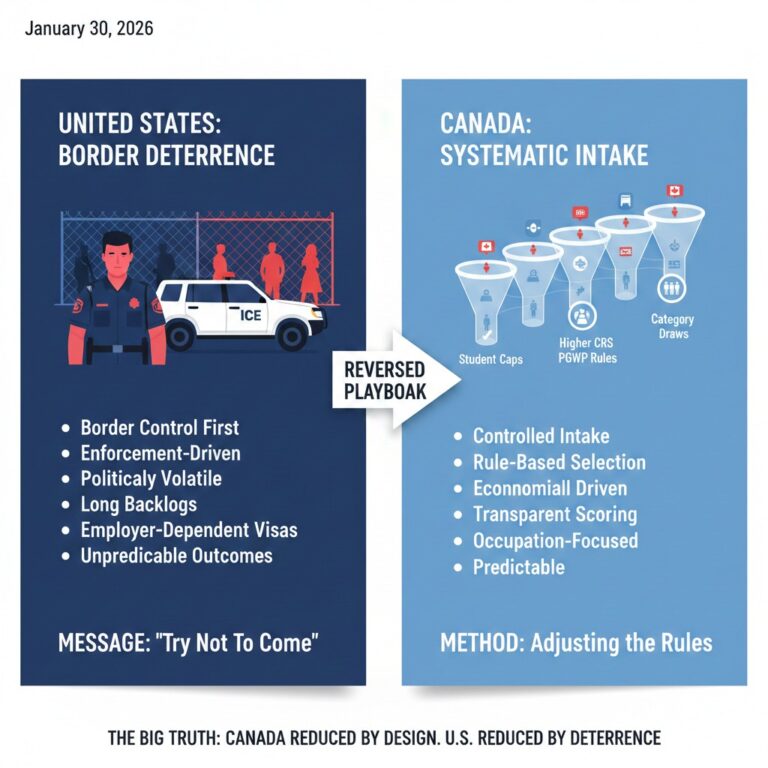
If you are planning to apply for Canadian Permanent Residency in 2026, you need to understand one major shift: immigration is no longer one-size-fits-all. Under Express Entry, Canada has moved from purely high-CRS draws to category-based selection focused on in-demand occupations. This means your job title now plays a bigger role than ever before. Candidates in priority sectors are receiving Invitations to Apply (ITAs) with CRS scores 50–70 points lower than general draws because they are competing within targeted occupation groups instead of the entire pool.
2026 Express Entry Categories and Priority Sectors
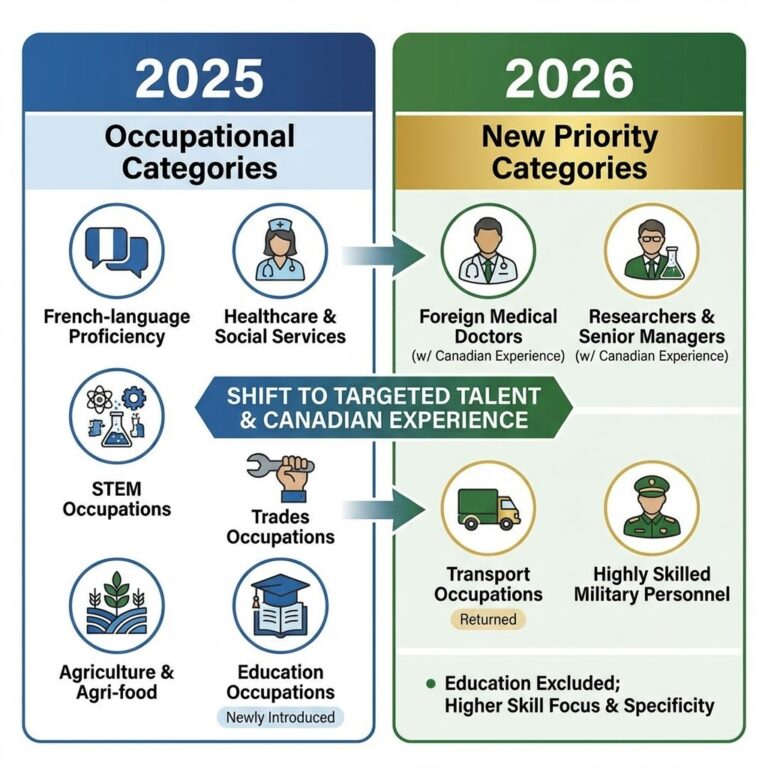
In 2026, Canada has narrowed its immigration priorities to specific economic sectors facing labour shortages. The key pillars include Healthcare, STEM (Science, Technology, Engineering and Mathematics), Skilled Trades, Agriculture and Agri-Food, and Education. In addition, new and strengthened categories include Transport Occupations, Physicians with Canadian Work Experience, Senior Managers with Canadian Work Experience, Researchers with Canadian Work Experience, and Skilled Military Recruits. These federal priorities are often aligned with targeted streams under the Provincial Nominee Program, increasing opportunities across provinces.
Healthcare: The Leading In-Demand Occupation in 2026
Healthcare accounts for nearly 25% of economic immigration invitations in 2026. Canada’s aging population and hospital staffing shortages have created urgent demand for Registered Nurses, Physicians, Medical Laboratory Technologists, Personal Support Workers, Pharmacists, and Physiotherapists. A special focus on physicians with Canadian work experience allows doctors already working in Canada to benefit from targeted draws. For healthcare professionals, this category presents one of the strongest PR opportunities in recent years.
STEM Occupations: Powering Canada’s Innovation Economy
STEM remains one of the most important in-demand occupation groups in 2026. Software engineers, cybersecurity specialists, AI and machine learning experts, data scientists, and various engineering professionals continue to receive targeted invitations. As Canada invests heavily in technology and digital infrastructure, STEM professionals are being prioritized even when their CRS scores are moderate compared to general candidates.
Skilled Trades: High Demand for Blue-Collar Workers
Canada’s housing expansion and infrastructure projects have pushed skilled trades into a top immigration priority. Electricians, plumbers, welders, carpenters, and heavy equipment operators are in high demand nationwide. Category-based selection has made it easier for certified tradespeople to secure permanent residency without needing extremely high CRS scores.
Education Category: A Major 2026 Addition
One of the most important updates in 2026 is the strengthened Education category. Due to teacher shortages across provinces, Early Childhood Educators, elementary teachers, and secondary school teachers are being fast-tracked through Express Entry. This development has opened new PR opportunities for professionals who previously struggled to compete in general draws.
Agriculture and Agri-Food Occupations
Agriculture remains essential to Canada’s economy and food security. Farm supervisors, agricultural technicians, and food processing workers continue to benefit from both federal and provincial immigration programs. Provinces are actively nominating agriculture workers to support rural economic stability and supply chain demands.
Transport Occupations: Newly Introduced in 2026
Transport Occupations have emerged as a new priority category in 2026. With ongoing logistics and supply chain pressures, Canada is targeting truck drivers, transit operators, aircraft mechanics, and railway conductors. This addition reflects the country’s growing reliance on transportation networks to sustain economic growth.
Canadian Experience Priority Categories
Canada is also placing special emphasis on retaining professionals already contributing to the economy. Targeted categories now include physicians, senior managers, researchers, and skilled military recruits with Canadian work experience. These focused draws aim to retain high-value talent already integrated into the Canadian workforce.
Why CRS Scores Are Lower for In-Demand Occupations
The reason candidates in in-demand occupations are seeing lower CRS cut-offs is straightforward. Express Entry now filters applicants by category before ranking them by score. Instead of competing against everyone in the pool, you compete within your occupation group. This smaller, more specialized pool often results in significantly lower CRS thresholds.
Final Thoughts on In-Demand Occupations in 2026
In 2026, immigration success depends more on your occupation than ever before. The critical question is no longer simply about your CRS score — it is whether your job aligns with Canada’s labour market needs. If your role falls under one of the in-demand occupations categories, your chances of receiving an ITA improve dramatically. Strategic profile positioning under the right category can make the difference between waiting indefinitely and securing Canadian Permanent Residency.