
Canada has always welcomed skilled immigrants—but there’s been one major problem for years: foreign credential recognition.
Thousands of newcomers arrive with degrees, licenses, and experience, yet struggle to work in their own professions. Doctors drive taxis. Engineers work survival jobs. Nurses restart from scratch.
Now, Canada is taking serious steps to fix this.
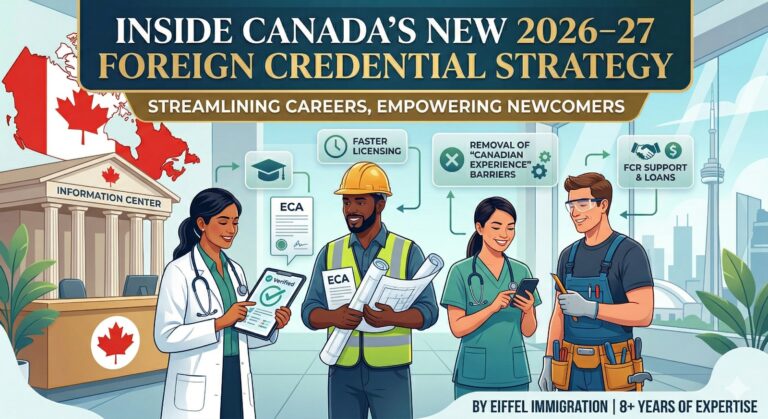
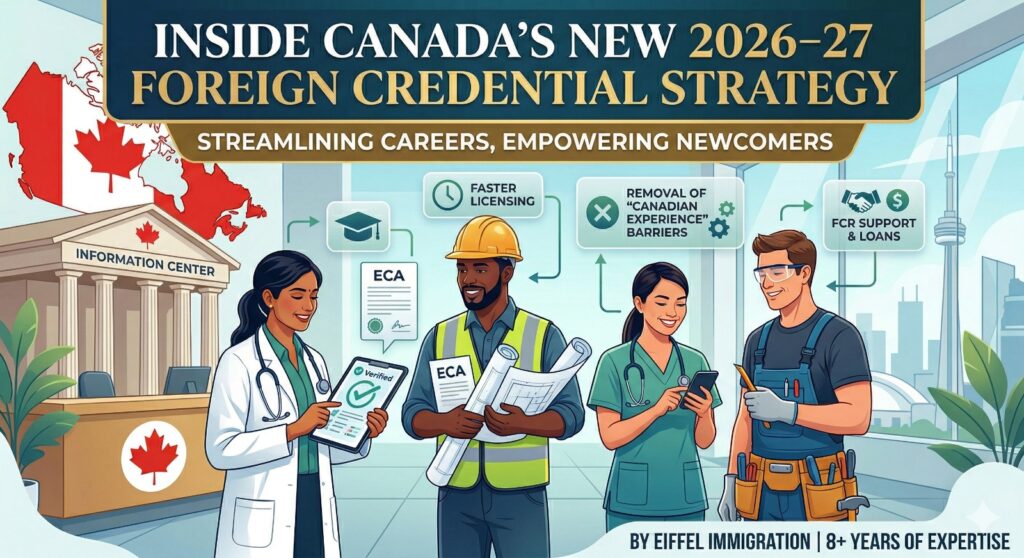
The 2026–27 foreign credential strategy is designed to remove barriers, speed up recognition, and help immigrants enter the workforce faster. Let’s break it down in simple language so you understand exactly what this means for you.
What is Foreign Credential Recognition?
Foreign credential recognition is the process of verifying that your education, skills, and work experience from another country meet Canadian standards.
If you studied or worked outside Canada, you may need:
- An Educational Credential Assessment (ECA)
- Licensing exams
- Additional training or bridging programs
- Proof of work experience
For example:
- A doctor trained abroad must be licensed before practicing
- An electrician must meet provincial certification standards
👉 In short: Canada needs to confirm that your qualifications match its system.
Why Canada Needed a New Strategy
For years, foreign credential recognition in Canada has been slow and complicated.
Common challenges included:
- Long processing times
- Lack of clarity in requirements
- “Canadian experience” barriers
- Different rules across provinces
This led to underemployment, where highly skilled immigrants worked in low-skilled jobs.
At the same time, Canada faced labour shortages in critical sectors like:
- Healthcare
- Construction
- Skilled trades
👉 The result? A mismatch between available talent and market needs.
What’s New in the 2026–27 Foreign Credential Strategy?
This new strategy is not just a policy update—it’s a system-wide reform.
1. Backed by Federal Budget: 32,000 Professionals Targeted
In Canada’s 2026–27 federal budget, the government announced plans to support approximately 32,000 internationally trained professionals through the Foreign Credential Recognition (FCR) Program.
This initiative is led by Employment and Social Development Canada (ESDC) and focuses on sectors with urgent labour shortages.
Priority sectors include:
- Healthcare (doctors, nurses, therapists)
- Skilled trades (electricians, welders, carpenters)
👉 This means faster pathways for professionals where Canada needs workers the most.
2. Faster and Simpler Credential Assessment
A key focus of the strategy is improving how foreign credential recognition works across Canada.
The government aims to:
- Reduce processing times
- Simplify assessment procedures
- Align immigration with licensing requirements
👉 This reduces confusion and helps newcomers plan their careers better before arriving.
3. Legal Reform: International Credentials Recognition Act (BC)
One of the biggest breakthroughs comes from British Columbia’s International Credentials Recognition Act.
Key legal provisions include:
- Section 3 – Prohibits requiring “Canadian work experience” unless truly necessary
- Section 4 – Ensures fair and transparent assessment processes
- Section 8 – Introduces timelines for decisions
👉 This is a major shift.
For years, immigrants faced a frustrating cycle:
No job without Canadian experience—and no experience without a job.
This law directly addresses that issue.
4. More Funding and Financial Support
The Foreign Credential Recognition (FCR) Program now offers stronger financial and career support.
This includes:
- FCR loans (up to $30,000) for exams, training, and licensing
- Career guidance and job search support
- Bridging programs to meet Canadian standards
👉 This reduces the financial burden during the transition period.
5. How the FCR Program Actually Works
To understand the strategy better, it helps to look at how the program is structured.
The FCR Program operates under three main pillars:
- Assessment and Recognition Supports
Helping applicants get their credentials evaluated quickly - Workplace Integration Projects
Supporting job placement and employer connections - Pan-Canadian Coordination
Improving consistency across provinces
👉 This shows the focus is not just recognition—but employment outcomes.
6. Stronger Federal–Provincial Coordination
Credential recognition is mostly controlled by provinces—but the federal government is now playing a bigger role.
The strategy introduces:
- Better coordination between federal and provincial governments
- Shared standards and faster decision-making
- National-level collaboration on licensing challenges
👉 This helps reduce differences between provinces and creates a smoother process.
📊 Policy Insight: What This Strategy Really Signals
The 2026–27 foreign credential strategy reflects a deeper shift in Canada’s immigration system:
- Moving from immigration selection → to employment integration
- Increasing federal involvement in provincial licensing systems
- Prioritizing job-ready immigrants over just high CRS scores
👉 This aligns with recent trends in Express Entry, including category-based draws targeting specific occupations.
What This Means for Immigrants
If you are planning to move to Canada—or already here—this strategy brings real advantages.
✔ Faster Career Entry
You may start working in your field sooner than before.
✔ Less Red Tape
Simplified processes and fewer unnecessary barriers.
✔ Financial Support
Access to loans and funded programs.
✔ More Job Opportunities
Especially in high-demand sectors.
What Still Hasn’t Changed
While the strategy is promising, some realities remain:
- Licensing bodies still control final approvals
- Regulated professions still require exams and certifications
- Processing improvements will take time to fully implement
👉 So, preparation is still key.
Step-by-Step: How to Prepare
To benefit from Canada’s foreign credential strategy, follow these steps:
1. Get Your ECA Early
Start with an Educational Credential Assessment.
2. Research Your Profession
Check if your occupation is regulated in Canada.
3. Understand Licensing Requirements
Each province may have different rules.
4. Use Bridging Programs
These help you meet Canadian standards faster.
5. Explore FCR Programs
Take advantage of loans, training, and job support.
Final Thoughts
Canada’s 2026–27 foreign credential strategy is a major step toward fixing one of the biggest challenges immigrants face.
For years, skilled professionals struggled to use their qualifications. Now, Canada is actively working to:
- Remove barriers
- Speed up credential recognition
- Connect immigrants with meaningful employment
👉 This is not just an immigration update—it’s a system transformation.
For newcomers, it means one thing:
A fairer, faster path to rebuilding your career in Canada.