
Canada’s 2026 Immigration Strategy: A Shift Toward Top Talent & Retention
Canada has officially updated its Express Entry occupational categories for 2026. But this year’s changes are not just about adding new job groups — they reflect a bigger shift in immigration strategy.
The 2026 focus is clear:
✔️ Attract top talent
✔️ Retain skilled workers already in Canada
✔️ Address urgent labour shortages
✔️ Strengthen French-speaking immigration outside Quebec
Let’s break everything down in simple language.
What Are Express Entry Occupational Categories?
Under Express Entry, Canada conducts category-based draws. This means applicants may receive invitations based not only on CRS score but also on whether their job falls under certain priority occupational categories.
Each year, IRCC adjusts these categories based on Canada’s economic needs.
2026 Express Entry Occupational Categories
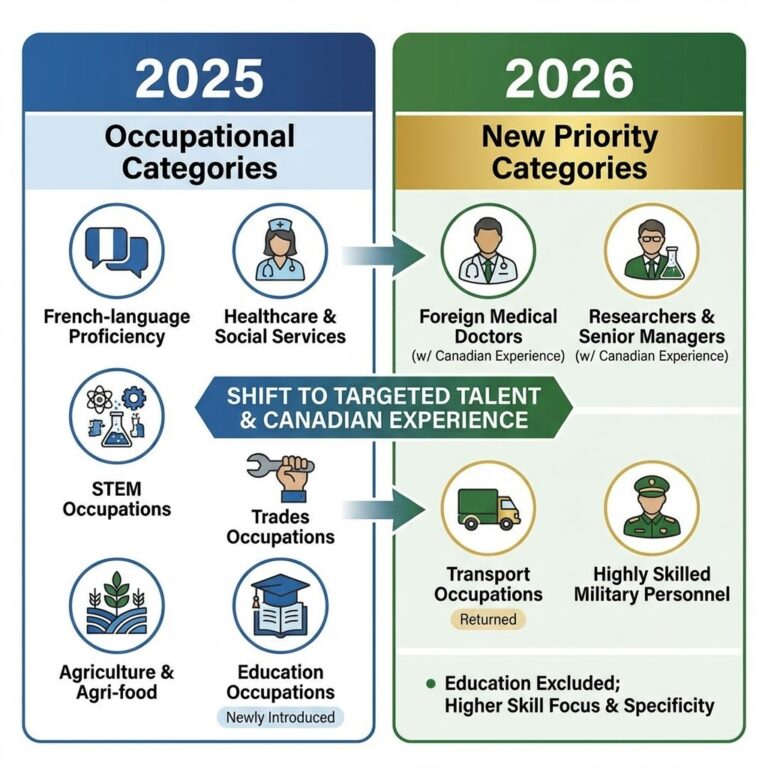
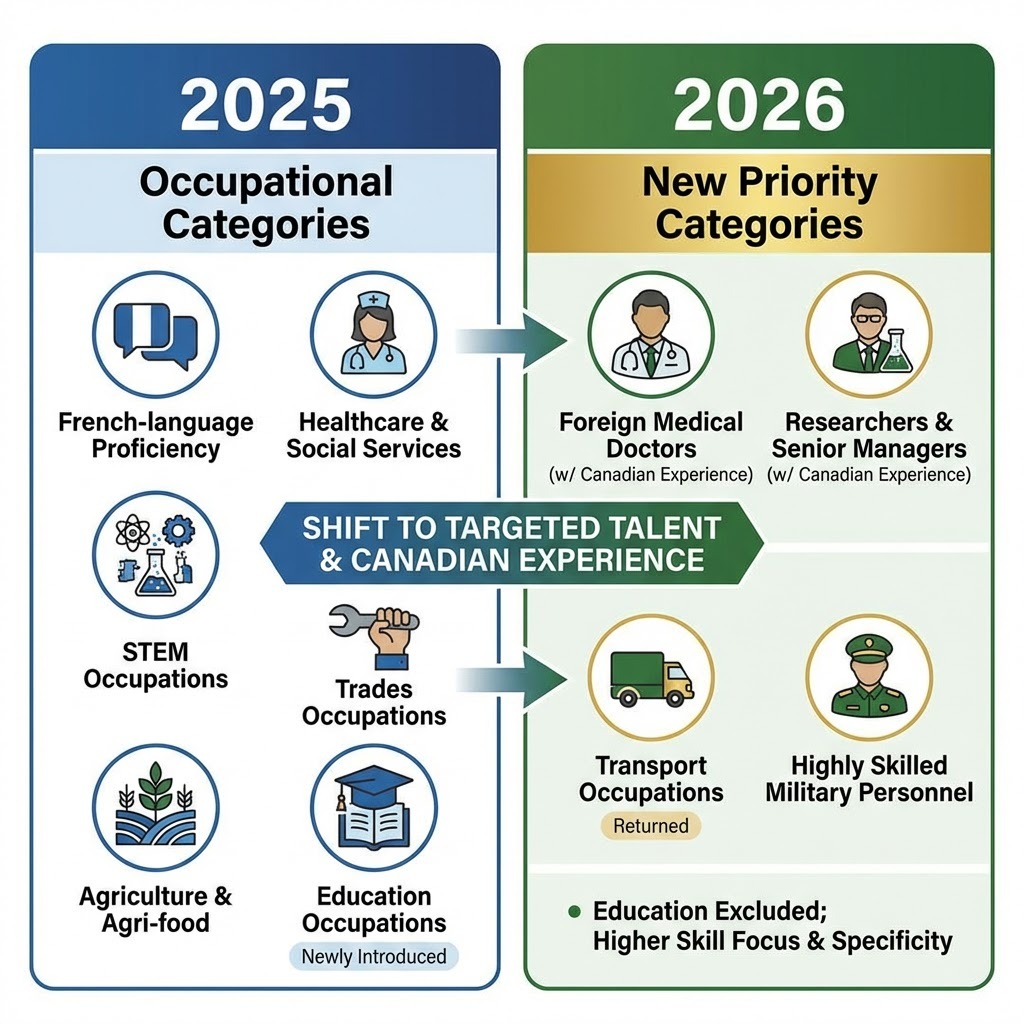
In 2026, Canada introduced a “Top Talent” strategy, focusing on highly skilled professionals — particularly those already working in Canada.
1. Foreign Medical Doctors (With Canadian Work Experience)
A major new addition in 2026.
Canada is facing serious physician shortages. Instead of recruiting only from abroad, the government is prioritizing doctors who are already working in Canada and helping them transition to permanent residence.
👉 This reflects the strong retention strategy for 2026.
2. Researchers and Senior Managers (Canadian Experience Focus)
Another new 2026 category includes:
-
Researchers
-
Innovation leaders
-
Senior executives
-
High-level managers
Again, the emphasis is on professionals already contributing to Canada’s economy.
This is not just recruitment — it’s about keeping global talent that is already here.
3. Transport Occupations (Reintroduced)
Transport occupations were removed in 2025 but are back in 2026.
These include:
-
Pilots
-
Aircraft mechanics
-
Aviation inspectors
-
Other transport professionals
This reintroduction shows Canada is responding to infrastructure and supply chain pressures.
4. Highly Skilled Military Personnel
2026 also prioritizes specialized military professionals such as:
-
Military doctors
-
Military nurses
-
Military pilots
This category supports national expertise needs.
The French Factor: The Golden Ticket for 2026
One of the most important aspects of the 2026 occupational categories strategy is French-language proficiency.
French remains the strongest advantage under Express Entry.
The government has set a target for 9% of all admissions outside Quebec to be French-speaking immigrants.
This means:
✔️ Strong French scores can significantly increase your chances
✔️ Even if your occupation is not in a priority category, French may help you receive an ITA
✔️ French remains a core category being maintained from 2025
For many applicants, French is truly the “golden ticket” in 2026.
Clarifying the Education Category Status
There has been some confusion about the Education occupational category.
Here is what changed:
-
In 2025, Education occupations were introduced as a priority category.
-
In 2026, Education is not newly added under the “Top Talent” strategy.
-
However, it is not completely eliminated.
The Minister clarified that IRCC is technically maintaining some 2025 occupational categories, including:
✔️ French-language proficiency
✔️ Trades
✔️ Healthcare
Meanwhile:
❌ STEM occupations have been de-emphasized
❌ Education occupations have also been de-emphasized under the 2026 primary strategy
So education professionals can still apply — but they are not a highlighted focus within the new Top Talent approach.
2025 vs 2026 Occupational Categories Comparison
Here’s a clear comparison:
| 2025 Priority Categories | 2026 Priority Focus |
|---|---|
| French-language proficiency | French-language proficiency (expanded target) |
| Healthcare (broad) | Focused medical doctors |
| STEM occupations | Research & senior leadership focus |
| Trades | Maintained |
| Agriculture & agri-food | De-emphasized |
| Education (new in 2025) | Maintained but not primary |
| Transport removed | Transport reintroduced |
The Big 2026 Theme: Retention Over Recruitment
The most important shift in 2026 is retention.
Instead of focusing mainly on bringing new workers from abroad, Canada is prioritizing:
-
Doctors already practicing in Canada
-
Managers already working in Canadian companies
-
Skilled professionals with Canadian experience
This reduces processing pressure and ensures Canada keeps talent it has already invested in.
For international students and temporary foreign workers currently in Canada, this is very important.
What This Means for You
✅ If You Have Canadian Work Experience
Your chances may be stronger in 2026 than before.
✅ If You Speak French
Your advantage is even greater due to the 9% admissions target outside Quebec.
⚠️ If You Are in STEM or Education
You can still apply through general Express Entry draws — but category-based draws may not prioritize you as heavily as in 2025.
Final Thoughts
Canada’s 2026 Express Entry occupational categories show a clear and strategic direction:
✔️ Focus on top talent
✔️ Maintain French priority
✔️ Retain skilled workers already in Canada
✔️ Narrow category focus compared to 2025
Understanding these shifts is crucial when planning your immigration strategy.
Frequently Asked Questions
❓ Is Education removed completely in 2026?
No. It is maintained but de-emphasized under the new Top Talent strategy.
❓ Is French still important?
Yes. French-language proficiency remains one of the strongest advantages in Express Entry, with a 9% target outside Quebec.
❓ Is Canada focusing more on people already in Canada?
Yes. Retention is a major theme in 2026.
Need Professional Guidance?
At Eiffel Immigration, we help you:
✔️ Identify if your occupation fits 2026 occupational categories
✔️ Determine if French can boost your chances
✔️ Plan around the retention-focused strategy
✔️ Maximize your CRS score
📞 Contact us today for a professional Express Entry assessment.