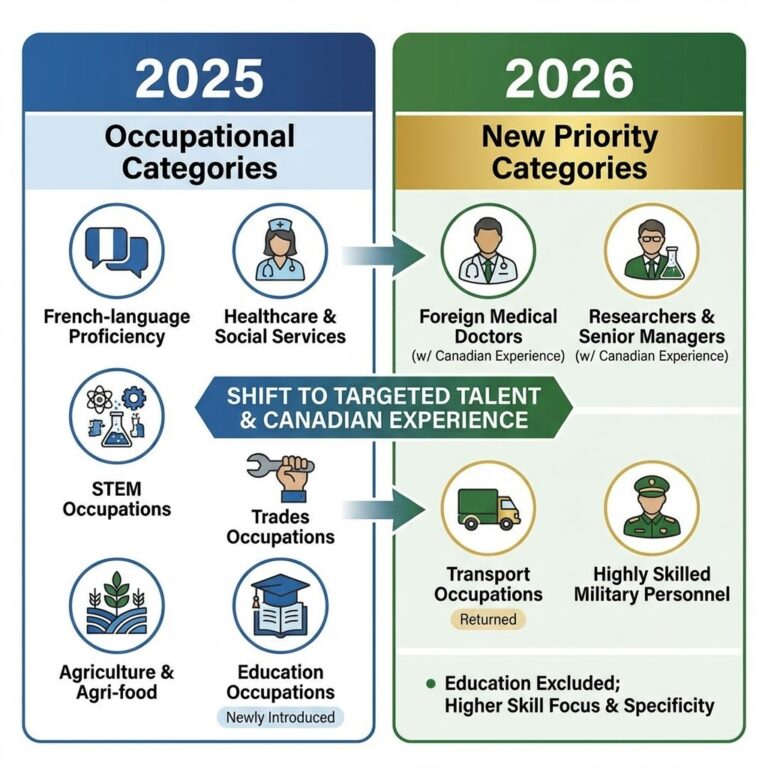

Canada continues to address national physician shortages by expanding pathways for skilled healthcare workers. In its latest 2025 update, IRCC has added three major physician NOC codes to Express Entry category-based selection — making Permanent Residency (PR) more accessible to doctors already working in Canada.
This change strongly benefits via Express Entry:
-
International medical graduates (IMGs)
-
Residents and fellows
-
LMIA-exempt physicians
-
Return-of-service doctors in rural Canada
1. Physician NOC Codes Added to Category-Based Express Entry
IRCC now includes doctors under the Physicians with Canadian work experience Express Entry Category, requiring 1 year of Canadian experience:
- NOC 31100 – Specialists in clinical and laboratory medicine
- NOC 31101 – Specialists in surgery
- NOC 31102 – General practitioners and family physicians
2. Does Residency Count as Canadian Work Experience for CEC and Express Entry?
✔ YES. Residency does count.
Residents are paid employees, holding a valid work permit, performing skilled work under NOC 31100/31101.
IRCC specifically states that Canadian experience must be:
-
Authorized work
-
Paid
-
Skilled
-
Not part of full-time study
Postgraduate medical residency is not considered full-time study under IRCC rules.
Therefore, residency and fellowship experience qualify for:
-
Canadian Experience Class (CEC)
-
Healthcare category-based draws
-
The new physician NOC selection streams
3. Do Doctors Need a Full Licence Before Getting a Work Permit?
✔ NO — a full independent licence is not required.
Physicians can receive work permits as long as they have:
-
A provisional / restricted / educational / supervised licence, and
-
A job offer from a hospital or provincial health authority.
IRCC typically issues:
-
LMIA-Exempt Work Permit (C10 or T13) for physicians
-
Occasionally LMIA-supported permits
Provincial Regulatory Sources:
College of Physicians and Surgeons confirm that provisional licenses authorize employment:
Your experience counts as long as your licence authorizes work and you are paid.
4. Which Countries Are Most Recognized in Canada’s Medical System?
Canada’s medical regulatory bodies (Royal College & CFPC) recognize training from several countries as “substantially equivalent.”
Highly Aligned Countries (Fastest Licensing)
-
United States
-
United Kingdom
-
Australia
-
Ireland
-
New Zealand
U.S.-trained doctors especially have the fastest licensing pathway, often receiving recognition of residency and board certification.
5. Where Do Most International Doctors in Canada Come From?
According to CIHI and the Canadian Medical Association:
Top source countries for IMGs in Canada:
-
India
-
Pakistan
-
Nigeria
-
Philippines
-
United Kingdom
-
Ireland
-
United States
-
South Africa
-
Egypt
-
Bangladesh
-
Middle East countries (Saudi Arabia, UAE, Qatar)
-
Australia & New Zealand
6. Percentage of Foreign-Trained Doctors in Canada (Official Statistics)
27% of all physicians in Canada are internationally trained.
— CIHI Physician Workforce 2024
Canada has approximately:
-
100,000 physicians total
-
27,000 foreign-trained doctors
This is one of the highest IMG rates in the world.
7. How Many International Doctors Will Benefit From This New Express Entry Update?
Of the 27,000 IMGs in Canada:
-
Many are in NOC 31100, 31101, or 31102
-
Most have Canadian work experience (residency or provisional licensure)
Based on CIHI workforce data and IRCC eligibility:
An estimated 10,000–15,000 internationally trained doctors already working in Canada can directly benefit.
This includes:
-
Residents
-
Fellows
-
LMIA-exempt physicians
-
Return-of-service doctors
-
Physicians practising under provisional licenses
This is the largest physician-focused PR expansion in Canada’s history.
8. Who Benefits the Most?
✔ Residents & Fellows
Residency now clearly counted as valid skilled work.
✔ LMIA-Exempt Physicians
Most hospital-based IMG doctors fall under this group.
✔ Physicians on Provisional Licences
Authorized work = PR eligibility.
✔ Specialist Doctors
High CRS scores & fast-track pathway.
9. Conclusion
The inclusion of physician NOC codes in Express Entry category-based draws gives internationally trained doctors in Canada a significantly improved pathway to Permanent Residency. With nearly one-third of Canada’s physician workforce being foreign-trained, the policy change is aimed at retaining the doctors already contributing to Canada’s healthcare system.
Key takeaways:
-
Residency counts as Canadian experience (IRCC backed)
-
Full licence not required for a work permit
-
U.S., U.K., Australia, Ireland lead in alignment with Canada
-
27% of doctors in Canada are internationally trained
-
10,000–15,000 IMGs may directly benefit
For personalized immigration guidance for physicians and IMGs, contact Eiffel Immigration.