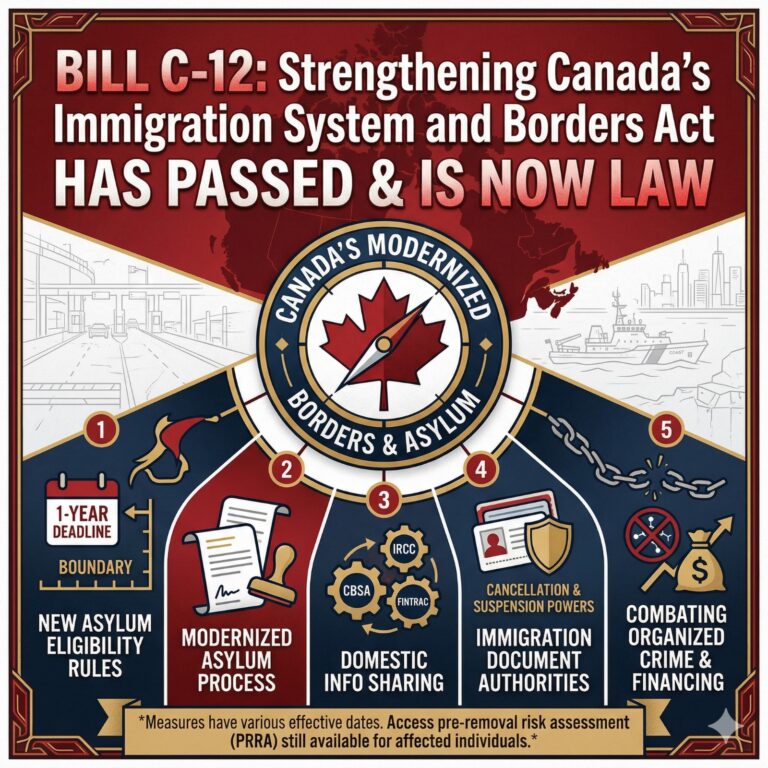

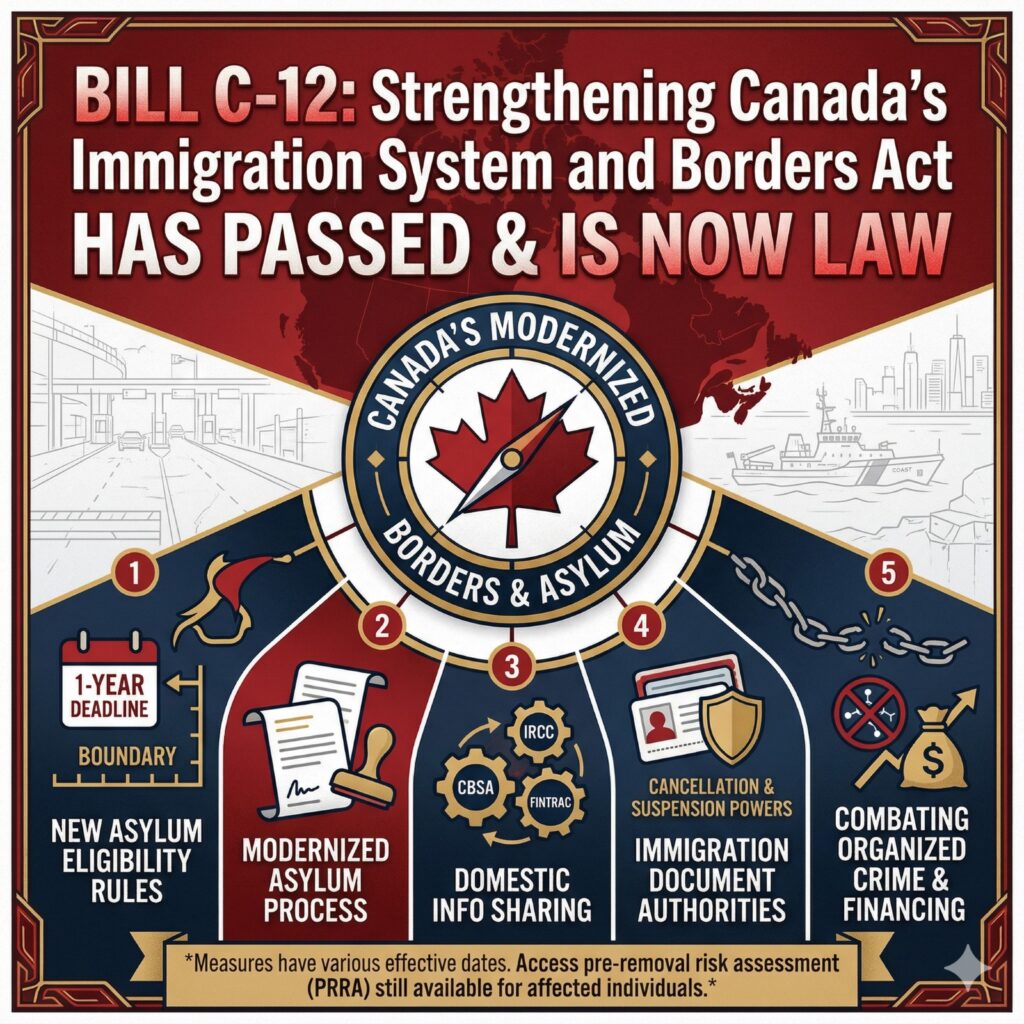
Bill C-12 received royal assent on March 26, 2026.
Canada has always been seen as a global leader in immigration and refugee protection. For decades, the system has tried to balance efficiency with fairness, ensuring those in genuine need of protection have access to due process. But with Bill C-12 now in force, this balance is shifting significantly. The new law introduces stricter asylum eligibility rules that apply to all claims made on or after June 3, 2025, and it fundamentally changes how Canada manages its immigration system.
These changes are designed to make the system faster and more controlled—but they also raise serious concerns about access to protection, particularly for vulnerable populations. In this article, we’ll break down the key components of Bill C-12, explain how they affect asylum seekers, and discuss the broader implications for Canada’s immigration landscape.
1. Late Claims Can Be Rejected
Timing is everything under Bill C-12. The law establishes clear limits on when an asylum claim can be considered by the Immigration and Refugee Board of Canada (IRB).
If someone entered Canada on or after June 24, 2020, and waits more than one year to make an asylum claim, their case will not be referred to the IRB. This is true even if the individual temporarily leaves Canada and later re-enters.
Why this matters:
The IRB is typically the first and most crucial forum for presenting a refugee claim. Without referral, claimants lose the opportunity for a full hearing. Instead, their case may only proceed through limited avenues, such as the Pre-Removal Risk Assessment (PRRA), which does not allow for the same comprehensive presentation of evidence or arguments.
Implications:
- Late claimants face faster refusals.
- There is a reduced opportunity to present a full case.
- Vulnerable individuals, such as those who delayed filing due to trauma or lack of information, may be disproportionately affected.
2. Irregular Entry Rule (Canada–US Border)
Another significant change under Bill C-12 relates to individuals entering Canada irregularly—specifically, crossing the Canada–US border between official ports of entry.
Now, if a person crosses the border irregularly and applies for asylum after 14 days, their claim will not be sent to the IRB. This rule aims to discourage delayed asylum applications following irregular entry, but it also eliminates the full hearing process for many claimants.
Implications in practice:
- Claims are processed faster, often resulting in quicker refusals.
- Individuals may not have the opportunity to present detailed evidence or legal arguments.
- The PRRA process becomes the primary route for evaluating risk, but this is more limited than the full IRB hearing.
⚠️ What This Means in Practice
The combination of late claim restrictions and irregular entry rules represents a major shift in Canada’s asylum system:
- ❌ No IRB hearings for late or delayed claims
- ⚡ Faster decision-making
- 📉 Fewer opportunities to fully present a case
In essence, Bill C-12 centralizes power, allowing the government to make mass decisions and prioritize speed over procedural fairness. While this may reduce backlog and improve administrative efficiency, it also raises questions about access to justice for asylum seekers.
📍 Safe Third Country Agreement Still Applies
It’s important to note that the Safe Third Country Agreement (STCA) between Canada and the United States remains in effect.
- If a claim is made at an official border, or within 14 days of an irregular entry, the individual will generally be returned to the US unless they qualify for an exception.
- Exceptions may include minors, family reunification, or other humanitarian considerations.
The STCA, combined with Bill C-12, further emphasizes that Canada is streamlining entry and claim procedures while maintaining tighter control over eligibility.
Major Change: Easier Data Sharing
A key feature of Bill C-12 is the expansion of data-sharing powers. Immigration, Refugees and Citizenship Canada (IRCC) can now share information more broadly and efficiently across federal departments, provinces, and different immigration programs.
✅ What’s New
- Personal identity, status, and documents can be shared across programs.
- PR details may be used for citizenship processing, reducing repeated document requests.
- Inter-agency coordination is faster and more reliable.
❗ Before vs Now
Before Bill C-12:
- Data sharing was slow, inconsistent, and unclear.
- Applicants often had to submit the same documents multiple times.
- Coordination across programs and jurisdictions was limited.
After Bill C-12:
- Faster, more streamlined processing
- Reduced duplication and administrative delays
- Greater government control over personal information
While these changes improve efficiency, they also raise privacy and procedural fairness concerns, as there is less separation between different immigration programs and departments.
The Bigger Picture
Bill C-12 reflects a broader shift toward centralization and speed in Canada’s immigration system.
👍 Potential Benefits
- Faster decision-making for immigration and asylum claims
- Reduced backlog in processing applications
- Stronger administrative control over immigration processes
⚠️ Potential Risks
- Reduced access to full hearings and due process
- Higher likelihood of refusals without comprehensive review
- Increased government control over personal data
- Potentially unfair impact on vulnerable populations, including those with late or irregular claims
Final Thought
Bill C-12 signals a new era in Canadian immigration policy: one that prioritizes speed, efficiency, and centralized control. While this may benefit the system in terms of reducing backlogs and improving coordination, it also raises serious questions about fairness and access to protection.
For some, these changes will lead to quicker outcomes. For others—particularly vulnerable asylum seekers—they may mean fewer chances to be heard.
The key question remains: Can a faster, more centralized system still remain fair and protective for the people who need it most?
Conclusion
With Bill C-12 now in force, Canada is taking a decisive step toward streamlining and controlling its immigration system. Late claims, irregular border crossings, and centralized data sharing will all shape the future of asylum and immigration in Canada. While efficiency is improved, the law also underscores the tension between control and fairness—one that will be closely watched by applicants, legal experts, and human rights organizations alike.