
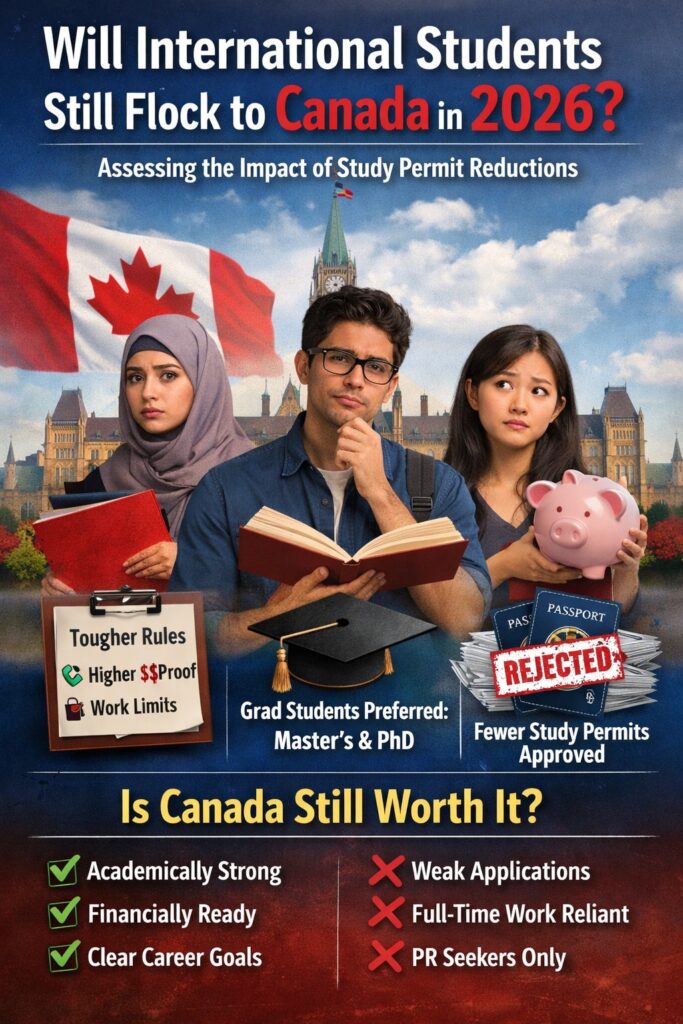
Assessing the Impact of Study Permit Reductions
For years, Canada has been a dream destination for international students. It offered good education, the ability to work part-time, and a realistic chance to stay back after graduation. But by 2026, the rules of the game have clearly changed.
Canada is no longer saying “come one, come all.”
Instead, it is saying: “Come prepared.”
With reduced study permits, higher financial requirements, stricter work rules, and new preferences for graduate-level students, many are asking the same question:
Is Canada still worth it for international students in 2026?
Canada’s Relationship with International Students: What Changed?
Canada relied heavily on international students for:
-
College funding
-
Labour supply
-
Immigration growth
But rapid expansion created stress on housing, healthcare, and education quality. By 2024–2025, the government admitted the system had grown too fast.
The result?
-
A national cap on study permits
-
Tighter screening
-
Policy changes that directly affect students’ daily lives
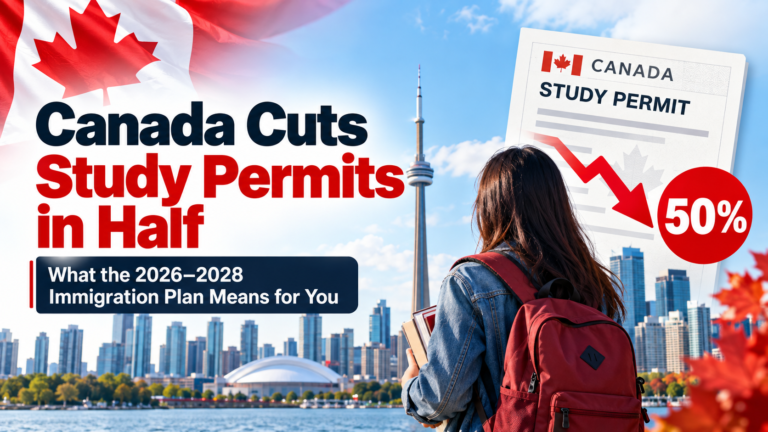
By January 2026, official IRCC data confirmed that study permit approvals are lower compared to earlier years.
Canada is not shutting the door — it is narrowing it.
The Cost of Living Barrier: A Major Shock for International Students
One of the biggest changes for international students in 2026 is money.
💰 Higher Financial Proof Requirement
For many years, students only had to show $10,000 (plus tuition) to prove they could live in Canada. That amount stayed unchanged for nearly two decades — even though rent and food costs doubled.
That era is officially over.
📌 New Requirement for 2026
International students must now show approximately:
$22,895 CAD (plus tuition fees)
This change reflects real living costs but has created a serious barrier for many applicants.
What This Means in Reality
-
Students from middle-income families will struggle more
-
Borrowed or “arranged” funds are closely scrutinized
-
Visa officers now expect realistic budgets
Canada is clearly signaling:
If you cannot afford to live properly, you should not come.
Graduate Exemption: Why Master’s & PhD Students Are Now Preferred
Not all international students are treated the same in 2026.
🎓 A Big Policy Shift (January 1, 2026)
As of January 1, 2026, Master’s and Doctoral students studying at public institutions are officially exempt from the Provincial Attestation Letter (PAL) requirement.
This is huge.
Why This Matters
-
PALs were one of the biggest bottlenecks for study permit approvals
-
Undergraduate and diploma students still need PALs
-
Graduate students now face fewer procedural hurdles
What IRCC Is Clearly Saying
Master’s and PhD students are:
-
More serious academically
-
Less likely to misuse work permits
-
More aligned with Canada’s long-term labour needs
In simple terms, graduate-level international students are now the “preferred category.”
Work Hour Limits: No More Full-Time Work Freedom
Another major reality check for international students in 2026 is work rules.
🕒 The Temporary Policy Is Over
During earlier years, students were allowed to work full-time off-campus under a temporary policy. Many relied heavily on this income to survive.
That policy has now ended.
📌 Current Rule (2026)
International students are strictly limited to:
24 hours per week off-campus during academic sessions
No flexibility. No extensions.
Why This Is Important
-
Students can no longer depend on full-time earnings
-
Survival jobs won’t cover high rents anymore
-
Financial planning before arrival is critical
Canada wants students to study first, not work first.
Study Permit Reductions: What the Numbers Are Telling Us
IRCC’s open data on students and workers shows a steady decline in monthly study permit approvals through late 2025 and into January 2026.
This confirms:
-
Fewer approvals
-
More refusals
-
Slower processing
For international students, this means competition is higher, and weak applications are filtered out early.
Does This Mean Canada Is No Longer Friendly to International Students?
Not exactly — but the definition of a “good student” has changed.
Canada still welcomes:
-
Academically strong students
-
Financially prepared applicants
-
Students with clear career plans
Canada is no longer welcoming:
-
Poorly planned applications
-
Students relying entirely on work income
-
Those applying only for PR hopes
Will International Students Still Choose Canada in 2026?
Yes — but the crowd looks different now.
Who Will Still Come?
-
Master’s and PhD students
-
Students attending strong public institutions
-
Applicants with genuine academic progression
-
Families who can afford the real cost of living
Who Will Think Twice?
-
Diploma-only applicants with weak profiles
-
Students depending on full-time work
-
Those choosing Canada purely for immigration shortcuts
What Smart International Students Are Doing in 2026
Successful international students today are:
-
Applying earlier than before
-
Choosing programs aligned with past education
-
Showing realistic financial planning
-
Understanding that PR is not guaranteed
-
Taking professional guidance seriously
The casual “apply and see” approach no longer works.
Long-Term Impact: Is This Bad or Good for Canada?
In the short term:
-
Fewer international students
-
Slower college growth
-
Tougher transitions
In the long term:
-
Better student experiences
-
Less exploitation
-
Stronger education reputation
Canada appears to be fixing a system that overheated too fast.
Final Verdict: Will International Students Still Flock to Canada in 2026?
Yes — but not blindly, and not in huge numbers.
Canada in 2026 is for:
-
Prepared students
-
Well-funded applicants
-
Serious academic pathways
For those hoping to “figure it out after landing,” the window is closing.
Final Thoughts
Canada is not rejecting international students.
It is rejecting poor planning.
The message for 2026 is clear:
Study in Canada only if you are ready — financially, academically, and mentally.
Those who are ready will still find opportunity here.